Hotel Medea

ZERO-HOUR-MARKET-2-credit-LUDOVIC-DES-COGNETS-600x400

Originally written for Exeunt.

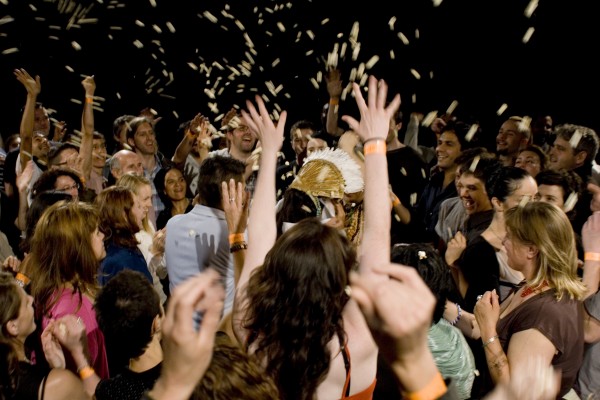
Not long into our interview, Jorge Lopes Ramos, co-creator of ambitious overnight theatre experience Hotel Medea, is at pains to stress the collaborative aspect of the durational piece he has helped to coordinate. “This is not my work,” he says firmly, “but ours”. He is referring specifically to his fellow director Persis-Jade Maravala, who is unable to join our chat, but he might as well also be speaking more widely about everyone involved in each performance, right down to the last audience member. Because if one thing is vital to this extraordinary night of theatre, it is the collaboration of its audience.

It was not initially clear, however, whether such an audience would even exist. “This is not – no pun intended – an overnight success,” Ramos insists. Despite emerging from its premiere at Edinburgh as a much discussed hit, it took a lengthy development process to translate Hotel Medea from a bold embryonic idea to a finished six-hour show. At first, Ramos explains, it met with a lot of scepticism and reluctance from industry programmers, mainly because of the sheer impractical audacity of staging a production between midnight and dawn. As a result, Hotel Medea became a self-proclaimed “act of resistance”, a stubborn placing of trust in the belief that audience members would want to take this theatrical endurance test.

“If you ask anyone who has seen the show, the fact that it’s six hours long never crosses their mind,” Ramos claims in response to my suggestion that keeping audiences engaged during the night must be a struggle. The length certainly seems not to have put off the many theatregoers who have happily jumped into their pyjamas for a night at Hotel Medea during its numerous runs, the latest of which takes place at the South Bank Centre this summer. In the minds of its creators, Ramos tells me, the experience is one connected with the unique quality of night time rather than with the number of hours it lasts. “Whether it’s four or six or eight hours long makes very little difference, because the engagement is with midnight and daybreak, so however long that is, you’re moving towards dawn.” It creates, as much theatre does, a fluid relationship with time.

Ramos does admit, however, that a fair amount of thought has had to go into sustaining the energy of audience members throughout the performance. “The whole dramaturgy of the event, which we call dramaturgy of participation, is centred on how a person reacts or engages with events at every time of the night,” he explains. Through a rigorous process of audience research, Hotel Medea is meticulously crafted to keep its audience actively and passively engaged at the right moments, judging when to recruit them in role play and when to give them a breather. Even more ingeniously, this structure of participation and rest has been carefully woven into the narrative of the myth that is being told.

So why this myth? Before answering my question, Ramos is quick to emphasise that this is not an adaptation of Euripides’ text – “we’re dealing with a myth, not a version of a myth”. Of all the Greek myths handed down to us, the tale of Medea’s betrayal and bloody revenge courts possibly the most enduring fascination, becoming the subject of recurring artistic interpretations. Ramos thinks that it’s all to do with the shock factor. “In other Greek myths, because of the time context, you almost need to redesign the taboo for today. With Medea you don’t; it’s still as fresh and as full of impact.”

But impact is not the only reason for selecting this particular myth. It also just so happens that all of Medea’s revenge against philandering Jason is wreaked overnight, rendering it the perfect story to tell in this nocturnal environment. As Ramos goes on to elaborate, the inexorable approach of the dawn holds equal significance for their presentation of the myth. “The arrival of the sun is symbolic,” he says. “The sun god is Medea’s grandfather, who has given Medea’s father the golden fleece as a birth present, which is what attracts Jason to invade Medea’s land in the first place.”

Hotel Medea’s attention-grabbing staging might have the slight whiff of a gimmick, but speaking to Ramos, I sense that these elements ultimately serve the show they are trying to create rather than the other way round. The same goes for the production’s use of audience participation. Immersive and interactive theatre are undeniably in vogue at present, which can hardly be doing Hotel Medea any harm, but it is a fashion that Ramos has little patience for. “It’s inevitable that you get branded and categorised with companies whose work people find, in a superficial way, similar to what you do,” he concedes, before frankly stating that he does not enjoy much of the work that typically falls into this camp.

“The point of immersivity for us was as a direct answer to the question of how we look after an audience overnight,” Ramos continues, seeing their interpretation of immersive theatre as intimately tied up with the unique demands of the piece they have created. “I dislike work that brands itself immersive,” he says, “because it tends to rely on that category to have an impact and a relevance.” Instead, Ramos and Maravala are interested above all in theatre that puts the individual experience of the audience member at its centre.

“I just like to be looked after,” Ramos says simply. “It doesn’t matter if it’s an opera, a musical, a highly participatory event – I just want to know that someone actually thought about me.” He and Maravala have applied this mantra to Hotel Medea, with the aim of putting their audience at ease and considering the individual experience of each theatregoer. This is partly achieved through the rather novel idea of an “audience training camp”, where tentative audience members are supportively put through their participatory paces before the show proper, the theory being that they then approach the performance with a more relaxed attitude.

But even without this, the very format of the show immediately nurtures a different relationship between performers and audience. Before arriving at the venue, theatregoers have made the conscious decision to lose a night’s sleep, to go on an overnight journey with a group of strangers. As Ramos puts it, “we already have an implied contract of trust”. This implicit contract is essentially what has driven the development of the show, prompting ways to first of all attract that audience and then to encourage those theatregoers into participation.

It seems to be working. Not only has Hotel Medea found its audience, it has taken its hand and led it through the early hours, allowing it to claim some ownership over the resulting creation. As Ramos makes clear, this new engagement with the audience is the desired culmination of six years of collaboration and hard work and of six sleepless hours. The ultimate hope is that, in Ramos’ words, “we are able to go quite far together”.

Utopia

utopia1-600x329

Originally written for Exeunt.

What might a perfect world look like? A new and unlikely project conceived through a collaboration between the Soho Theatre and Newcastle’s Live Theatre sets out to ask just this. Utopia is a reaction against the current overwhelming mood of pessimism, both in the world in general and in theatre in particular, charging its team of writers – including Simon Stephens, Janice Okoh and Dylan Moran – with dreaming up a vision of a flawless society.

As contributor Thomas Eccleshare tells me, the Soho Theatre’s artistic director Steve Marmion, who helmed the show together with Live Theatre’s Max Roberts, “wanted to create a piece of political theatre that wasn’t cynical or pessimistic”. Their aim instead was “to challenge people to write a view of the world in a completely optimistic light and to think ‘what would perfection look like?’”

I suggest that it seems a slightly incongruous time to be thinking about perfection, in light of a strikingly imperfect world, but Eccleshare disagrees. His research has revealed that “utopias have often come out of pretty dark places”; it would seem to be human nature that when the gloom is at its thickest we are most intent on glimpsing that faint glimmer of hope for a better future. Eccleshare echoes this: “I don’t think it’s impossible to view the light at the end of the tunnel just because we’re in such a dark place”.

Marmion and Roberts both agree that the timing is important, precisely because of the prevailing atmosphere of doom and gloom. As they see it, people have forgotten political optimism and seem content to accept imperfection. Offering the example of socialism, they contest that a few years ago this concept “wasn’t seen as fantastic but simply as the other option, to be followed and tested and explored. We seem to have lost some of that urge for solving our problems rather than just enduring them.” The directors go on to explain that the project also sets out to differentiate itself from the similarly abundant pessimism in much of today’s theatre. “So much of the theatre that we see nowadays is essentially dystopian with a small chink of hope offered at the very end; Utopia is something very different”.

Unlike Thomas More and other authors of early utopias, however, the writers involved in this project have had to grapple with a pervading atmosphere of cynicism and a generally accepted recognition that there is no one utopia that can satisfy everyone. Conceding this, the directors tell me that “the only option for us as we created this show was to present each writer’s vision truthfully and then celebrate the moments of humanity that shone out in each”. As a result, this is necessarily and perhaps wisely a patchwork of several different, personal utopias rather than one grand, unified vision of a perfect world.

Eccleshare admits that he struggled somewhat with the inherent subjectivity of the idea at this show’s centre. “There’s an awareness of how many people there are in the world and an acceptance, at least in the liberal leaning Western world, that there isn’t one right way of doing it,” he says. “If you’re looking to write about perfection, you inevitably come up against the problem that one person’s perfection is someone else’s imperfection.” As a result, it is a struggle to approach the concept of utopia without a healthy dose of irony, and Eccleshare tells me that, even with the directors’ brief, a lot of the pieces have “a sting in the tail”.

This evening of theatre is also more political than it might appear at first glance. “I think there’s something quite political about the idea in itself,” Eccleshare suggests, going on to ask, “who is imposing this utopia?” His words point to the inherently complex nature of what this project is attempting to do; if one individual’s paradise can be another’s idea of hell, how is it possible to even begin to approach the idea of an overarching utopian ideal without imposing this? The problematic nature of the endeavour has been confronted head on by Marmion, who has inserted a political speech by Hitler as a counterpoint to the plays being presented and, as Eccleshare puts it, as “a reminder of how dangerous utopian visions can be”.

Rather than being presented one by one in a line-up of separate entities, the project’s resulting short plays have been chopped up and sewn together by Marmion and Roberts, all contained within a framing narrative of “six fools creating utopias in a world of blueprints”. These are also intersected with a variety of other wildly different utopian visions, from More to Shakespeare to, perhaps most strangely of all, The Village People. The directors have embraced this ideological messiness, while at the same time acknowledging that what they have produced is only a snapshot: “a show that tried to accommodate all the subjective visions of utopia would quickly become a logistics presentation of town planning and psychotherapy. Instead, Utopia is about the fruitless, stubborn hope that leads us to create such perfect plans in the first place.”

Despite speaking enthusiastically about the way in which this piece has been put together, Eccleshare has personal reservations about projects that ask writers to create work separately and then present that work together, expressing concern that if not done carefully it can become “a bit of a talent show”. Instead of the end result being viewed as a collaborative effort, there is the danger that audiences come along to contrast and compare, to rank the individual elements against one another. “It’s a really interesting form of political theatre,” says Eccleshare, “but whether I think that the best way of reacting to a theme is getting ten writers to work in isolation and create different plays …” He hesitates, before diplomatically adding “that’s a very delicate process”.

Plugging into current debates about new writing and new work, Eccleshare believes that the issue is primarily down to the inflexible definitions that are typically imposed upon British theatre. “The problem is that because the way in which theatre is divided up in this country is so rigid, people will see this as new writing, they won’t see it as a co-authored show,” he explains, his frustration palpable. Eccleshare argues that had this same show been produced by a company who were all in one room together at the same time, it would be seen as an organic whole rather than a mechanical construction of individual parts. He chooses not to dwell further on the point, other than to say that the divide between new writing and new work is “an unhealthy and unhelpful division”.

During our chat about the concept of utopia, what that might mean and how it is investigated through this piece of theatre, Eccleshare muses that theatre itself is a sort of “mini-utopia”. As he goes on to explain, through theatre “we see these impossible visions that are kind of real but not quite real at the same time.” By creating a vision of a perfect society within the essentially ephemeral space of a theatre, Utopia is implicitly recognising both the human capacity to conjure perfection and that perfection’s material insubstantiality. It is telling that the Greek term originally coined by More, which now forms this show’s title, literally means “no place”.

It may be an ultimately unattainable ideal, but Marmion and Roberts believe that the concept of utopia is integral to the human imagination. “Primarily, it is what lies at the end of all our politics and altruism,” they claim. “Without the hope for perfection, or at least the ability to aim for it, our willingness to cooperate diminishes and with that our empathetic relationship to the rest of humanity. Utopia is also the reconciliation of our religious visions with our practical ambitions. It allows us to build Nirvana rather than blindly hoping we will get there someday.”

So what does the project aim to achieve by building these utopias? Acknowledging once again the subjectivity of this concept, Eccleshare’s main hope for the show is that it will inspire debate. “I hope that audiences will be inspired to talk about it afterwards, that they’ll go with friends to the Soho Theatre bar and have a good old discussion about what their utopia is and whether it’s possible to have a utopia now.” Although he recognises that many audience members might simply think “that wasn’t my vision at all”, Eccleshare is confident that it is a positive outcome to get people talking about it at all. “And of course,” he adds with a slight laugh, “I also hope people will say ‘he nailed it’.”

Marmion and Roberts also hope to get their audiences talking. “As theatre producers, we’re at our best when we provoke argument in the bar afterwards. Not necessarily a sectarian, glass-smashing brawl, but a passionate discussion across generations, ethnicities, between strangers or friends, and one that has real content.” Utopia may not come up with any solid answers, but it is asking that vital, challenging question: “how good can we make it?”

Theatre Ad Infinitum

translunar-paradise-2-600x398

Originally written for Exeunt.

“Bereavement is a lonely process,” says Theatre ad Infinitum’s co-artistic director George Mann. It is a simple statement and perhaps an obvious one, but a painful truth nonetheless. This bruising observation is at the heart of Theatre ad Infinitum’s latest show, Translunar Paradise, a delicate journey through grieving and letting go that is embarking on an international tour following outings at the Edinburgh Fringe and the London International Mime Festival.

The Lecoq-trained Theatre ad Infinitum have forged an increasingly distinctive path for themselves in physical theatre and mime since their conception in 2007, with work that resists neat pigeon-holing. The company have experimented with an a capella score inThe Big Smoke, physical solo storytelling in Odyssey and spirited clowning in Behind the MirrorTranslunar Paradise is similarly, refreshingly unwieldy, marrying mime, masks, puppetry and music in a wordless love letter to the relationship between one couple and that relationship’s poignant termination through the intervention of mortality.

“You need a constraint when you create,” is Mann’s artistic mantra. He explains to me over the phone that during the long development process for Translunar Paradise, the first seed of an idea for which was born from the W. B. Yeats poem The Tower that lends the piece its title, he found it unhelpful to think of the story in literal terms. While the basis for the show was the simple premise of an elderly man losing his wife and learning to let go, it was clear from an early stage that this was not going to be a traditional, straightforward portrayal of loss. “I was looking for something that was going to force me to think creatively and do something exciting,” Mann goes on.

This was eventually found in the form of puppetry and masks, both of which have had a heavy influence on the finished piece, but Mann’s approach to these elements has directly clashed with the principles ingrained by his own training. Holding a mask up to the face and, in a similar way, exposing the join between puppet and puppeteer both contradict the aim of illusion, flagging up the artificial. These distancing techniques sat uneasily with Mann’s creative background, but he identified something “poetic” about that distance between puppet or mask and performer, as well as a way of “time-travelling” between old age and youth. By holding up masks to their faces, Mann and his co-performer Deborah Pugh can instantly inhabit their characters’ present, elderly selves, whipping them away to jump into flashbacks.

Mann’s careful, considered description of the creative process behind Translunar Paradise, which he conceived, devised, directed and performs in, conjures an image of a theatrical scrapbook, borrowing fragments from various other art forms and pasting these together into something identifiably his. Another, surprising source of inspiration was Art Spiegelman’s graphic novel Maus and the way in which Spiegelman’s black and white sketches movingly evoke the past. “We started working in a comic book, photographic way,” Mann expands. “We picked out the actions that we wanted to use and started creating the back story of this couple and their life together scene by scene as if we were flicking through photographs.”

Was it always intended that this story would be told without words? Mann tells me that the decision to incorporate masks effectively precluded the possibility of speech in his mind, but there was also a deeper reason for this artistic choice; quite simply, “this is something that is really hard to describe”. Death remains one of the last taboos, and particularly in our culture loss and grief are not topics that are openly discussed. More than this, grieving is an experience that is in many senses divorced from verbal communication. As Mann continues, “it’s a lot about what you feel and experience and remember. I wanted to communicate an experience and I wanted emotion to be part of that experience. I felt that words couldn’t say it as strongly in this case.”

In the absence of words, music has taken on an integral role within the performance. More than simply a soundtrack, Mann and his creative team discovered that the music could function almost as a third character. “It interferes, it stops things, it punctuates moments,” he says. “It made the piece so much richer and the music became the soul of the piece, the heartbeat behind everything.” Much like the rest of the process, however, this musical integration was not something that came easily and was the result of much trial and error. One of the most important decisions to be made was what instrument to use; the eventual choice of accordion has clear resonances. “I wanted an instrument that breathes,” Mann explains. “Breathing is such a big part of emotion and it’s such a big part of life that we sometimes forget.”

Grief affects everyone, lending this piece the universality that has so moved its audiences, but it has particular significance for Mann. While ideas were still taking shape, Mann was forced to deal with the illness and death of his own father, a personal experience of loss that has informed the piece in many ways. Mann is extraordinarily open about the impact of this experience upon Translunar Paradise: “I was with my father when he died and that was very quick, very simple and very beautiful, and it made me realise that was what the piece needed as well.” He admits that creating the death scene, however, was challenging. “I didn’t know how to do that moment and I was scared of not knowing,” he shares. “And then it just came to me very quickly and I realised it wasn’t as complicated as I had thought. It’s actually extremely, painfully, beautifully simple.”

Speaking about his process, which is clearly a painstaking one, Mann expresses irritation at the public perception of devised theatre as being “random” or unconsidered. “For us it really isn’t,” he protests with feeling. “It’s such precise work; it takes a long time and a lot of thought.” Despite Mann’s involvement in all areas of the show, it emerges that this piece is in fact the product of extensive collaboration. The company’s other two co-artistic directors have regularly provided feedback along the way and the production has been honed through various scratch performances, at which Mann was surprised and encouraged by the honesty of their audiences. He admits with genuine frankness, “I really needed that outside perspective and I wasn’t going to pretend for a minute that I could do everything by myself.”

Translunar Paradise’s protracted, precise development appears to be paying off, with early performances spawning a full international tour that will be stopping off in Athens, Jerusalem and Sao Paolo, as well as making trips to various festivals around the UK this summer. Taking the show to new audiences is a prospect that excites Mann: “Because I trained at an international theatre school, I’m very aware that there exists a world beyond British theatre and I wanted to be able to share my work with as many people as possible.” Thanks to its lack of words, the play would seem to naturally lend itself to international audiences, but Mann was still concerned that the gestures and references might be too British – “a big part of the piece is set around drinking and making tea,” he laughs. The emotion of the piece, however, translates all too easily.

It is evident from speaking to him that the gradual process of teasing Translunar Paradiseinto life has been an intensely personal journey for Mann, and he hopes that this journey will be reflected by the experience of audience members. “The audience are connected to the piece through their own loss and that’s what I want people to feel,” he explains as our conversation draws to a close. Mann also hopes that the show he has created, despite grappling with death and grief, will depart with an uplifting sensation of relief. “Life goes on,” he says simply. “Every ending is a beginning.”

Photo: Alex Brenner

Someone Who’ll Watch Over Me

someone-over-me

Originally written for Exeunt.

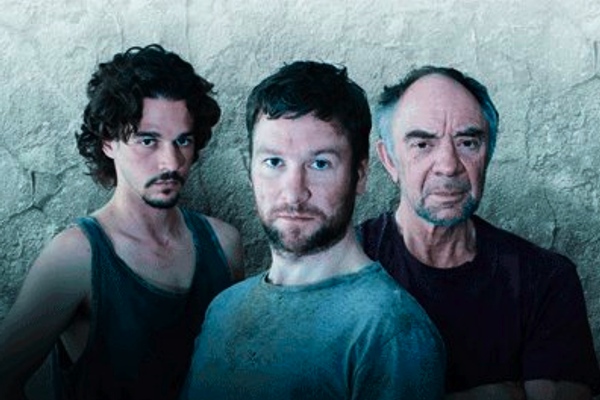
It sounds like the start of a bad joke: an Englishman, an Irishman and an American. This multi-national trio, however, are not walking into a bar, but are instead chained to the wall of a gloomy basement in Lebanon, indefinitely imprisoned by their captors and faced with the all too likely prospect of their own execution. Actor Robin Soans summarises the situation succinctly when he describes the feelings of his character, Michael: “It seems to him that he has awoken in hell”.

This is the premise of Frank McGuinness’ Someone Who’ll Watch Over Me, a play written twenty years ago about the hostage crisis in Lebanon that was then just coming to a close, and which is now being revived by Red Handed Theatre Company and the Southwark Playhouse to coincide with the anniversary. As I chat to the cast in their dressing room at the atmospheric, dungeon-like space under the arches of London Bridge station, Soans admits with a laugh that “you couldn’t find a better space in London to put it on”.

While the action of the play may be rooted in the hostage crisis that gripped Lebanon between 1982 and 1992, during which 96 individuals from a range of different, mostly Western nations were kidnapped and held in captivity, McGuinness’ image of three men trapped in an impossible situation is more notable for its universal resonance. This might, as the actors discuss, be any extreme situation in which the human spirit is pushed to its outer limits. It is the ways in which these three characters deal with their imprisonment and the truths about humanity that emerge through this that provide the true pull of the piece.

“Anyone watching the play could identify with the struggles that these characters go through,” explains Joseph Timms, who plays American captive Adam, the hostage who has been imprisoned the longest of the three. Soans, whose character Michael is an English academic who enters the mix after the other two, agrees: “It’s a universal play and there are situations like this all over the world all the time, even in domestic situations, where people feel locked in or hemmed in”. It does not matter all that much whether these characters are in a makeshift cell in Lebanon or a prison on the other side of the world; what really matters is how they cope.

It is perhaps surprising to learn, as third cast member Billy Carter, who is playing Irishman Edward, tells me, that “the script is heavily layered with lots of humour”. Humour, along with improvisation, role-playing, music and debate, becomes a vital survival mechanism for the three men trapped alone with nothing but their thoughts and one another. Soans emphatically describes laughter as “the greatest tool for survival”, adding that if you don’t make jokes about a hopeless situation “you just collapse, you deflate”. As Timms chips in, “the worst thing to do is to give in and to cry”.

Although the tedium of imprisonment is punctuated with the jokes and play-acting of McGuinness’ script, any production of this play is physically limited by the very situation in which it is staged, with the actors only able to move as far as their chains will allow. This must have been a challenge to keep the performance feeling dynamic? “It doesn’t feel like a static play at all,” Soans protests. “Physically, yes, it’s quite confined, but in every other sense it’s very fluid.” Timms, meanwhile, compares the confined energy of the three men that the actors explore on stage with that of a chained, unpredictable animal.

As Carter goes on to explain, there are tonal shifts between scenes that help to break it up, shifts that director Jessica Swale has used to propel the action forward. Speaking about the dialogue, Carter says, “it’s so sparky and as actors we’ve hit a beautiful rhythm. It’s like a dance.” Continuing the musical analogy, the actors describe each scene as having its own key that needs to be hit, creating something of a challenge for director and cast. To ensure that the necessary precision is achieved, I am told that they have used a method of ‘actioning’ in rehearsals, assigning a transitive verb to each line, which Soans explains was an invaluable process because of the “mercurial” nature of McGuiness’ script.

Also central to the dynamic of the piece is the relationship between the three very different characters, who are thrown together against their will and must learn to support and respect one another in order to survive. Soans describes it as a “pressure cooker version” of any close relationship where people must become accustomed to and absorb one another’s quirks and irritating habits. Such essential, intense relationships demand an atmosphere of collaboration and generosity among the cast, an atmosphere that was actively nurtured by director Swale. This is not a play in which any actor can afford to be greedy.

The result of this closely collaborative effort is one that is intense for both cast and audience. Timms describes the experience of watching this play as that of “watching a human struggling against an inevitability or a darker evil, which we all have in our lives, and we all fight against it and think we’re alone in having to deal with it, but then when you see it on stage it actually gives you a comfort and a strength. It gives you a joy in being alive.” The true aim of McGuinness’ play, at least as the cast see it, is to share something about what it means to be human and the mechanisms that human beings use in order to survive in desperate situations.

Contradicting those who would dismiss the arts as a waste of public money, Soans continues in the same thread as McGuinness by asserting that “drama is absolutely integral to the human spirit”, an assertion that is heavily supported both by the play and by the true accounts of hostages that have informed it. “A number of people left alone will sooner or later make a play,” Soans goes on, “because they want to explore themselves and their predicament. We want self-knowledge, and one of the best ways to get self-knowledge is through drama, through making a paradigm of something similar to your situation”.

Throughout our conversation, what reveals itself as the dominant, uplifting theme of McGuinness’ work, and what has ensured that it remains as relevant and resonant today as at its conception twenty years ago, is the indomitable and endlessly imaginative nature of the human spirit. The play also convincingly positions itself as an argument for the arts, not just as a decorative addition to human life, but as an integral part of our existence. As Soans puts it, with a slight note of triumph, “it’s a very good justification for theatre”.

How to write a prize-winning play

ImageHandler (1)

Originally written for IdeasTap.

Opportunities for budding playwrights are now more plentiful than ever, but how do you make your play stand out from the rest? Catherine Love shares playwriting tips from the winner and runners-up of last year’s Papatango New Writing Competition…

Get inspired

You’ve decided that you’re going to write a play – what now? Dawn King, who won thePapatango New Writing Competition with her play Foxfinder, admits that “once you’ve learnt your craft, having an idea is the hardest bit”. But the worst thing you can do is just stare at a blank Word document waiting for that light bulb moment.

“The main thing is that if you’re trying to have an idea it’s actually quite hard to have one,” says King, “so if I’m trying to have an idea I tend to do something else.” Try taking a break and getting out of the house; you’re far more likely to find inspiration away from the computer screen.

Let your characters drive the plot 

Plenty of advice has been written about plotting plays, but it is best to let the plot be guided by your own characters and ideas rather than by a set of textbook rules. Competition runner-up Matt Morrison prefers to think of a play’s structure “in terms of patterns and permutations”. He explains that one of the best ways to move the plot forward is to make your characters interact with one another in different combinations and scenarios. “A small amount of plotting will actually get you quite a long way.”

Nail the dialogue 

It may sound obvious, but one of the central elements of any play is the words coming out of the characters’ mouths. Well-written dialogue should drive the action and develop your protagonists. Although writing dialogue involves much more than just replicating the way that people speak, Dawn suggests that listening to real speech is a good start. Matt, meanwhile, stresses that making your characters say what’s on their mind is the biggest mistake you can make, adding that “language is a force field to stop characters getting to the truth.”

Know your characters

Your characters are the heart of your play and you should know them better than your bosom buddies. Papatango runner-up Carol Vine believes that it’s “fundamental as a playwright to know what the character wants”. She goes on to explain that the desires of your characters are what keep your play moving forward: “as long as somebody wants something, then the play [and] the characters are active”. Matt agrees that the motivations and decisions of the characters are key. “The most important thing is to show characters making choices,” he advises. “You say, here’s a character, here’s their dilemma – which way are they going to jump?”

Keep trying 

Carol entered her play Rigor Mortis into several different playwriting competitionsbefore it impressed the Papatango judges and emphasises that the judging process is inevitably subjective. “Competitions can be a wonderful platform if you win,” she says, “but if you don’t, given that there are hundreds and sometimes thousands of submissions, it certainly doesn’t mean your play is awful. You have to have guts and champion your own work, as there will be times when no one else will.”

Finally, don’t be discouraged if your play fails to win the first prize or competition you enter. As proved by Carol’s experience, persistence pays off. And most importantly, in the words of competition winner Dawn King, “be tenacious”.

Photo: Garry Lake