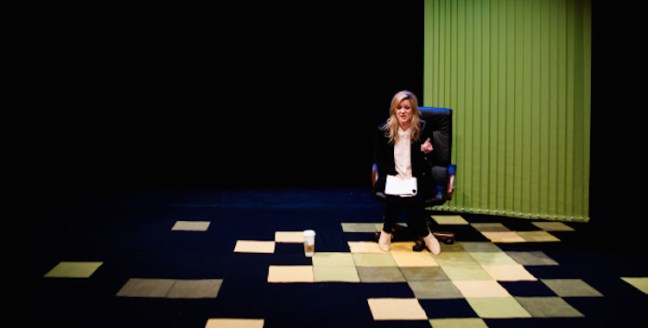
Product, Arcola Theatre

Originally written for Exeunt.

There’s something behind Olivia Poulet’s eyes. It might be steely pragmatism. It might be desperation. It might be suppressed disbelief at the spectacularly awful script she is determinedly trying to sell. It might, worse, be genuine passion for the regurgitated tropes she’s trotting out. It might even be dollar signs, if the starlet she’s pitching to gives the nod.

Mark Ravenhill’s monologue is a witty parody of the film-studio hard sell, the product of its title a slice of syrupy Hollywood cliché – the kind that rots your teeth. Girl meets boy. Girl goes on journey. Love over all else. It’s sharp, clever, self-satisfied. Only in the (nervously gesturing) hands of Poulet does it become something more than that. As a riff on the cynical, opportunistic practices of movie executives, Product is arch and entertaining. As an essay on shit-shovelling desperation, it’s blackly depressing.

Poulet is Leah, the producer charged with getting a star name on board for a new project. Problem is, the project in question is Mohammed and Me, a post-9/11 mash-up of romcom and jihadism with a cameo from Osama Bin Laden (yes, really). Sitting in for Julia, the actor selected to save this rapidly sinking ship, we’re treated to Leah’s increasingly frantic pitch as she takes us on the emotional journey of “three-dimensional” lead Amy. “I would love to see you play three-dimensional,” she croons at us, smile fixed.

Folding the War on Terror into classic chick-lit formula, Mohammed and Me is the doomed love story of a 9/11 widow and a suicide bomber – or, in appearance-obsessed Hollywood-speak, a Versace-clad businesswoman and the “tall, dusky fellow” she finds herself sat next to on a flight. Step aside Romeo and Juliet; this is a star-crossed romance like no other. Leah walks us through the movieland Holy Trinity of attraction, separation and reunion, with bomb threats and prison break-ins thrown in for good measure. “This is the world of the heart,” she earnestly intones, with all the persuasion of one who’s never had call for the organ.

It’s clearly tripe, with Ravenhill using the godawful script in Leah’s hands as a vehicle for taking pops at everything from Hollywood’s casual misogyny to its obsession with sex and violence (the two often barely distinguishable from one another). There’s a transformation montage scene, a blandly identikit mother/aunt/neighbour figure – “she’s too old to fuck, too old to kick ass, but we still have a place for her in our world” – and a suitably slushy soundtrack. Tick, tick, tick.

But what Poulet does in Robert Shaw’s production is give the money-making behemoth of Hollywood human context. Darting her eyes from side to side, appealing to us with her ever-moving hands, narrating the plot of Mohammed and Me with desperate abandon, Leah has the look of a woman possessed. What she’s possessed with, exactly, is ambiguous. At moments, she seems swept away by the story, eyes closed in its telling. At others, she’s practically gagging on this material, correcting herself mid-sentence: “This material is fab – is going to be fabulous once it’s punched up”. Either way, there’s a constant undertow of desperation and self-deceit, hinting at all the things we force ourselves and others believe in the name of self-interest.

Having the monologue spoken by a woman (it was originally performed by Ravenhill himself) also twists it in intriguing directions, glazing the misogyny with an even sourer coating. When Leah patronisingly says that she “cried like a woman” and jokingly refers to her listener as a “bitch”, you sense that she really means it. Especially in Shaw and Poulet’s interpretation, this isn’t just about the movie industry; it’s about all those oppressive internalised narratives – of sexism, of racism, of greed – that twenty-first-century capitalism shoves down our throats. The scariest suggestion is that we might just end up swallowing them.

Photo: Richard Davenport.
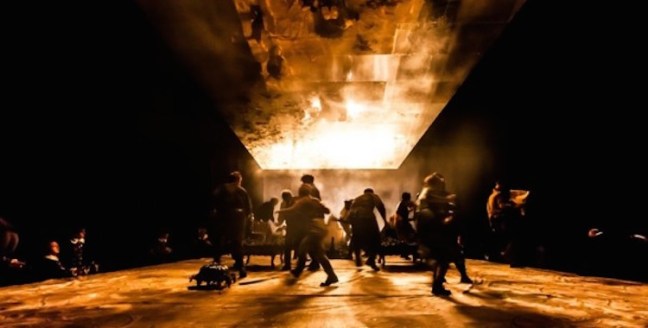
Light Shining in Buckinghamshire, National Theatre

image8-600x337

Originally written for Exeunt.

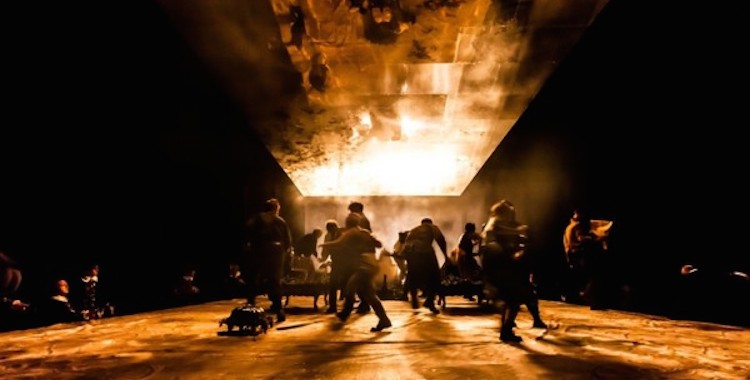
Light Shining in Buckinghamshire begins with a feast. In the National Theatre’s new production, the safety curtain opens to reveal a vast table heaving with food. Overstuffed pies; plates spilling over with fruit; a whole, glistening pig. An obscene bounty. Around the edges, heedlessly stuffing their faces throughout the people’s battles and declarations, sit a shadowy host of figures in gowns. The poor scrabble while the rich gorge.

It’s one hell of a metaphor – and one hell of a table, at that. Es Devlin’s raked design spreads greedily across the stage of the Lyttelton Theatre, occupying our entire field of vision. Above, a huge slanted mirror reflects back the candlelit opulence, while a gilt throne looms at the back of the stage. This is what the impoverished idealists and revolutionaries of Caryl Churchill’s Civil War play, dwarfed by the finery that surrounds them, have to contend with.

Eschewing textbook Cavaliers and Roundheads for a focus on the radical far-left groupings of the Levellers, Diggers and Ranters, the sympathy of Churchill’s play lies with those dismantling the banquet. Her history is one of workers persuaded to fight by a fervent belief in the imminent arrival of Christ on earth; of radical thinkers and penniless hopers; of the heady possibilities of a nation without a monarch; and, finally, of those who would freely distribute rights to speech and land being crushed by those unwilling to relinquish their power. In this telling, it’s a war fought on heavenly promises for ultimately earthly spoils.

That’s where, again, the central metaphor comes in. Bit by bit, the opening feast is stripped back to the earth from which it came, as Devlin’s set undergoes an extraordinary transformation. But while the people may till that newly uncovered soil, it soon returns to the hands of a small elite. As revealed by the Putney Debates of autumn 1647, slap-bang in the middle of the play, the Civil War quickly becomes a battle not for freedom but for land. For Oliver Cromwell and his allies, this is the sticking point; democracy is not to come at the price of their privileged property rights.

Churchill’s is a play full of proclamations, of speeches grand and simple. We, the audience, are very deliberately addressed, positioned almost as witnesses. During the pivotal Putney Debates, the house lights are gently raised, daring us to speak up. Later, Steffan Rhodri’s butcher stares right out at us, refusing to sell us any more meat. We’ve had more than our fill.

All that speaking, though, doesn’t always make for compelling drama. Lyndsey Turner’s production is a gorgeous thing to look at, with all the light, shade and careful composition of a series of paintings, yet like paintings the scenes too often feel static and poised. The rawness of anger and revolution has been given a pretty, polished sheen. There are some briefly breathtaking moments of theatricality – the voluminous tablecloth taking on a life of its own, or the wooden slats of the table being made to give way to the soil beneath – but for the most part it’s all talk and backdrop.

There are obvious, though not forced, resonances. We live in a time that feels similarly on the brink of an apocalypse – though one heralded by climate change rather than Christ – and we’re approaching the most genuinely unpredictable general election in decades. Again, we face both possibility and despair. And seeing the show on St George’s Day, the nationalist rhetoric tugs on the ear, speaking of all the ways in which pride for one’s country has been – and continues to be – used to mobilise people. But “for England” (or Britain) only ever really means for a select few.

In a subtle touch, Soutra Gilmour’s costumes suggest that the distance of rulers from ruled is temporal as well as economic. While the aristocratic chorus are got up in period gowns, the non-specifically scruffy Diggers, Levellers and Ranters could have been plucked out of various points in history – right up to the present day. One would-be revolutionary even pulls out a thermos. This has been going on for hundreds of years, Turner’s production seems to be saying, and those at the top still have yet to change.

This plays out on an epic scale, with the already large cast (Leo Bill, Joshua James, Trystan Gravelle and Adelle Leonce all stand out from the considerable crowd) supplemented by a community company of more than 40. There are an awful lot of bodies on stage. This is less the fragmented experience of war suggested by the play’s many small scenes and vignettes and more of a mass event, with a crowd of other players always lurking in the background. While this breadth can give a powerful sense of “the people”, however, the sheer size and ambition of the production – like the lavish spread it opens with – all feels a bit much. It’s a plea for the earth coming from the heart of the feast.

Animals, Theatre503

Animal Production Photos at Theatre 503

Originally written for Exeunt.

It’s 2046 and utility is the watchword. In Emma Adams’ dystopian satire, the current rhetoric of strivers and scroungers has snowballed into a society in which each last member is judged on their usefulness. Fit, docile, unquestioning adults are in; the ill, the curious and the elderly are out.

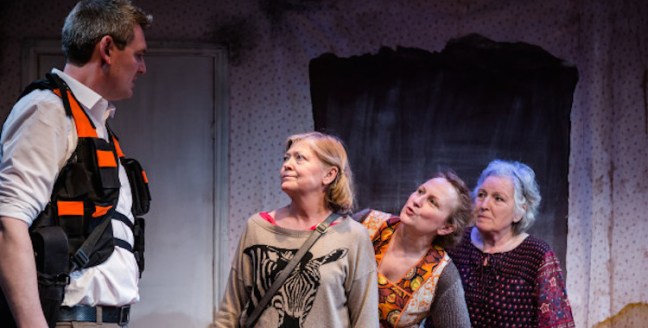
In this nightmare world of bubble-wrapped children and door-to-door euthanasia, lapped by the steadily rising tides of a planet out of control, Adams homes in on three resourceful older women. Tough, forbidding Norma (77 posing as 37), her ageing home help Joy and their drug-stashing neighbour Helen scratch out an existence through a mixture of cheerful blackmail and steely pragmatism, always taking what they can get. That includes Maya, the wide-eyed, over-protected girl who unwittingly disrupts the fragile peace of their lives. Teetering on the brink of adulthood, and with a father responsible for the “clearance” of those judged useless, she’s either the answer to their prayers or the catalyst of their destruction.

As dystopias go, this is an intriguing one. Rather than being precipitated by violent upheaval or nuclear apocalypse, the crisis here is positioned as a brutal extension of austerity logic, going one better than cutting benefits by cutting the people dependent on them. This is a society with no room for the ageing or unproductive, spurring on a chilling Darwinian drive in its citizens. Terminate or be terminated.

Trouble is, it’s too specific and yet not specific enough. Dystopias on stage bring with them a nightmarish burden of exposition, demanding the swift yet subtle illumination of an entire world. There’s a hint of Philip Ridley to Adams’ set-up – think Mercury Fur – but with none of the menace of the withheld. In Ridley’s plays, surreal landscapes shift indistinctly in the background, never fully revealing their logic. Here, however, detail upon detail about this imagined future world is uncovered, but without the accumulating information ever quite forming a consistent fictional universe. There are still dangling loose ends and big, yawning gaps.

The tone, too, fails to cohere. It feels like a Sunday-night sitcom dropped into a Philip Ridley fantasy dropped into a political dystopia, with all the disconnect such a combination implies. Lisa Cagnacci’s production is also something of a hodgepodge, struggling to get a grip on the slippery world that Adams has written. Max Dorey’s suitably time-(and water-)stained design neatly separates inside and outside, but the transitions between these two spaces are invariably clunky, while absolutely nothing is added by Max Pappenheim’s future-meets-videogame soundtrack or by the sparse and superfluous use of video projection. If this is what the future looks like, it’s a mess – though perhaps not in the way Adams intended.

The real problem with Animals, though, is that it’s a play about capitalism that wants to simultaneously be a play about ageing. Trying to do both, it succeeds at neither. Cheering as it is to see such meaty roles being written for older women – something Adams has been rightly vocal about – this intention finds itself tussling with the play’s conceit. We get fascinating glimpses of a society in which relationships have become coolly detached transactions and language is being steadily corporatised, but the sharp edges of this satire are blunted by the largely unchallenged and all too familiar tropes of old age. There’s plenty to be said here – about austerity, about capitalist logic, about the way society sees older women. But in trying to say too much of it, Animals ties its tongue in knots.

So It Goes, Shoreditch Town Hall

So It Goes Production Photos

Originally written for Exeunt.

So It Goes is about the unspeakability of grief. About those wounds so raw they resist words.

Strike that. Start again.

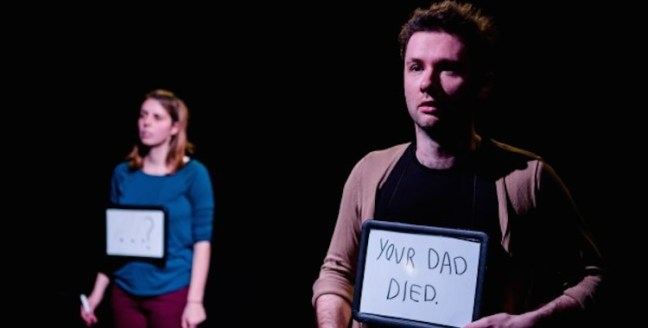
So It Goes is about Hannah Moss. When Moss was 17, her dad died. For a long time, she didn’t talk about it. In the show she has made with David Ralfe, she doesn’t talk about it either. Or at least not out loud.

Recognising that some things are impossible to speak, So It Goes reaches for other forms of communication. Instead of talking to us, Moss tells her story in written fragments, holding up placards and scribbling on whiteboards strung around her neck. Childlike in its simplicity – reflecting, perhaps, the early memories of her dad that Moss gleefully reenacts for us – the spirit of this central device extends to the cartoonish, storybook aesthetic of the whole show. Backdrops are outlined in bold sweeps of felt-tip pen and props come in the form of cardboard cut-outs.

Actions, replacing as they do words, are similarly broad-stroked. There’s a silent-film-meets-Lecoq influence to Moss and Ralfe’s use of movement, whether in energetic running montages or endearingly gawky dance sequences. At times, this style animates Moss’s story in ingenious and surprising ways. A reconstruction of the moment Moss’s parents met is gorgeous and bittersweet, while the sudden revelation of her dad’s illness slices abruptly through the carefully constructed whimsy that surrounds it. At others, though, the form feels forced, hampering rather than driving the narrative.

On the one hand, words can only say so much. The beauty of the show’s concept is that it places a light but poignant emphasis on the unsaid and the unsayable. At her dad’s bedside, Moss struggles to fit her feelings in the limited space she has given herself, repeatedly scrubbing out half-started sentences. In the end she just settles for “goodbye dad”. A chorus of “oh”s in the doctor’s office is all that needs to be – or can be – said, while the power of those six terrifying letters, “CANCER”, is even more suffocating in stark back and white.

On the other hand, words can only say so much. Especially when those words are limited to the surface of a small whiteboard. Often, there is the sense of one idea being stretched to fill an entire show, limiting its scope in the process. The form puts brakes on the content, short-circuiting complexity. The feelings that both Moss and the piece are grappling with are big and messy, but presented like this they become deceptively simple and neat-edged, like the hand-drawn scenery they play out against. Sentimentality trumps complication.


Eclipsed, Gate Theatre

image

The worst things are always unseen: the bloodshed just off-stage or -screen, the implied atrocity, the imagined worst case scenarios. The same goes for Eclipsed, a violent play in which violence is more a texture than a series of acts. Set in a warlord’s compound during the Liberian civil war in 2003 and focusing on the women scratching out a living there, Danai Gurira’s play and Caroline Byrne’s production keep all of the worst horrors out of sight, but their shadow is ceaselessly cast over everything else.

So we see guns, but we never witness anyone being shot; we see the aftershocks of battle, but never the moment of impact. The daily reality of sexual violence, meanwhile, is gestured towards with little more than the clanging of a door and the sudden, obedient formation of the commanding officer’s “wives” into a line: a ritual as regular as clockwork, broken when one is selected and silently offers her body in exchange for her safety. The microcosm that Eclipsed depicts is a man’s world populated by women, with the forces controlling their lives always just around the corner, their presence oppressive but invisible.

“Violence,” writes Lucy Nevitt in Theatre & Violence (part of Palgrave Macmillan’s excellent Theatre& series), “tells us things about the culture that produced it: the kinds of power relationship on which it is built, the attitudes and values that it takes for granted. A representation of violence can reiterate or challenge normalised social structures.”

This raises a knotty and regularly asked question: does the representation of violence (and especially violence against women) simply reinforce the structures and ideologies that allow that violence in the first place? And is a representation of violence on stage indeed an act of violence in itself? Here, violence has become habitual in the lives of these women, but its destructiveness is never normalised. When a nameless new arrival turns to guns rather than her body as a tool of survival, we feel the full, horrific weight of that (non-)choice, as well as the power structures that force it upon her.

Violence also turns things upside down, unsettling reality. Beneath the routine brutality, there’s a strange tedium to conflict in the experience of these women. Eclipsed brilliantly captures the precarious yet mundane rhythms of their existence, in which war has become a constant, faded backdrop. It’s not the atrocities that demand stage time so much as the long expanses in between, dead hours to be filled with joking and squabbling and reading eagerly from a battered Bill Clinton biography (the States always distant yet near). Humour is punctuated with horror.

Much like Palestinian drama Fireworks (another of the best new plays I’ve seen so far this year), life in Eclipsed has a flat yet brittle texture, one that threatens to be shattered by the yearned-for but terrifying promise of peace. It’s become impossible to imagine a time beyond the conflict – as one character puts it, “I don’t know who I is out of war”. When your identity is so wrapped up in violence and instability, how do you get a hold on who you are?

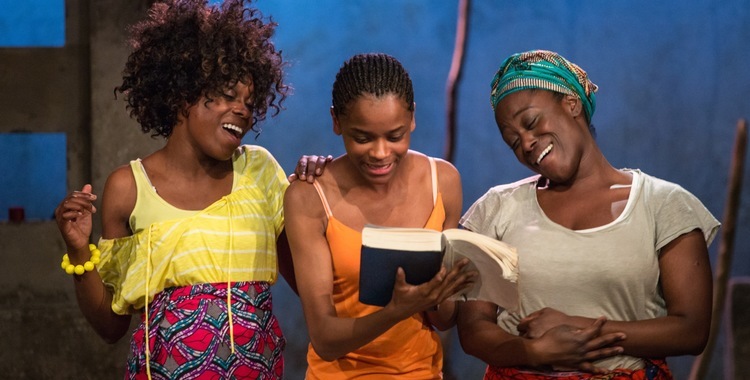
For all of its vital wider critiques, it’s the five complex female characters who emerge most powerfully from both Gurira’s play and Byrne’s assured, compassionate production. They’re all known by role rather than name: the commanding officer’s wives numbered by rank, the visiting outsider simply identified as one of Liberia’s Women of Peace. Yet in the hands of Byrne and her brilliant cast, each is distinctly and humanely individual. Wives number one and three (Michelle Asante and Joan Iyiola respectively) bury fear and anxiety in affectionate quarrelling, jostling for the CO’s favour. The former discovers a glimpse of herself when she scores her real name – Helena – into the scorched earth; the latter finds meaning in the birth of her daughter.

Lingering on the edges of the compound are Faith Alabi’s diamond-hard wife number two, now going by the name of Disgruntled and toting a gun, and Rita (T’Nia Miller), a woman on a mission for both peace and her missing daughter. But it’s the astonishing Letitia Wright as the new girl – we never learn her name – who leaves the most shattering impact. Tough yet vulnerable, there’s a determined stillness to her suffering, everything contained behind the eyes. When that exterior finally cracks, the shockwaves reverberate long after the curtain call. We don’t need to see what has happened to her to feel the depth of its horror.

Photo: Helen Murray.