Edinburgh 2013

9047152094_eef76e8424_c

You may have noticed that the website has gone a little quiet over the last few weeks. That’s because I’ve been up in Edinburgh for the Fringe Festival, reviewing several shows a day for Exeunt and Fest Magazine. Rather than reposting dozens of reviews on here, I’ve set up links below for anyone interested in what I’ve been seeing and writing about this month.

Edinburgh reviews for Fest Magazine.

Edinburgh reviews for Exeunt:

Dark Vanilla Jungle
If Room Enough
Captain Amazing
Stuart: A Life Backwards
Grounded
Death and Gardening
The Fanny Hill Project
Hamlet
Anoesis
On the One Hand
Banksy: The Room in the Elephant
Ballad of the Burning Star
I’m With the Band
The Poet Speaks
Squally Showers
Cape Wrath
The Bloody Great Border Ballad Project
Fight Night
Dumbstruck
We, Object
Specie
Don Quijote
The Various Lives of Infinite Nullity
The Smallest Light
The Future Show
Freeze!
The Beginning
Whatever Gets You Through the Night
Forest Fringe
There Has Possibly Been An Incident

Photo: Andrew Reid Wildman.

Josephine and I, Bush Theatre

Cush Jumbo, photocredit Max Narula 7

Framing history with the contemporary is nothing new. The best backward-looking art uses the past as a way of illuminating the present, often saying things about the now that might otherwise be perceived as too raw or too crude. Likewise, applying an autobiographical lens to historical material can sometimes offer fascinating new insights, using the subjective voice as a pathway to wider understanding. When the slippage between these layers – of past and present, of fact and fiction – is too pointed, however, the result can become a tangle of distractions.

This is a fate to which Josephine and I veers dangerously close. In her self-penned one-woman show, actress Cush Jumbo plays a fictionalised version of actress Cush Jumbo, who in turn plays twentieth-century entertainer and activist Josephine Baker. Confused yet? When she first appears, it seems plausible that Jumbo really is playing herself – or at least a version of herself, as anyone arguably is as soon as they place themselves in a public space. By way of introduction, she explains her almost lifelong obsession with Baker, a fascination sparked as a young child by the surprise of seeing a black woman starring in a film from the 1930s. This soon segues into representations of Baker herself, establishing a back and forth habit of shape-shifting that characterises the structure of the show. Throughout, the action flits regularly between telling Baker’s extraordinary life story and giving way to interjections from the storyteller.

As the show goes on, however, and we receive more and more direct addresses from the (never named) modern-day black actress, this character gradually diverges further from Jumbo and the truth of her escalating confessions is thrown into deliberate doubt. (Small disclaimer: I interviewed Jumbo before seeing the show and was therefore perhaps better placed to discern what was “real” and what wasn’t, but the framing makes it fairly clear that this is not in fact Jumbo speaking – or at least not always) Some aspects of the character tally with what we might know about Jumbo, although that of course depends on an audience’s familiarity with the performer’s background, but others are evidently fictional. Which is where the framing of the piece begins to become unstuck.

There are entirely understandable reasons why Jumbo has adopted this approach. Beyond the obvious vulnerability inherent in exposing oneself, unmasked, to an audience, there are important points that the show attempts to make through the parallels drawn between Baker and her modern-day narrator. As well as questioning the nature of success and how that success is judged by others, the show uncovers the race and gender-related prejudices that continue to persist today, while throwing in a central dilemma to trouble the “have it all” philosophy that modern women are so often fed. But the central themes, one suspects, would peek through the narrative without the occasionally heavy-handed fabrications, which run the risk of undermining themselves through the doubt that they cast on the rest of the show. I find myself wondering if it might be more interesting to see Jumbo’s unadorned take on Baker, framed with her own experience.

Instead, what we are left with are questions that deflect interest away from Jumbo’s political points rather than enhancing them. Is this Jumbo speaking, or is this a fictional character whose thoughts are being expressed? Are we watching Baker, or are we watching a version of Baker that serves the motivations of the character portraying her – or indeed the motivations of Jumbo herself?

Differently structured, the tension and uncertainty between these layers could be intriguing and productive in their own right. Unfortunately, Jumbo’s device is not quite cheeky enough to make an arch comment on its own meta-theatricality and not quite persuasive enough to tug us along with its semi-fictional heroine regardless. Instead we are left slightly dislocated, ricocheting between Jumbo’s real and fictional selves while increasingly doubting the veracity of everything we’re told. Which is perhaps the point – there’s definitely something interesting to be said about the constructed public persona, particularly when considering such a chameleonic figure as Baker – but its articulation is unclear.

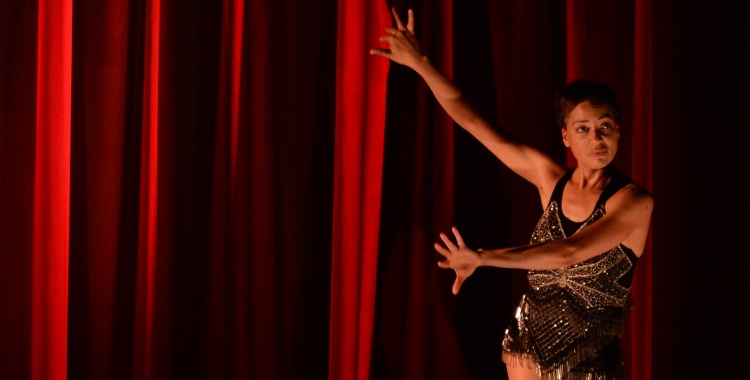
What saves the piece – perhaps ironically – is Jumbo herself. She is a consummate performer, papering over any cracks in the piece with energy, humour and sheer, incandescent charisma. A cynical perspective might write this off as a simple showcase, calculated to allow its star to shine as blindingly as possible, but Jumbo’s obvious passion for her subject dispels such ungenerous doubts. She throws herself into every last jazz number and dance move with tireless intensity (not easy in this heat), while effortlessly morphing from character to character, voice to voice – as much a master of reinvention as Baker herself. She’s also naturally funny, lending an easy conversational charm to the segments in which she addresses the audience.

The only problem with Jumbo’s intoxicating stage presence that it occasionally threatens to obscure Baker, whose story she is so intent on telling – and, for the most part, tells with dazzling force. As presented here, it’s not hard to see why Jumbo was compelled by Baker’s remarkable life. This was a woman who had already been in and out of two marriages and performed on Broadway before becoming a celebrity in Paris at the age of 19, where she moved in starry artistic circles that included Picasso and Ernest Hemingway. During the Second World War she played a key role in the French Resistance and in the following decades she supported the American Civil Rights Movement while creating her own “rainbow tribe” of adopted children from around the globe. For once the phrase “you couldn’t make it up” feels justified.

In the process of retracing this astonishing life, we’re left in no doubt that Jumbo is an extraordinary performer, and although my criticisms might suggest otherwise, this remains an engaging and entertaining show. The cabaret set-up of director Phyllida Lloyd’s production is perfectly judged and the best sequences are those in which Jumbo joyously embraces the staging, venturing out into the audience and fully occupying the role of entertainer. In fact, Jumbo herself is so winning that it seems a tad churlish to lodge so many objections to the piece she has painstakingly crafted. Whatever popular opinion might suggest to the contrary, it’s never nice to feel mean as a critic.

There’s one startling, standout moment, however, that neatly points up the flaws elsewhere. Reading from the reviews that Baker received upon her return to New York after making her name in Paris, the shocking racist content stretches almost seamlessly into a comment that Jumbo reveals, in a gut-punching transition, to have been posted on a profile on the Observer website just last year. Here, through a precise and disturbing jolt, the entire thematic heft of the piece is loaded onto a few bigoted words, illustrating just how far we still have to go. Unlike the clumsy shifts and laboured parallels elsewhere, this scene administers raw, immediate shock. Sometimes, the more simple and bare the statement, the greater the punch.

Photo: Max Narula.

Glasshouse, Battersea Arts Centre

web_GLASSHOUSE_176_view

Ever been to one of those dinner parties where it feels like people just keep saying the same thing? At The Honest Crowd’s surreal culinary experience, they actually do. Here, the dinner guests are bludgeoned with small talk and the anecdotes are set to repeat. It’s like being stuck inside a DVD, relentlessly rewinding, fast-forwarding, pausing and skipping.

Glasshouse starts ordinarily enough. After being led into one of BAC’s many small side rooms, we seat overselves at a series of tables arranged in a square, facing one another across the gap in the centre. Our places are laid with plates, serviettes, glasses of wine. Five performers are seated in our midst, while a waitress lingers at the edge of the room. And then the conversation starts, following a plausibly familiar path as the guests discuss wine, films, quirky stories on the news. In fact, everything is pointedly normal; even the acting style is understated, while the audience’s gradual sips of wine lull us into the rhythm of a recognisable social situation. We know what’s going on here – we can do this.

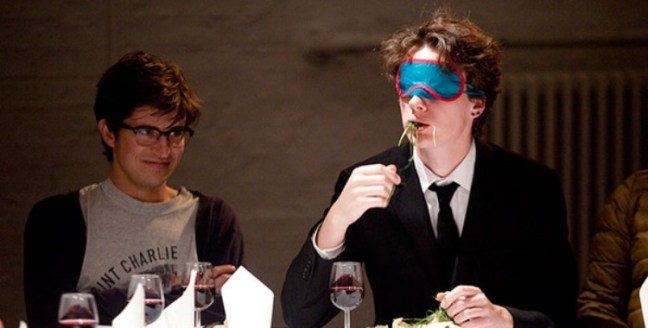
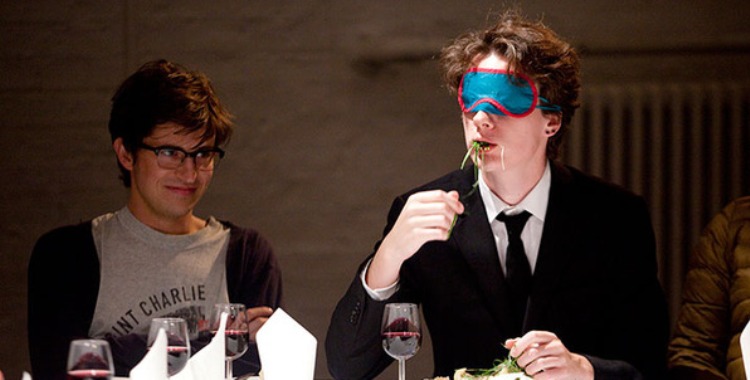
Of course, as most of us probably anticipate even as we enjoy our wine, there’s a lot more to Glasshouse than social ritual. Suddenly, the conversation is rudely truncated and reset. We hear the same questions, the same answers, the same laughs at exactly the same moments. From this moment onwards, the same snippet of prosaic conversation is played out again and again in seemingly endless, grating variations, as the circling waitress pours wine into overflowing glasses and adds more and more ridiculous items to the guests’ plates – lemons, grass, chili peppers, sponges. The dialogue jumps and intercuts, skittering like a broken record, while the performers’ table manners become more and more repulsive. Grass is flung across the table and saliva oozes down chins.

Throughout this surreal spectacle, every last giggle, gasp and grimace of our fellow audience members is deliberately visible across the room. Although the level of audience involvement could be more carefully thought through (our role in this space and in the bizarre universe of the characters is not entirely clear, while I could feel irritation radiating from the actor next to me when I dared to ask him to pass the butter), our arrangement within the space is cannily calculated for maximum impact. Just as the increasingly animalistic habits of the actors reveal something uglier beneath the gloss of small talk, perhaps our reactions reveal something about us as they catch us off guard.

The piece’s implicit nods to absurdism and its borrowed elements of live art – putting the performers through genuine physical ordeals before our eyes – might be more obvious reference points, but what I find myself reminded of is Cheek by Jowl’s recent production of Ubu Roi. Framing the crude extremes of Alfred Jarry’s text within a teenage boy’s frustrated fantasy, the company used this disruptive narrative as a sort of theatrical grenade thrown into the centre of a pristine dinner party, which carried on blithely amid the accumulating mess of the production. The Honest Crowd show the same stubborn, illogical attachment to social norms while everything else unravels around them, simultaneously upturning the very conventions they cling to.

At the same time as it decimates its social setting, however, Glasshouse is in danger of pulverising its point – if, indeed, it seeks to make one. Perhaps the point, if there is any, is the sheer, ridiculous futility of these social routines, exposing the emptiness of the words we eat up as hungrily as the gourmet cuisine. Like Ubu’s oblivious guests, we sip wine and trade anecdotes while the world crashes down around us. This implicit comment on vacuous middle class dinner party culture might not be new, but the mess and vigour of its delivery makes it difficult to forget in a hurry.

Photo: Ludo Des Cognets.

The Strange Undoing of Prudencia Hart, Royal Court Theatre Local

1069380_10151698714439099_1041612077_n

However you do it, there’s something a bit odd about thrusting yourself headfirst into imaginary winter in the midst of sweltering summer heat. As pipe-playing actors stubbornly tell us it is December 2010 while sweat trickles slowly down their foreheads, the prelude to the National Theatre of Scotland’s The Strange Undoing of Prudencia Hart has something of the school play about it; well meaning, big hearted and determinedly blind to its own obstacles – but it’s not fooling anyone. Fans continue to whirr valiantly away, while theatregoers gulp down drinks with a fervour not usually witnessed outside the Edinburgh Fringe.

Then something sort of magical happens. As the actors begin their story, we’re instructed to throw handfuls of improvised paper ‘snow’ into the air, settling on heads and tables and floor. Melody Grove (dressed in so many layers I’m impressed she makes it through the show without fainting) sits atop another performer’s shoulders as a mimed steering wheel, a gleefully waving windscreen wiper, and a tax disc, rearview mirror and two torches held aloft instantly conjure a car. It’s the simplest kind of theatrical illusion, but the rough and raucous spirit in which it’s done brilliantly sets the tone for the show that follows. The heat doesn’t abate, and we’re not quite transported to the snow-blanketed landscape of the Scottish borders, but all of a sudden our sweaty environs seem to matter a little less.

This effervescent little firework of a show is the joint creation of playwright David Greig and director Wils Wilson, joyously embracing both the traditional ballad form and the rowdy pub setting – in this instance, the intimate (and uncomfortably muggy) Welsh Centre bar. Greig’s text takes the form of a ballad about ballads, encompassing everything from lively folk sessions to dry academia, but its knowing self-referentiality never sacrifices a vital sense of fun. At the heart of the piece, effortlessly marrying form and content, is a tension between the purity of tradition and the inclusiveness of a form that morphs to appropriate new cultural phenomena – two camps into which Greig’s bickering gaggle of academics are firmly divided.

One of these academics is the eponymous Prudencia Hart, a prim and reserved traditionalist specialising in the topography of hell, for whom fashionable attempts to intellectualise Facebook statuses and football chants are little short of blasphemy. The story begins at a midwinter conference in Kelso, a small Scottish border town, where Pru’s purism is decidedly in the minority, up against post-post-structuralism and theses on Lady Gaga. Tradition is out of vogue. Adding inconvenience to humiliation, Pru then finds herself stranded with her colleagues in a snow-surrounded pub, trapped somewhere between the drunken locals and the horror of the karaoke machine.

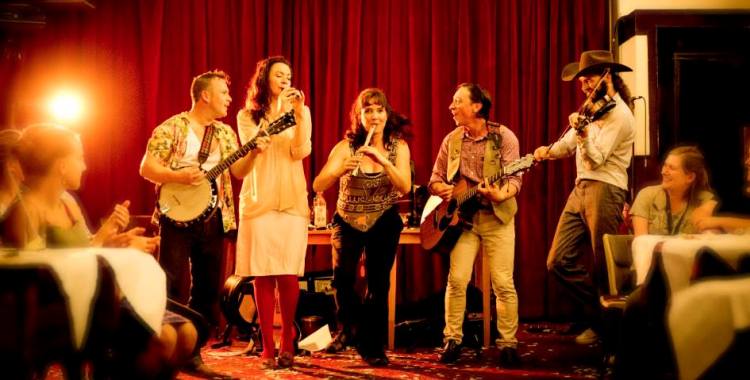
Rattling through academic papers and beer-drenched revelry with equal ease, the first half of the show is mostly hilarious scene-setting, affectionately poking fun at its characters and drawing its audience into the circle of the story. This is narrative at its simplest and most familiar: a yarn down the pub. We are made to feel that the story belongs to everyone, as the narrative is shared and passed between the five performers, who in turn pass through the audience. Actors dance on tables and leap up onto the bar, while several audience members find themselves roped in as props or extras (fellow critic Dan Hutton, incidentally, makes an excellent motorbike). Greig and Wilson find a popular form, populate it and turn it inside out.

The action only begins to drag in an extended sequence featuring four drunken locals, who might be realistically hammered but add little to the gathering story; it’s the one point at which the production feels indulgently overlong. It’s not surprising, then, that Prudencia wants to get away, escaping the drink and drug-fuelled hedonism of the pub for the snow-covered town and a suspiciously friendly B&B owner. Nick, it turns out, collects rare books – and souls. As Prudencia’s academic subject swiftly becomes her reality, it soon transpires that she is the devil’s latest prize, condemned to eternity in a tartan-filled bungalow next to the Asda car park.

Pru’s subsequent ‘undoing’ in the second half offers both a transformational narrative of self-discovery and a movement towards reconciling the two sides of the argument established by Greig in the first part. As the verse that has propelled the story thus far is abandoned in favour of prose, Prudencia learns over several millennia that a life without passion and poetry – no matter how many books you surround yourself with – is no life at all. This section of the show, settling into a quiet rhythm after the raucous first half, is certainly strange. But it’s also sort of beautiful. In one gorgeous, startling sequence, the devil (played by both Paul McCole and David McKay in a slick and surprisingly effective bit of shape-shifting) finally surrenders to poetry, melting together with his captive in a slow and intimate dance.

This section also provides an opportunity for the excellent Grove to become a captivating central anchor for the piece, as her Prudencia gradually reveals an unknown, passionate facet of her otherwise reserved character. Her undoing refers less to a tumble into sin than an unstitching of her distant, sedate exterior. This is paired with Pru’s visual disrobing, as her meticulously neat layers are discarded one by one, leaving her in just slip and tights, while her hair cascades down from its prim bun. Transformation runs through the form, too, as prose gives way to a torrent of poetry and the explosive power of a collective football chant unites the ballad with its modern cousins. There’s even a bit of Kylie thrown in for good measure.

Alongside the production itself, it feels worth pausing to consider its context. Prudencia’s specialist subject might be the topography of hell, but the specifics of this production concern far more earthly locations. Like many of Vicky Featherstone’s early moves as the new artistic director of the Royal Court, this programming has the feel of a statement, and a multi-layered statement at that. Firstly, it’s a bridge of sorts between Featherstone’s role with the National Theatre of Scotland – for whom she commissioned this piece – and her new home at the Royal Court. Secondly, the fact that this show from a theatre without walls is being presented outside the brick and mortar of the Court, as part of its Theatre Local season, suggests a continuation of that gesture of opening up that has so far characterised Featherstone’s tenure. More and more I think that only an artistic director with the experience of not being shackled to a building could give as much thought to what a building really means as Featherstone has already.

Then of course there’s the fact that this show from the National Theatre of Scotland, engaging with Scottish folklore, is being presented at the Welsh Centre in London, England (all that’s missing is a slice of Northern Ireland). And it’s a show about border ballads, in which the narrative itself floats, flitting from performer to performer and only briefly settling. At a time when British identity is increasingly under pressure, this implicit stretching and questioning of nationality feels significant, inviting us to reconsider our connection with our country and our past. It’s also fascinating to see this ahead of Northern Stage’s Bloody Great Border Ballad Project at St Stephen’s in Edinburgh, offering another modern, border-crossing take on this form.

The pub setting, too, is vital to the rowdy sense of community that emerges in the room by the end of the night. As already mentioned, the forms that Greig and Wilson are recruiting to tell this story are very much popular forms, from ballads to folk music to karaoke. There is the sense that, wound together in this way and planted in a familiar social setting (ideally oiled with a few drinks), this marriage of popular forms both old and new offers a new and yet old way to share our stories with a group of people gathered together in a room, breaking through many of the stifling conventions that often hamper theatre. The Strange Undoing of Prudencia Hart is, like the tale round the campfire or the roaring anecdote told over pints at the pub, a basic but accomplished lesson in storytelling. And it’s devilishly infectious fun.

Photo: Johan Persson.

Open Court, Royal Court Theatre

IMG_8404

Originally written for Exeunt.

In each week of the Open Court festival, the downstairs space at the Royal Court is dominated by a huge wooden crate. As the house lights go down on the latest weekly rep offering, Chloe Lamford’s design is a closed box, a sealed-off world within a world. But almost as soon as the action begins, this box tips open, its sides dramatically tumbling down. It’s hard to imagine any better visual metaphor for what is happening at the Royal Court under new artistic director Vicky Featherstone.

Lamford and her design team must also take the credit for much of the transformation elsewhere at the Court, where Featherstone’s giddy promises of playfulness are translated into bright splashes of colour. The bar, once gloomily sophisticated, is now a riot of yellows, blues and greens. One whole wall is given over to an image of a bright green hedge, while paper lanterns glow overhead and the childish mischief of the summer festival finds its expression in a big blackboard covered with multi-coloured magnetic letters. Burgers and chips are the order of the day.

The atmosphere being cultivated in the early weeks of Featherstone’s tenure, in which she has boldly handed the keys to the writers, is one of both opening up and discovery. No longer is the drama confined to the two auditoriums, as yellow and red tags offer up brilliant ‘found plays’ for curious passersby (which can also be discovered online, if you have a few hours to kill). Lost in Theatre, meanwhile, offers a truly new perspective on the Court, inviting audiences into its unexplored nooks and crannies. I have yet to find the time to get lost myself, but the bright circles on the floor enticingly beckon me every time I’m there, calling visitors into the unseen depths of the theatre.

In the work itself, the aesthetic is rough, raw and exciting – and, as a result, slapdash. With the need for polish stripped away, there is the room for both thrilling discovery and messy execution. What I’ve seen of the weekly rep shows is a decidedly mixed bag, unleashing a frighteningly skilled ensemble on a pair of underwhelming plays. Lasha Bugadze’s The President Has Come to See Youcertainly kicks off proceedings in the right spirit, with Featherstone’s production and the excellent cast lending a shambolic energy to this bonkers Georgian satire. It would probably help to be acquainted with the Georgian politics being skewered, but in this festival context the freshness and excitement of it all is just about enough to carry it – even if the references do fall a little flat.

The second rep show, Lucas Hnath’s Death Tax, fares less well. Hnath’s string of dense scenes asks big, uncomfortable questions about an ageing population, but the play as a whole feels uneven and full to the point of bursting. Everyone talks too much. There are important issues being chewed over here, such the consequences of life-extending medicine, the privileges money can buy and the selfishness of what motivates us – “no one does something for nothing”, we are repeatedly reminded – but this could almost be several different plays. The cast, however, do their best to inject some life into the lengthy scenes, and it remains extraordinary what everyone involved has managed to pull together in just a week.

One of the most exciting elements of Open Court is also mixed, but it makes up for its patchy variety with glorious unpredictability. Surprise Theatre is just what it says it is: it offers its viewers a genuine surprise. In an information-saturated age when we are used to going into the theatre armed with endless details, it’s novel and disarming to be confronted with the unknown in this way. The configuration of the Theatre Upstairs (once again, credit to Lamford) also plays with this novelty, continuing the colour that is splattered throughout the building and concealing each night’s surprise behind mocking red velvet curtains.

The first offering, Cakes and Finance, is a bold and exciting gesture, immediately asking questions about what a theatre building is and what it should be. In a verbatim piece of sorts, Mark Ravenhill reads from interviews with a number of playwrights about their ideal theatre – from plush red seats to a building without walls. While none of the subsequent surprises I’ve seen have quite met the brilliance of this opener, there are some genuinely startling moments; Lauren O’Neill’s delivery of the final, punishing monologue in Sarah Daniels’Masterpieces administers a bruising blow to the gut, while scenes of piercing poignancy and fierceness emerge from The Ship’s Name, put together by a collection of writers of Somali and Eritrean descent. As a viewer, there is also something particularly engaging about feeling one’s way through a piece without any props (the supporting kind, though the theatrical kind are also in short supply), demanding an active act of spectatorship.

Just in case the festival as a whole was not already engaging sufficiently with what the Royal Court as a theatre might mean and might be able to say, the weekly Big Idea pushes playwrights into addressing the important questions – sex, age, death. Alongside these timeless themes, a more obviously timely subject is found in PIIGS, the acronym referring to five of the countries hit hardest by the eurozone crisis: Portugal, Ireland, Italy, Greece and Spain. Pairing writers from each of these countries with their British counterparts, the five nights of theatre engage with the realities of everyday life for those living on the front line of austerity.

The offering from Ireland, penned by Deirdre Kinahan and Kieran Hurley, feels terrifyingly close to home – and not just in the geographical sense. While Ireland is suffering more than the UK, the plight and the conversations feel familiar, if heightened. Around two compassionate, funny but ultimately stark pieces by Kinahan and Hurley, about an attempted protest at an Irish school facing cuts and the erecting of fake shop fronts in Northern Ireland during the G8 respectively, the pair have made the powerful choice to incorporate a selection of verbatim interviews. Their interviewees range from a financial journalist who quotes debt figures to make the eyeballs bulge, to a woman reduced to selling everything and uprooting her family’s life to Canada. The numbers baffle, but the stories move.

Coming full circle to that gesture of opening up, it is also important to acknowledge how much of this work is being made available beyond the four walls of the Royal Court. Each of the Surprise Theatre shows is being broadcast live online on Mondays and Tuesdays and left on the website to view on demand, while the Royal Court Soap Opera collides theatre and television in a series of nightly episodes that can be streamed online – not to mention the treasure trove that is the Found Plays website. While such initiatives always carry the potential danger of eroding the live moment, Featherstone’s intention seems to have less to do with the theatrical event than with the building hosting it, a building that appears increasingly open. Perhaps because of her time operating a building without walls with the National Theatre of Scotland, under Featherstone the walls of the Court suddenly seem a lot less containing.

Photo: Helen Murray.