Medea, Richmond Theatre

In a modern society supposedly desensitised to blood and horror, the grim tale of Medea might just be one of the last taboos. Apart from perhaps Oedipus, whose plight has been largely subsumed into Freudian psychoanalysis, it is this vengeful murderess and her infamous crime of infanticide who holds the greatest sway on the modern imagination of all the protagonists of Greek tragedy.

Passed down through adaptation upon adaptation, this latest version by Mike Bartlett and Headlong sees her transplanted to the unlikely location of a British housing estate. The chorus become gossiping neighbours and work colleagues, all nosily observing the collapse of Medea’s family as philandering husband Jason prepares to marry Kate, the young daughter of his landlord, while Medea and her son Tom co-exist in a silent state of grief.

Bartlett’s conflicted updating of Euripides’ tragedy is myth as simulacra – all surface and no depth. His approach opts for naturalism with a hard, plastic edge, drawing attention to its own fakery, while everywhere the artificial and the shallow loudly dominate. Medea’s “friends” keep up the appearance of concern while pursuing their own interests and desires; the dissatisfied next door neighbours make relentless home improvements; Jason and Medea’s silent, ghost-like son might as well be the symbol of a child.

Nowhere is this sense of the superficial facade more unsettlingly conveyed than in Ruari Murchison’s pop-art doll’s house of a set, which conceals four boxed-in rooms behind screens displaying the pointedly flat exterior of Jason and Medea’s house. These contained domestic spaces are disturbingly neat, pretty and precarious, a fitting microcosm of the identical houses and manicured lawns that fill the sterile, hermetically sealed suburbia outside. Like the chilling rows of perfectly pastel homes in Edward Scissorhands – far more frightening than Johnny Depp’s razor digits or shock of black hair – the production evokes a stifling suburban ennui in which Rachael Stirling’s restless, raging Medea writhes like a flame-haired Fury.

What Bartlett is attempting to demonstrate through this shiny, brittle aesthetic, however, never becomes fully clear. Is the unapologetic flatness of both design and performances a comment on the superficial emptiness of modern life? If so, how does that emptiness resonate with the tale that Bartlett is reworking? There is a straining tension at the heart of this updated adaptation, but it is a damaging rather than a productive antagonism. Alongside the contrast of ancient and modern, the production frequently finds itself torn between opposing camps: misogyny versus the plight of women, psychological damage versus seemingly unexplained madness, logic versus magic, religious faith versus the empty realisation that all we have is “life and death and the waiting in between”.

In clumsily negotiating between the ancient and the contemporary, Bartlett’s version finally comes down on the former. Abandoning the lacklustre attempt at psychological exploration that lightly peppers the piece, in the end his Medea is faithfully vicious and unrepentant. As she stands at the play’s close dripping with blood and triumph, Euripides’ starkly uncompromising vision of a woman prepared to go to any lengths for revenge emerges unscathed from the wreckage of this muddled attempt at wrenching her into the modern day.
Beats, Bush Theatre

Originally written for Exeunt.

The most disturbing aspect of the dystopian nightmare constructed by George Orwell in 1984 is not the unblinking eye of Big Brother, or the children blithely betraying their parents, or even the terrors of Room 101. What really conjures the cold, black grip of dread is the whispered name of the Thought Police, the idea that the final refuge of the mind might be infiltrated and soiled. It is the untamed power of the mind to resist that holds possibly the greatest subversive power, because thoughts are impossible to capture; as Kieran Hurley breathes into his microphone at the beginning of Beats, eyes wide, “they can’t arrest your imagination – yet.”

On the surface, Hurley’s startling piece appears to be simply a surprising blend of storytelling and techno music. These unlikely bedfellows are harnessed to relate the distinctly ordinary narrative of Johnno McCreaddie, a fifteen-year-old boy growing up in Livingstone who becomes entangled in the rave culture of the early 1990s, while at the same time policeman Robert wrestles with the day to day demands of his job and the insistent, disappointed ghost of his father. Yet Beats is, in its own pulsing, unapologetically noisy way, one of the most invigorating pieces of recent political theatre. It’s a strobe-lit love song to the radical potential of the collective act of imagination, the live sharing of thoughts that can’t be clubbed or cuffed.

Although speaking deafeningly to the disillusioned present moment, Hurley’s narrowed focus is 1994 and the Criminal Justice Act’s bizarre outlawing of public gatherings to listen to music that consists primarily of “the emission of a succession of repetitive beats”. Collected in the Bush Theatre to the pounding soundtrack of DJ Johnny Whoop, we are – according to this definition – breaking the law. Hurley, an unassuming but fiercely captivating performer, flirts with this idea of transgression and with the lines drawn between real and imagined in the space of the theatre, playfully suggesting that because it’s not real its criminality doesn’t really count.

While Hurley’s characters are vividly drawn and fleshed out by his morphing voice and physicality, much of the weight that gathers behind this simple narrative is reliant on the sound with which it is intertwined. Audience members become auditors in the most literal sense, as the piece channels the power inherent in music and its force to bring people together against the atomising efforts of those in authority. The integral beats of the title are not just beats of music, but beats of the heart, beats in time, the very stuff of humanity and of history.

From the exhilarating rush and noise of the show Hurley has crafted, one grinningly rebellious anecdote sounds a note above the rest. In the immediate wake of the Criminal Justice Act, one of Johnno’s mates explains how the song blaring from his car speakers has no repetitive beats at all – not one. Each series of beats follows a different rhythm, scattering logic. If they had a rave and only listened to this one track, the boy continues, no one could legally arrest them.

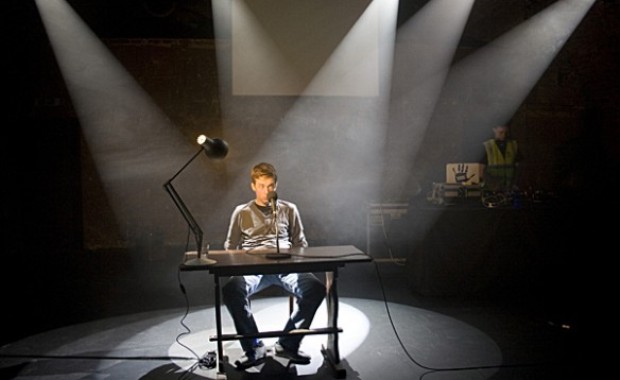
It’s a fitting analogy for the subversively chameleonic nature of resistance, which will constantly find new ways to push against imposed systems from within, often using those systems’ own apparatuses. It also speaks to Hurley’s own recycling and reinvention of the essentially traditional form of storytelling in which he is working, visually hinted at by the rather old-fashioned wooden desk at which he sits and its juxtaposition with the light and sound enveloping it. As Johnno puts it upon entering his first rave, “it’s been done before, but not by me” – a fresh sense of novelty that Hurley manages to inject into his mode of narrative, generating a kind of optimism in the ability of political theatre to shift and evolve at the same pace as its circumstances.

As the pulsing sound and lights finally dim, what Beats leaves us with is a collective conviction that this matters. Hurley’s closing refrain, the piece’s own pulse and repetitive beat, rings out as a subversion of the criticism so often levelled at the seemingly marginal activities of political theatre: it doesn’t mean nothing. A simple, casually deployed double negative delicately inverted to reveal its true meaning. It doesn’t mean nothing.

Where the Mangrove Grows, Theatre503

mangrove

Originally written for Time Out.

Under the looming shadow of spending cuts, it’s a pertinent time to focus on the youngsters slipping through society’s deepening cracks. Joe Hammond’s new play, however, is less an examination of the system than a confused vision of one boy’s attempt to dream himself out of it.

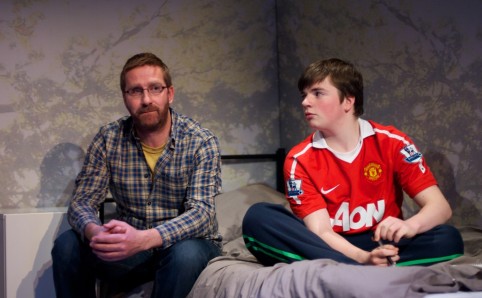
A grim chronicle of neglect, ‘Where the Mangrove Grows’ offers us the figure of Shaun (Charlie Jones), a gobby but vulnerable 12-year-old boy discarded by his mother and left to fester in the dark, unobserved corners of the care system. Comforted by a library book illustrated with mangrove trees, his only ally appears to be embittered care-worker Mike (David Birrell).

The worlds of interior and exterior, vivid imagination and bleak reality, are in constant friction with one another in Tamara Harvey’s claustrophobic production. Amy Jane Cook’s design papers the walls of Shaun’s room with the trees that suffuse his dreams, while his window looks out on nothing but blackness. It’s a metaphor that transcends the confines of the play, colliding a common desire for the exotic with the creeping realisation that all is not as it seems.

But just as Shaun is trapped by his circumstances, nurturing a dying spark of imagination against the black void outside, Hammond’s play finds itself equally stuck. Aside from one puncturing moment of horror, the meandering script lacks the muscle to successfully indict the situation it depicts. The cry for help is strangled by its surroundings.

Constellations, Duke of York’s Theatre

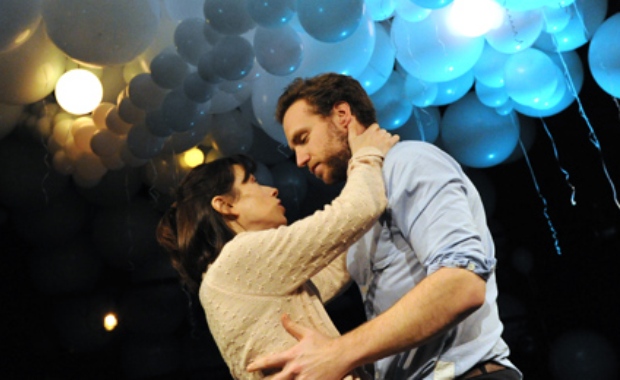
The first thing to note about Constellations is the balloons. Tom Scutt’s gorgeous set design is full of them – hovering weightlessly above the two actors, clustered at the sides of the raised platform that fills the stage, occasionally tumbling slowly down. Watching this cloud of balloons while waiting for the performance to begin, I was reminded of two things: one was the simple delight of coming home on the night before my 21st birthday to find that my bedroom had been filled with dozens of the floating, multi-coloured things by my housemates; the other was that childhood game of letting go of a helium-filled balloon and watching it drift away to faraway imagined lands.

There’s something about the fragile gesture of hope and congratulation contained within the balloon – and implicit within those two associations – that makes a remarkably apt comment on Nick Payne’s gently complex two-hander. Built on the theory of the multiverse and the premise that each moment gives birth to a multitude of possible outcomes, all being lived along parallel lines in separate universes, Scutt’s balloons take on the character of floating possibilities, equally as likely to puncture as to soar. Like the child who lets go of the string and releases their helium bubble of dreams into the hostile air, the leap of faith required to open your life to another individual is a deeply optimistic act, dogged with the threat of failure at every slight gust of wind.

Payne’s defiantly hopeful figures being swept around the multiverse are quantum physicist Marianne and beekeeper Roland, who are engaged not so much in a “will they/won’t they” situation as “they do/they don’t”. In some variations of their first meeting, Roland rejects Marianne’s goofy flirting, while in some universes one of them is married before they even encounter one another; in some they get engaged, in some they cheat on one another, in some they pass each other by. Like the balloons, which flicker and light up around the two characters as they rapidly feel their way through different scenarios, Marianne and Roland emerge as two atoms “being knocked the fuck around” and occasionally finding contact.

The early part of Payne’s script runs the gamut of basic possibilities – think rom-com with a side of knowing wit – snapping sharply from scene to scene with quickfire precision while Sally Hawkins and Rafe Spall shine in brief flashbulb bursts. Reflecting the initial encounters and early dates that form the majority of these scenes, this is theatre as flirtation: charming, calculated to impress, a tad shallow. The meticulously constructed scenes jitter attractively over the surface of Payne’s chosen subject matter, peppered with arch little references to time, mortality and the possibility of other universes, but not quite penetrating the depths. Form and content are intricately tangled up with one another, but the latter seems to serve the self-congratulatory cleverness of the former.

The nature of the piece – or perhaps of the sheer awkward charm of Hawkins and Spall, as it’s hard to tell – means that we become increasingly attached to Marianne and Roland, mirroring the same process that Payne appears to have gone through in writing the play. Half-abandoning the swift, dazzling structure of the opening scenes, our time with these two characters in each of their possible interactions becomes more prolonged and the multiple possible dramas they go through gradually heighten, shifting the emphasis away from formal virtuosity and towards emotional identification. The production is suspended in mid-air, caught between telling the many tender stories of this one couple and exploring the connected, wider concepts of chaos, control, choice and time.

Perhaps there is something in this emergence of a dominant narrative from the many splintered possibilities, something other than the need for a level of cohesion in order for the piece to function (though Caryl Churchill might debate that need, at least on the basis of the unapologetically fractured Love and Information). My extremely vague understanding of science, composed mostly of what little I managed to absorb by osmosis during two years of living with a physicist, makes me want to suggest that patterns hold some degree of importance; patterns are what we seem to search for in the chaos, what we latch onto in order to explain things, as much in everyday life as in scientific research.

Therefore the emergence of a pattern from this particular amorphous collection of possibilities might speak to our (and Marianne and Roland’s) desire for meaning, narrative and the illusion of control. Michael Longhurst’s direction, which bleeds the scenes into one another and avoids too much explicit guiding of our reading, further encourages this almost inevitable mental process of forming connections. One external connection that my mind jumped to was Philip Ridley’s recent play Shivered, another masterclass in shattered plotting. His splinters of story seem to have been thrown about and pieced back together at random, yet an overall shape progressively emerges and simultaneously erases itself as suspicion is thrown on our very act of narrative reconstruction. Even the title of this play called Shivered to mind (a pertinent example of those coincidences that emerge from the chaos and that we swiftly bind together, perhaps?), recalling one speech about “illusory contours”: the patterns we identify in unconnected objects, such as constellations of stars.

As intriguing as these questions of chaos and connection are, however, the piece is at danger of falling prey to the inherent problem of endless possibilities. If there are potentially billions of different universes, with more spawned at every fork in the road, how is the decision made about what to show? How much to show? Due to the nature of its premise, the play is necessarily a tiny fraction of the idea it posits. There is a tension between the concept, which is seemingly limitless, and the conventions of the space and form in which it is being explored, which are decidedly limited. Perhaps it is this tension, ultimately, that makes the piece feel a little too delicate for the structures it is attempting to support. Constellations is pretty and hopeful and occasionally soars high, but it also nurtures the suspicion that, much like its accompanying host of balloons, its fragile containing structure is easily punctured.

The Trojan Women, Gate Theatre

Originally written for Exeunt.

The king is dead, Troy is burning and the “crème de la femme” of the city are imprisoned in the maternity ward of the hospital, awaiting their fate amid teddy bears and pill bottles. The chorus screams while the gods cackle through mounted television monitors, peering down at the anguished humans with hand-rubbing glee. The Gate Theatre’s bold, visceral new realisation of the fall of Troy and the long tumble from grace to which its female inhabitants are subjected is certainly not a tragedy given to moderation.

Caroline Bird’s thrilling, muscular adaptation of Euripides is, as Poseidon sneers down from his distant Olympus, “an artistic impression” of Troy – a contemporary riff on tales indelibly impressed on the collective cultural memory. This allows for an implicit critique of the way such wars and massacres are historicised; an arch, glancing appraisal of the passing of stories from mouth to mouth. “Am I a poem?” asks Lucy Ellinson’s compelling one-woman chorus, begging the question of how individuals are memorialised, be it by Homer or Euripides or the modern media. It is a question that is as relevant to the depiction of perceived “victims” in present day conflicts as it is to the reading of ancient literature.

And Bird certainly isn’t shy about underlining Troy’s contemporary resonances, as she and director Christopher Haydon wrench Euripides’ characters out of the ancient world and into an unspecified modern realm. This Troy may still have gods in the form of Roger Lloyd Pack and Tamsin Greig’s pre-recorded deities, but it also has smartphones, machine guns and anti-monarchy blogs. This tension between ancient faith and modern secularism emerges repeatedly throughout the piece, with the fickle and malicious gods worshipped by the Greeks and Trojans becoming an apt reference point for the shifting, false idols of our age.

Just as the chorus, cannily pared down to Ellinson’s pregnant woman of the people, wonders whether she is merely “the idea of woman”, this interpretation also feels its way around what it means to be a woman caught in the conflict of motherlands. Louise Brealey’s dazzling, chameleonic portrayal of three of Troy’s pivotal female figures – Cassandra, Andromache and Helen – functions to illustrate three different facets of how women have been painted in the Troy legend: as hysterics, helpless victims and temptresses. The clinical surroundings of Jason Southgate’s striking design, meanwhile, define these women through the role of motherhood, mocking them with the hope of offspring that will be ripped from their breasts while childish paraphernalia laughs down from the walls.

But for all its brutally poetic language, searching interpretation and sheer winding power, there is something that grates a little within this reimagining. Rather than teasing out timeless threads from Euripides’ tragedy and applying these to our current predicament, Bird’s adaptation grasps and rips with both hands. As a result, the stubbornly imposed contemporary parallels, such as Talthybius’ use of Western democracy’s rhetoric to justify the Greek invasion of Troy, sit somewhat disjointedly with the Classical references preserved from Euripides. Meanwhile, the pointedly modern gadgets and glib, incongruous video sequences – as predictably enjoyable as Lloyd Pack and Greig’s performances are – have a touch of smugness that threatens to blunt the potency of the whole.

Heavy-handed as it may be, however, it’s hard not to be enthralled by the antiseptic horror and devastatingly intense performances. There is also something profoundly timely in Troy’s excess and destruction that speaks louder than all of the grinningly placed modern references. As the doomed spires of Ilium look more and more like the towering skyscrapers of late capitalism, perhaps this fresh, harrowing vision of Troy is a Cassandra for our times.