The Darkroom, C nova

26899_article

Originally written for Fest Magazine.

To pass on your memories is to achieve immortality. This, at least, is the fascinating premise of this new piece by Ellen Carr and Witness Theatre, an interrogation of the way we remember. Asking questions about the memories we leave behind us and how they add up to a life, we are presented with a shed, scraps of paper, a pair of slippers, a photograph: clues to be assembled.

But these various different jigsaw pieces don’t quite slot together. There is, at the work’s core, an intriguing idea to be pulled apart around the way that memories work and how they survive us, but this potential is never quite grasped by the production. Instead, the company’s creative curiosity has led it down too many different avenues, playing with a range of aesthetics that are interesting in isolation but fail to fully mesh.

There are some striking moments that emerge from the experimentation. Tightly choreographed movement conveys the jolting monotony of remembered routine, while the fragmentary nature of memory is hinted at through snippets of film projected inventively onto a range of surfaces: a box, a tablecloth, a folder. The execution, however, is uneven.

At one point, Carr’s script delves into psychology, describing the vast unexplored terrain that still exists in the human mind. Is this a gap or a possibility? Carr has certainly seized on a captivating possibility, but it feels like a regrettably wasted one.

I Heart Hamas: And Other Things I’m Afraid to Tell You, The Point Hotel

26879_article

Originally written for Fest Magazine.

There is something about nationality that makes us distinctly uncomfortable. American Palestinian Jennifer Jajeh has noticed this discomfort more than most, having spent her life trying to set people at ease about a national identity that many refuse to even recognise. One baffling question keeps recurring: “what are you?”

This intimate solo show is an attempt by Jajeh to define just what and who she is, a definition refracted through where she is from. Charting her heritage and returning to her family’s hometown, she is searching for a place in which she makes sense, a search that takes her right to the core of the conflict that characterises how people see her.

Jajeh, a naturally warm and candid performer, communicates this search through sketches, projections and direct address, engaging with humour to make her points. The result is at times messy, and relies a little too heavily on a recurring visual gimmick created by Jajeh to fill the gaps in her scenes, but it is impossible not to become wrapped up in this pursuit of selfhood.

While Jajeh’s experiences in Palestine have made her a deeply political individual, the very personal piece she has crafted is as much about identity and origins as it is about the specific afflictions faced by her nation. Like the piece, her sense of identity is fractured by her dual national identity and the repeated assaults on her roots. In the right conditions, Jajeh is arguing, anybody can snap.

Chapel Street, Underbelly

chapel-street-ed-review_540_306_Crop

Originally written for IdeasTap.

On Chapel Street, “every week it’s shit”.

Same people, same bars, same drinks. Or so we’re told by Joe and Kirsty, both out on a Friday night and each with their own reasons to seek oblivion. Through these two characters, Luke Barnes’ viciously funny and quietly devastating two-hander sketches out a searing, booze-stained portrait of the Pro-Plus generation, grabbing at their next energy kick while putting off tomorrow.

In a culture that seems determined to paint its youth as violent rioters and benefit-sponging lost causes, Barnes and his characters are paradoxically both embodying and kicking out against those stereotypes. There are shots, kebabs and smashed glass, but there are also concealed depths peeking through the fake-tan facades. Kirsty, it transpires, has ambitions to go to university and would rather go on holiday to Paris than to Kavos; Joe remains unemployed not through a desire to dodge work, but due to a dread of wasting his life in a soulless office.

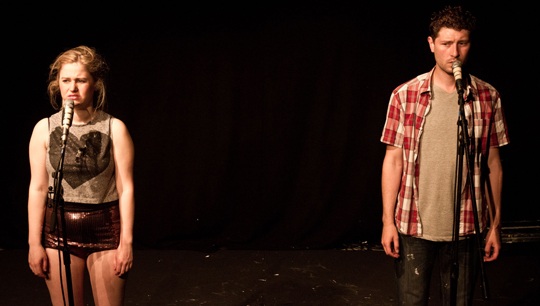
Such fragments of personality are revealed through overlapping monologues spoken into microphones at opposite sides of the stage, an initially static set-up by director Cheryl Gallacher that gradually unravels into a frenetic reflection of the characters’ escalating intoxication. Performers Cary Crankson and Ria Zmitrowicz weave and stumble around the small space, making convincing and disarming drunks, yet tempering the humour with a poignant strain of vulnerability. The laughs, of which there are many, have a habit of souring in the mouth.

It is a piece that feels very much of the now, offering grim reality but few solutions. Barnes’ lyrical yet gritty language crystallises the brief euphoria and crashing despair of a whole swathe of young people emerging into a world that seems not to want them, with references to useless master’s degrees and the lie of an Olympic “legacy” that delivers very little opportunity. In a telling touch, we are told that the local church has been converted into a bar – home of the new religion. As Joe and Kirsty argue, with the way things are, you “might as well just get fucked”.

Photo: Jassy Earl

Bitch Boxer, Underbelly

bitch-boxer-edinburgh-review_540_306_Crop

Originally written for IdeasTap.

Every fighter has a reason.

That’s the thinking behind this new show written and performed by Charlotte Josephine, taking a particularly timely dive into the world of female boxing. Chloe has wanted to fight ever since a family betrayal fractured her world, but in the lead up to the London 2012 Olympics – the first Games in which women can compete in boxing – two events once again shift the ground beneath her, tripping her footwork.

With a rough sort of poetry, pounded out to the rhythm of punches, Josephine offers us a glimpse into Chloe’s chalk-outlined world. This is more about the individual at its heart than the sport in which she competes, but boxing forms a constant background drumbeat and a language through which to understand life. For Chloe, romance is a winding “sucker-punch of love”, an emotion, like grief, that she can only understand in terms of a knockout blow. Emotion, in this male-dominated world, feels like a weakness.

Beneath the fighting mentality that permeates Chloe’s character, however, there is something surprisingly tender and charming about this piece. Much of that charm radiates from Josephine herself, who somehow makes an activity inherently reliant on two parties – red corner and blue corner – work as a solo show. Hopping from toe to toe and pacing restlessly around the space, she rarely loses the coiled physicality of the boxer, but she also melts into moments of sudden, startling softness; reading a note from boyfriend Jamie, or smiling at a memory.

The other surprise of the show is its humour. From miming deadpan to Eminem, to a gag about Tesco that will never let you read the slogan “every little helps” in quite the same way again, the piece packs as many laughs as it does punches. Ultimately Bitch Boxer is, like the odd affection inspired by real boxing champion Nicola Adams, a reminder of the very human side of a sport often characterised by aggression. For all that the fighting thrills, it is the moment when a closed fist unfurls into an open hand that is the most compelling.

Photo: Jassy Earl

Puppet. Book of Splendor, Summerhall

Originally written for Exeunt.

The title of neTTheatre’s hypnotic physical theatre show is a little misleading. There is, throughout this compelling hour and twenty minutes, a distinct scarcity of puppets. Instead, channelling the work of Tadeusz Kantor and excavating dense Jewish scripture, this is a non-linear, disorientating journey through the realms of life and death. Viewing the human condition through the lens of cabalism, director Pawel Passini’s creation is a contorted compendium of dreams, desires and nightmares, as captivating as it is bewildering.

We are given a road map of sorts, a projected schema studded with words such as “beauty”, “justice” and “understanding”, through which the performance can be refracted but never quite clearly seen. This, we are warned, is to be expected. In one of several deft nods to the artifice of theatre, the knowing voice of the director cuts in to tell the audience that we will probably struggle to follow what we are about to see and that we might not enjoy it; this is “sit down tragedy”, not “stand up comedy”.

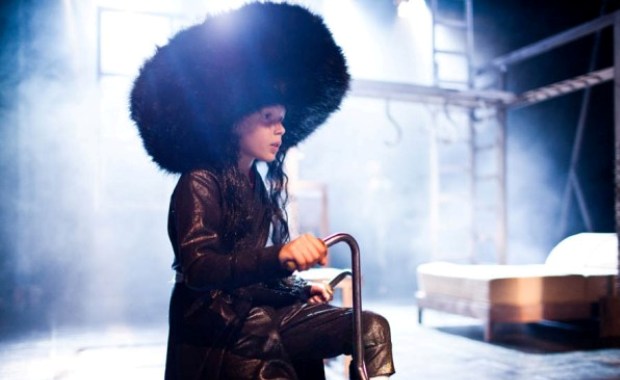
The piece, however, is as visual as it is intellectual. Rich and sometimes ridiculous images compete for attention, from dreamlike projections to a host of angels in white wigs and hipster glasses. In the midst of Passini’s assault on the eyes, it is the alternately graceful and vicious physicality of neTTheatre’s performers that captures the gaze. A man and woman, cast as Adam and Eve figures, move fluidly as one body, arms hemmed together inside the same shirt; another woman spits the Hebrew alphabet, the letters bodily wrenched from her diaphragm as her torso spasms.

The screaming succession of startling images summons questions, tumbling feverishly one after another. Who is the silent artist figure, seeming to paint the world into creation around him? What is reality and what is dreamed? Does the gaping emptiness of a figure made from clothes – one of the production’s few instances of puppetry – suggest that God too is just a void clothed in empty faith?

Questions, however, are deflected by both text and performance. We are told that “to know is to pose questions”; questions breed questions in the same way as Passini’s baffling imagery, with none of those insistent “why’s” bringing us any closer to understanding or satisfaction. The answers that we seek are repeatedly evaded. In this way, neTTheatre grasp us by the hand and roughly guide us to the relinquishing of linear logic that is required to experience their performance as intended – as an experience.

And as an experience it is exhilarating and exhausting. There is perhaps too much going on, certainly too much to fully absorb both the surtitles and the stage language, but this seems to be the point. A fraction of enlightenment is all that we can hope for. But understanding is not everything. As a Rabbi in the show says of the young daughter who insists on reading from cabalist teachings, “she understands nothing, but it pleases me”.