The Body of an American, Gate Theatre

body1-600x399

At the time I saw Chimerica last year, I found myself preoccupied with the idea of the photographic image. A play that promised – in its very title, no less – to be about the relationship between China and America struck me as having many more interesting things to say about the nature of the image and the knotty ethics of photojournalism. Not long after, I read both Susan Sontag’s essays on photography and Vivienne Franzmann’s 2012 play The Witness, which also folds its dramatic possibilities outwards from an image taken in the midst of violence. All ask interconnected questions. What is the currency – both economic and political – of images? What does it mean to bear witness? And is to observe to also and inevitably turn away from intervention?

Repeating those questions, The Body of an American might now be added to Chimerica and The Witness to form a fascinating trio of twenty-first-century plays with photojournalists at their hearts. Like the other two shows, Dan O’Brien’s tense, muscular play is concerned with the haunting legacy of a famous image – as well as much else besides. Taking as its starting point the long email correspondence between the playwright and his subject, Canadian photojournalist Paul Watson, the play painfully dissects the psychological damage of Watson’s work and the personal demons of both men. While there’s certainly something to be written about the relationship between this, Chimerica and The Witness (and indeed the renewed interest that might have provoked all three plays), The Body of an American alone offers so much to process that it feels necessary to narrow the lens for the time being. So where to start?

There is, first of all, an intriguing relationship with authenticity that is persistently pointed to by the Gate’s production. Even before the performance begins, The Body of an American prompts us to engage with questions of veracity. On filing into the claustrophobic, snow-lined bunker that designer Alex Lowde has constructed inside the Gate’s already intimate theatre, our attention is immediately drawn to the two screens bookending the space, both projected with the same statement that everything we are about to see and hear was produced or captured by O’Brien or Watson. At the outset, the show very deliberately announces both its truth and the vantage points from which that truth is to be told.

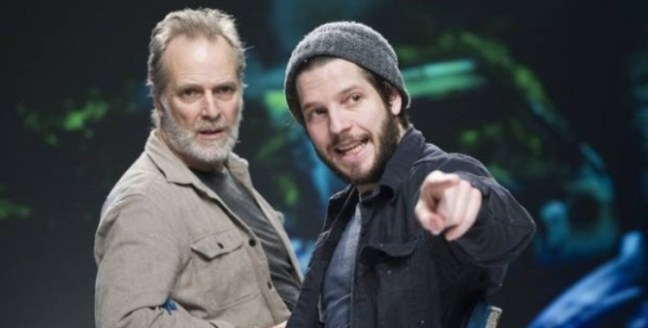
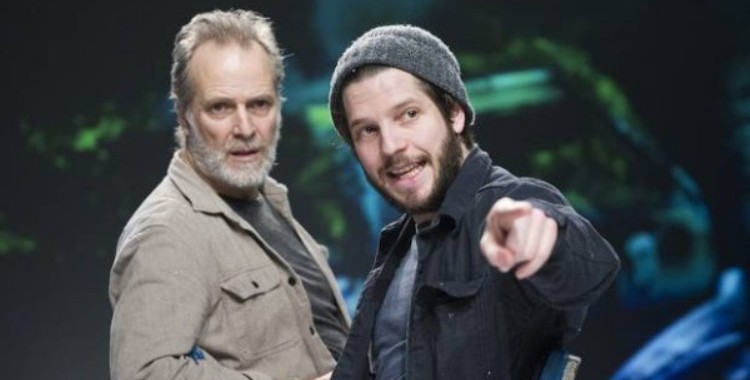
What becomes clear as the piece unfolds is that the play has been constructed from a combination of the two men’s words, drawing on their long email correspondence, their eventual meeting in the Arctic, and other documentary materials. This is all compellingly delivered by just two performers: William Gaminara as “Paul” and Damien Molony as “Dan”, with both also standing in as the large cast of supporting characters (although Gaminara and Molony effectively portray Watson and O’Brien respectively, they are of course distanced representations of real people, so let’s just assume the quotation marks from here on in). The Body of an American is, essentially, a verbatim show.

And yet O’Brien has sculpted his own form of documentary theatre from these many fragments. The story he originally wanted to tell was that of Watson, the Pulitzer Prize-winning photojournalist who has documented atrocities across the world. O’Brien was drawn to Watson while attempting to write a play about ghosts; Watson, the haunted man, became his new subject. What The Body of an American has turned into, however, is a play documenting the process of documentary theatre, jumping frenetically between emails, conversations, recordings and reflections. The text is lyrical but dense, its restless movement demanding total concentration from an audience.

As well as continually hopping about, the whole thing constantly gestures to its own construction, telling its audience as much about O’Brien’s efforts to write it as it does about the life of the man he has attempted to put on stage. In this way, The Body of an American deftly sidesteps the more problematic elements of verbatim theatre. Despite that initial declaration of authenticity – which I suspect is as much to train the audience’s minds on the idea of authenticity as it is to reassure us of the show’s truth – there is no question of obscuring the process of editing in an effort to pretend to absolute, unmediated truth. The play is, unapologetically, just one version of reality.

The same might be said, rather aptly, of a photograph. Photographic images purport to be snapshots of the truth, images of reality, but someone always has to frame them, to isolate that particular moment in time and decide that it is worth capturing. Paul’s words even refer to this. The most important photograph in the play is the one that sealed his success and his torment, both winning him the Pulitzer Prize and haunting him for life. In the moment of taking the infamous image, which shows a US soldier’s battered corpse on a street in Mogadishu, he talks about framing it better, about getting the right shot. Part of what tortures Paul throughout, perhaps, is the disconnect between the truth he endlessly seeks and the artificiality of how he tries to capture it.

For all that the show’s content is dark, disturbing and infected with a pervasive sense of melancholy, James Dacre’s production delivers this difficult material with a sharp kick of adrenaline. The pace rattles furiously along, sweeping its audience up in the same addictive thrill that keeps Paul doing what he does. In this way, the production is very good at complicatedly recognising both the compulsive excitement of Paul’s work and the gnawing depression that is, the piece implies, both a symptom and a cause of his chosen career. As the show goes on, it becomes increasingly clear that the same deadening sorrow eats away at Dan; there are moments when a chilling, identical look of desolation pours out of both Gaminara’s and Molony’s eyes.

As much as anything, it occurs to me about halfway through, The Body of an American is about relationships between men. The strange yet moving central friendship between Dan and Paul is the most obvious of these, but their respective relationships with the men in their families loom large, as does Paul’s unbreakable link with the ghost of the man he ironically immortalised. It is often the damage of these male relationships that binds Dan and Paul closer together, linked by their common losses and their struggle with normative ideas of masculinity. In their depression, their loneliness and their retreat from society, the two men seem more and more alike; two broken individuals in a broken world.

On reflection, it strikes me that the photojournalists in Chimerica and The Witness are also male – perhaps not without reason. All three photojournalists, real and fictional, are observing from a position of white male privilege; their gaze is especially problematic because of the troubling power balance between watcher and watched. In his review, Andrew Haydon brilliantly articulates the significance of choice in the situations depicted by the play, which he argues is a central characteristic of privilege itself. The privileged choose to look on wars and atrocities, to seek them out and capture them for the eyes of people living on the other side of the world. Those caught up in the midst of conflict or disaster simply have nowhere else to look.

The tight, intelligent layout of Dacre’s production also makes an audience’s gaze loaded. Those all-important screens at either end of the performance space play host to projections throughout the show, showing harrowing selections from Paul’s back catalogue of warzone horrors. Because of their positioning, these images never directly confront us, meaning that – like Paul – we have to very deliberately look if we want to comprehend the images in question. Though, actually, this isn’t quite true. There is a choice involved in looking at the photographs full-on, in all their horror, but the haunting fact of their presence is unavoidable, flickering away at the peripheries of our vision. Like the tightly packed ideas in the play, they dance around the edges, framing the electrifying action at the centre of the piece.

As well as the obvious comparisons to be made with Chimerica and The Witness, Andrew links The Body of an American with Grounded, another Gate show that was equally electric, equally intelligent and equally concerned with America. I’d argue that it also demands to be considered alongside No Place to Go, the third production in a season that the theatre pointedly framed with ideas of work and modern American identity. Despite their differences (and No Place to Go is in most respects very different to the other two productions), what I found myself taking away from all three shows was their deep sense of loss – a loss often stained with bitter disillusionment. Which, taken as a collective statement, seems to say a lot about the USA, our external perspective on it and the modern world more widely. A grim image indeed.

P.S. I will, one day, write the essay I have simmering away about photography, photojournalism and the ethics of the image in The Body of an American, Chimerica and The Witness …

Photo: Tristram Kenton.

Purple Heart, Gate Theatre

Purple-Heart-600x400

Originally written for Exeunt.

It’s no accident that in the taut domestic space of Bruce Norris’ play the clocks are being turned back. First produced in Chicago in 2002, the piece rubs at one of the sorest wounds of recent American history – the Vietnam War – in the aftermath of another that is only just beginning to scab over. Now receiving its UK premiere at the Gate Theatre, it’s impossible not to read this searing acid burn of a play through the lens of conflicts sparked by 9/11, implicitly asking the unsettling question of whether the world is simply caught in a relentless cycle of rewind and replay.

While Vietnam is the scar that Purple Heart concerns itself with, its approach is a glancing one. In a Midwest living room in 1972, a setting realised with gaping spaces at either side that might as well be the holes blasted by loss, Carla is agonisingly caught in the process of grieving for a violent, unfaithful husband. Suffocated by condolences and stuffed with sympathetic casseroles, her strained relationships with attention starved twelve-year-old son Thor and overbearing mother-in-law Grace are shown at breaking point when soldier Purdy breaks unexpectedly into this poisonous space. It’s a classic, almost clichéd dramatic device furnished with freshly sharpened claws, tearing through the fraying fabric of the family’s worn out existence.

Not unlike the mysterious intruder in early Pinter plays, Purdy is a figure half-explained and oddly, indefinably sinister. Trevor White lends this stranger an almost disturbing stillness, an upright, static quality that is physically at odds with Amelia Lowdell’s restless, frenetic, maniacally laughing Carla. As startlingly candid dialogue bounces sharply between the pair, there is a marked rupture to the naturalism of the piece, an almost painful heightening of the situation until it reaches the piercing pitch of Grace’s faulty hearing aid battery. Acerbically funny and flooded with an acute sense of the ridiculous, the believability of the scenario – a visit from a soldier who met Carla in a military hospital and who may or may not have been friends with her late husband – is less important than its grim power to compel.

The world that Christopher Haydon’s production wrenches us into is one of laughs gulped down with horror, of love mashed up with violence and kids enraptured by stories of torture and aggression. It’s important, though, that the worst is never seen and even its spoken references are spare; structured in this way, the Vietnam War is a constant, queasy backdrop, like the patterned yellow wallpaper pasted on the walls of Carla’s suburban prison. Within this retrospective frame, the specific conflict in question, like the desperate relations of these characters, is only symptomatic of a wider, never fully specified sickness.

Intelligently framed, too, is Simon Kenny’s canny design for the small space of the Gate, placing the audience in banks on either side of the family’s dissected living room. This configuration forces us to look quite literally through the play and see ourselves almost mirrored on the other side; a reflection, perhaps, of an ugliness that Norris’ broken characters fail to submerge. It is this penetrating ugliness, despite an occasional heavy-handedness in the approach, that ensures its unrelenting assault pummels audience as much as characters. It may be grimacingly entertaining, but it is never easy to watch.

Photo: Hugo Glendinning

The Trojan Women, Gate Theatre

Originally written for Exeunt.

The king is dead, Troy is burning and the “crème de la femme” of the city are imprisoned in the maternity ward of the hospital, awaiting their fate amid teddy bears and pill bottles. The chorus screams while the gods cackle through mounted television monitors, peering down at the anguished humans with hand-rubbing glee. The Gate Theatre’s bold, visceral new realisation of the fall of Troy and the long tumble from grace to which its female inhabitants are subjected is certainly not a tragedy given to moderation.

Caroline Bird’s thrilling, muscular adaptation of Euripides is, as Poseidon sneers down from his distant Olympus, “an artistic impression” of Troy – a contemporary riff on tales indelibly impressed on the collective cultural memory. This allows for an implicit critique of the way such wars and massacres are historicised; an arch, glancing appraisal of the passing of stories from mouth to mouth. “Am I a poem?” asks Lucy Ellinson’s compelling one-woman chorus, begging the question of how individuals are memorialised, be it by Homer or Euripides or the modern media. It is a question that is as relevant to the depiction of perceived “victims” in present day conflicts as it is to the reading of ancient literature.

And Bird certainly isn’t shy about underlining Troy’s contemporary resonances, as she and director Christopher Haydon wrench Euripides’ characters out of the ancient world and into an unspecified modern realm. This Troy may still have gods in the form of Roger Lloyd Pack and Tamsin Greig’s pre-recorded deities, but it also has smartphones, machine guns and anti-monarchy blogs. This tension between ancient faith and modern secularism emerges repeatedly throughout the piece, with the fickle and malicious gods worshipped by the Greeks and Trojans becoming an apt reference point for the shifting, false idols of our age.

Just as the chorus, cannily pared down to Ellinson’s pregnant woman of the people, wonders whether she is merely “the idea of woman”, this interpretation also feels its way around what it means to be a woman caught in the conflict of motherlands. Louise Brealey’s dazzling, chameleonic portrayal of three of Troy’s pivotal female figures – Cassandra, Andromache and Helen – functions to illustrate three different facets of how women have been painted in the Troy legend: as hysterics, helpless victims and temptresses. The clinical surroundings of Jason Southgate’s striking design, meanwhile, define these women through the role of motherhood, mocking them with the hope of offspring that will be ripped from their breasts while childish paraphernalia laughs down from the walls.

But for all its brutally poetic language, searching interpretation and sheer winding power, there is something that grates a little within this reimagining. Rather than teasing out timeless threads from Euripides’ tragedy and applying these to our current predicament, Bird’s adaptation grasps and rips with both hands. As a result, the stubbornly imposed contemporary parallels, such as Talthybius’ use of Western democracy’s rhetoric to justify the Greek invasion of Troy, sit somewhat disjointedly with the Classical references preserved from Euripides. Meanwhile, the pointedly modern gadgets and glib, incongruous video sequences – as predictably enjoyable as Lloyd Pack and Greig’s performances are – have a touch of smugness that threatens to blunt the potency of the whole.

Heavy-handed as it may be, however, it’s hard not to be enthralled by the antiseptic horror and devastatingly intense performances. There is also something profoundly timely in Troy’s excess and destruction that speaks louder than all of the grinningly placed modern references. As the doomed spires of Ilium look more and more like the towering skyscrapers of late capitalism, perhaps this fresh, harrowing vision of Troy is a Cassandra for our times.

Tenet, Gate Theatre

Originally written for Spoonfed.

Greyscale’s latest work, the first in the Gate’s ‘Resist!’ season, comes with a tongue-twisting disclaimer. This is, as we are told upon entering the auditorium, “a very true story about the revolutionary politics of telling the truth about truth as edited by someone who is not Julian Assange in any literal sense”. If that’s a mouthful, then what we are fed after we take our seats is even harder to digest.

Intertwining the lives of Wikileaks founder Assange and revolutionary nineteenth-century mathematician Evariste Galois, Tenet plays with truth, mathematics, radicalism, power, metaphor, roots and polynomial equations. Keeping up?

At the centre of the piece is the concept of mathematical logic as a radical way of seeing the world. Performers Lucy Ellinson and Jon Foster begin with a familiar mathematical question – how do you find x? – and use this as the basis for questioning our understanding of truth and of the world around us. Like radical genius Galois, we are prodded into finding a new way of thinking. In maths, as arguably in life, the radical simplifies a complex equation; radical thinking, therefore, is demanded if we are to understand and challenge the complicated nature of the status quo. Behind this there is also the issue of Assange’s role as the “editor” of Galois’ life and work, questioning the power and reliability of those who hold the book of facts.

There is a lot going on here, sometimes too much. Despite running at a swift sixty minutes, this is full to the brim with ideas, and difficult ideas at that. As our heads swim with numbers and concepts, it can feel like we, along with the tragically short-lived Galois, are running out of time to work it all out. Fortunately, creators Lorne Campbell and Sandy Grierson never make this feel too much like the classroom; as Ellinson knowingly comments, you can’t make the audience work that hard.

Despite the demanding subject matter, the piece that Campbell and Grierson have assembled is also very funny, and when it gets too hard there are always tea and biscuits helpfully on hand. Maths and theatre, meanwhile, make unlikely but surprisingly comfortable bedfellows. After all, the metaphor that we willingly immerse ourselves in when we watch a performance is just another kind of equation – one thing always stands for another.

The conventions of theatre are also up for analysis in a performance that is sardonically served with a “soupçon of post-modern deconstruction”; we are presented with a set within a set within a set, the performers interrupt the narrative to contradict one another, an explicitly mentioned fourth wall is conjured up and smashed down.

Upon exiting Greyscale’s world, there is a desire to echo Galois’ call for more time and rewind this tightly packed performance in order to mull it over again in all its intricate complexity. Maths may be a straightforward case of black and white, but this intriguing, challenging night of theatre treads the same area of grey occupied by the company responsible for creating it.

~

Some further thoughts on Tenet

Never does the vicious word count seem more cruel than when attempting to crystallize a piece such as Tenet. During the hour-long performance, I scribbled possibly the most notes I have ever made at the theatre, all the while trying to keep my eyes ahead so as not to miss one minute of the ever-shifting performance. I feel as though I really needed two viewings to fully process everything that was going on – one to take notes and one to simply absorb. Away from the rush and heat of the performance space, my initial impressions have cooled, but there are still a good few more words to peel away from my frazzled brain.

Firstly, I want to write more about Julian Assange’s role as the “editor” of the piece. If we’re getting critical, this is slightly underexplored, but that is perhaps because there is simply so much else going on. Since formulating my own thoughts above, I’ve read other reviews of the play, some of which see Assange as an outlying narrator whose relevance is crowbarred in. While Assange may be less of a central figure than Galois, this was not how I saw it at all. If anything, he functions as an essential conduit for Galois’ story; we see only what he chooses to select from his “book of facts”, further illustrating the reiterated point that knowledge is power. As an individual who demonstrated to the extremes just how powerful knowledge can be and whose actions prompt troubling questions about what knowledge should and should not be released, Assange’s inclusion is anything but arbitrary.

Lucy Ellinson’s Assange protests early on “I am not involvable”, before proceeding to involve himself again and again in the process of storytelling. The two performers frequently interrupt and contradict one another, their voices competing for our attention, Assange overwriting Galois’ own story. It is a potent demonstration before our eyes of the immense influence held by the gatekeepers of history. Who are we meant to believe? What can we trust? For me, Tenet was not only deliciously perplexing because of the complexities of advanced algebra (and maths was never my strong point); Greyscale invite complexity and ambiguity from all angles, a risky but laudable choice. This is theatre which demands engagement from its audience.

Which conveniently brings me onto the second point I wanted to explore further: audience interaction. This has to be possibly the gentlest brand of interactivity to be found on London’s stages – one game audience member was even offered an encouraging hug on press night. With the help of some tea and biscuits, Greyscale seem to have perfected the delicate balance of involving their audience without scaring them off. Yet while the level of performance asked of the audience is relatively minimal, its use prompts intriguing questions about the performer/spectator relationship, the audience dynamic and the wider issue of public protest.

At one point, Jon Foster’s frantic Galois raises us all to our feet, gets us to hold hands and has us collectively, if a little awkwardly, humming “La Marseillaise”. It is a vivid illustration of the power inherent in harnessing an audience. But a moment later we are back in our seats and the balance has shifted back once again to where it was, demonstrating that the wall can be smashed through but it will always quietly reform – a fact that resonates with politics as much as with theatre. As Galois observes, a situation can change, but it can also change back. In another interesting choice, Ellinson and Foster also openly discuss the deliberate choice of the Gate and its typical audience demographic, which opens up a whole other debate about the importance of the type of audience (and their political leanings) to a piece of theatre.

Without seeing this piece all over again, which I’m sorely tempted to do, it is impossible to fully investigate Greyscale’s creation to the level it deserves. Part of my brain is still trying to catch up. Perhaps the best sort of metaphor for Tenet is not an algebraic one but, inspired by the emergency biscuits, a dessert related one. Because really Greyscale’s play is a lot like brain freeze; it makes the head hurt, but it’s more than worth the pain.