The Wolf from the Door, Royal Court

700x650.fit_2-600x399

Originally written for Exeunt.

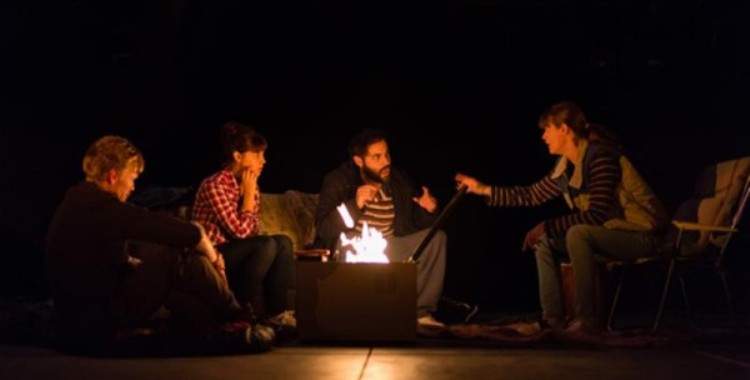
Middle England is revolting. Flower arrangers are building bombs, the Morris dancers have their axes at the ready and the village choir are armed with AK47s. In Rory Mullarkey’s new play, violent overthrow is instigated not on city streets but in provincial church halls. Unlike the urban unrest that Alecky Blythe has attempted to capture over at the Almeida, the Royal Court is staging an altogether more parochial brand of revolution.

On the surface, this vision of OAPs raiding Buckingham Palace and pub quizzers razing the City of London to the ground is deliciously absurd. The idea that cosy rural villages are brimming with hidden discontent is not necessarily new, but there’s still plenty of comic mileage in revealing the violent predilections of hobbyists preparing for armed insurrection. Beneath that very English humour of incongruity, however, is a much trickier play.

At the close of Men in the Cities, Chris Goode poses the implicit, troubling question of whether now is the time for violence. Whether it’s even a question is debateable, but certainly the possibility of violence is powerfully present in the final sequence. Or, in Goode’s words, “fuck ‘em”. Mullarkey’s play imagines that violence into reality, but in ways that vividly, surreally animate its complications. Must a two finger salute to the state be accompanied by machine gun fire?

Lady Catherine, the steely aristocrat spearheading the revolution dreamed up by Mullarkey, certainly thinks so. “This is the only way to start again,” she insists, briskly preparing to smash apart her own privilege. The ever-extraordinary Anna Chancellor inhabits the role as only she can, somehow blending cool, wry disdain with an incendiary – yet always dignified – passion for radical change.

The play follows Catherine and Leo, her rootless young protégé, as they spark the uprising from coffee mornings, supermarkets and roadside cafes, sending out a flare to community groups across the country. Lady Catherine advocates “the beautiful violence which brings change”, but with seemingly little thought as to what that change might actually be. Equality is the one certainty; everything else is a bit woolly.

This vagueness about the new order is just one of the many facets of Mullarkey’s revolutionary vision that make it far more interesting and problematic than it initially appears. This is no straightforward rebellion. Aside from the absurdity of a-capella groups and historical re-enactors tearing down the halls of government, there is something complicatedly ironic about a society brought down from the top. For all the distrust of hierarchy, it is still the toffs who lead the way.

The leader who is to be installed when these revolutionary elites honourably allow themselves to be liquidated, meanwhile, is an intriguingly blank slate. Leo, a naive yet mysterious figure as played by Calvin Demba, has no job, no home, no family. And like the elusive Messiah figure at the heart of Mike Bartlett’s 13, whose only belief is belief, he is remarkably empty of opinions. This unlikely, semi-Biblical saviour, paired with the surprising source of the play’s revolutionary fervour, seems almost to skewer the whole possibility of violent overthrow.

To complicate matters further, ambivalence around revolutionary violence is built right into the theatrical framework of James Macdonald’s production. Not so much as a drop of blood is spilled on stage all evening, as visceral brutality is replaced with the cool, distanced reading of stage directions (“he chops his head off”; “she shoots her in the head”). In a theatre with such a history of represented violence, it’s a curious choice, and one that immediately raises a question mark over the use of force. It also begs questions of the whole practice of representation on stage, not quite taking a torch to theatrical convention but certainly tearing away at some of its illusions.

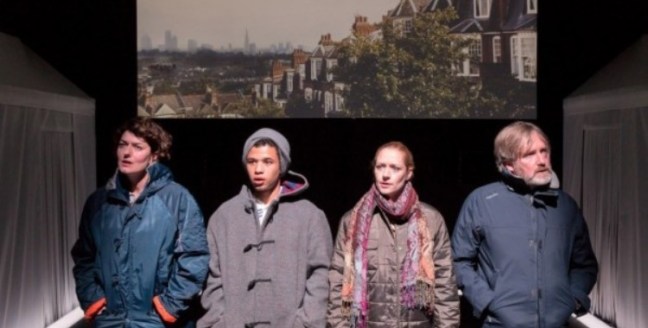
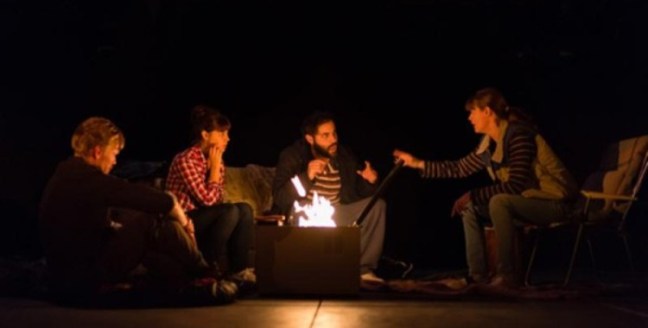
Tom Pye’s design is similarly multi-layered and self-aware. There’s a feeling of the community hall about the green plastic chairs and fold-up tables that stand in for all of the play’s locations, flanked by village fete-style white marquees in place of wings. It all beautifully sends up the bunting festooned “Keep Calm and Carry On” aesthetic, without ever being too smug about it. I’m less convinced, however, by the large screen at the back of the stage, onto which is projected scene numbers and images to indicate the setting at any given time. It adds to both the strangeness and constructedness of the drama, but to uncertain effect.

Uncertainty is a lingering sensation throughout The Wolf from the Door. Take the relationship between Catherine and Leo. At one level, their dynamic embeds a crucial question about the efficacy of individual care and action versus the greater ambitions of ideological and systemic change. Or, to put it another way, what use is revolution without compassion? But this central pairing is also trying to do something else, culminating in a lacklustre and surprisingly sentimental couple of closing scenes which frustratingly undercut much of what has gone before.

For all its wonkiness, however, there’s something compelling and oddly galvanising about this peculiar allegorical drama. It also features some truly stunning scenes, the standout among these being a one-sided exchange between a mini-cab driver and passengers Catherine and Leo, which is a blackly comic combination of the mundane and Beckettian. From the bleak patter of the writing to the precise rhythms of Pearce Quigley’s delivery, it is exquisitely excruciating. And perhaps it’s here, in presenting the indignity of this everyday despair, that the play’s real politics reside.

Photo: Stephen Cummiskey.
Stories About Stories

Mr-Burns-2-resized-for-web-by-Manuel-Harlan-600x399

Originally written for Exeunt.

In my first year of studying English at university, we were all enrolled on a course titled ‘Literary Transformations’. The blurb on the website mentioned the story of Troy, literary tradition, The Iliad, mediaeval literature. I was less than enthusiastic. In the end, it turned out to be one of the best courses I took in three years of my undergraduate degree. Because actually, more than any of those things on the website, it was about the ways in which we tell and retell stories.

I was reminded of that course twice recently at the theatre. The first occasion was during Mr Burns, which over the course of 80 odd years in the wake of an imagined global catastrophe mutates an episode of The Simpsons through a similar series of transformations to that undergone by the Troy legend. The second was at Idomeneus, a playful exploration of the fate of the eponymous Cretan king after travelling back from war in Troy. And in between I saw Adler & Gibb, a piece about narrative appropriation of an altogether more disturbing character.

These shows are all stories about stories about stories; stories that are at once about the centrality, instability and dangers of narrative. We need stories, but stories can curdle and corrupt just as easily as they can comfort.

Much of the critical response to Mr Burns has fastened on playwright Anne Washburn’s use of The Simpsons as the cultural foundation of a fledgling new human civilization. Some shook their heads at the thought that pop culture would survive over great literature, while others suggested that an intimate knowledge of the television show was required to appreciate the play. There is a certain cultural snobbery to these criticisms, as Mark Lawson has pointed out, but they also miss the point spectacularly.

The reason The Simpsons works so brilliantly as the focal point of Washburn’s game of post-apocalyptic Chinese whispers is because it is already a gleeful mash-up of different cultural references. The Cape Feare episode that gets retold in each act (first as campfire tale, then as primitive performance, and finally as a gloriously gaudy opera) is a parody of the Robert De Niro film Cape Fear – which was itself a remake of an earlier film – and also contains allusions to numerous other sources. What better starting point to demonstrate how humans recycle and repurpose culture? There is also the suggestion that our cultural inheritance is as much a product of mistake and reiteration as anything else – a troubling thought for some, perhaps, but also a liberating one. Suddenly the behemoths of high culture look a little less indestructible.

For evidence that this habit of narrative borrowing and transformation is as old as the idea of civilization itself, just swap one Homer for another. The story of Troy that we see a partial glimpse of in The Iliad and that has filtered down through Western culture over thousands of years in countless different forms is perhaps one of the most mutable myths we have. In its intelligent, multi-layered retelling of one small facet of this myth, Idomeneus – both Roland Schimmelpfennig’s script and Ellen McDougall’s playful production – is sensitively attuned to the processes by which stories become solidified and then dissolved again into countless possibilities.

As realised by McDougall, the whole thing is an inventive modern riff on the Chorus of Greek tragedy. A collection of awkward, displaced strangers wander onto the stage and begin to tell us about Idomeneus, a Cretan king and general who has been away for years fighting the Trojans and has made a terrible bargain to ensure his safe homecoming. But where tragedy usually presents us with fate and inevitability, here the story is told in all its shaky contingencies, pausing and rewinding to offer an audience all of its possible permutations. This is no longer one story, but many, the once firm outlines blurred over the centuries. And now, Idomeneus appealingly implies, we have the choice to tell it how we like; we can change the outcome.

But there is a darker side to the playful, potentially democratising stories of Mr Burns andIdomeneus. In the recovering society of Washburn’s ravaged near future, an embryonic form of capitalism is driven by the desire for stories. Half-remembered lines of old television episodes become commodities to buy and sell, while competition between storytellers is cutthroat. And there is an even more crucial way (only lightly touched upon by Mr Burns) in which the stories that provide the foundation for a new civilization can shape what that civilization eventually becomes – for good and for bad.

The danger circling the multiple stories of Idomeneus is more elusive, only occasionally glinting beneath the grins and giggles of its mischievous players. Violence – conveyed in striking visual metaphors of water, ink and chalk – always sits just underneath the narrative, insistently saying something about how we tell stories of conflict. There is an implicit comment on the insidious ability of stories like this to rile and rouse, with their undercurrents of glory, honour and destiny – an ability that is unsettled, but remains exposed.

In Adler & Gibb, which is much more critical of our storytelling strategies than either Mr Burns or Idomeneus, narrative is both a tool for manipulation and a commodity to be traded. Tim Crouch’s knottily self-referential play shows us a pair of actors representing (at first cursorily, and then increasingly naturalistically) another actor and her coach, who are preparing to make a film about a fictional pair of contemporary artists, the eponymous Adler and Gibb. Supposedly on the hunt for authenticity, they break into the house shared by the two artists in their later years, only to be confronted by an ageing Gibb. This is all framed by another story in another time, as a nervy student delivers a presentation on the lives and work of the artists. Got that?

Throughout the show, Crouch repeatedly aims his fire at the ways in which artworks and the stories surrounding them are commodified by a fiercely acquisitive capitalist economy. Scorn is poured on the art dealers, critics, journalists, filmmakers and obsessive fans who all want a bit of Adler and Gibb – not just their work, but them as individuals, or at least the romanticised story that has been cultivated around them. Everybody wants a scrap of the myth.

There is also an important comment on the shapes that our stories take. Extending the focus on theatrical form that has characterised all of his work with co-directors Andy Smith and Karl James, Crouch needles once again at representation. Throughout the first half, dialogue is directed blankly out at the audience, while two young children disrupt the workings of the theatrical machine, standing in for various elements of the narrative and substituting props – a spade for an inflatable bat or a gun for a lobster (one of many sly nods to modern art). From this base, the piece moves progressively through realism towards a kind of Hollywood hyperreality, asking difficult, brow-furrowing questions about our artistic efforts towards “truth” and “authenticity”.

In one of the show’s crucial moments, we see a screen wheeled onto the stage and witness the first kiss between Adler and Gibb cruelly snatched for the sake of cinema – or, as the actor would insist, art. “Is this the way you want your stories?” Crouch finally seems to ask, as we watch brutality in the flesh morph into high definition passion on the screen. And the answer, uncomfortably, is “well, yes”. The high stakes drama and hyperreal film that emerge in the second half of the evening are far more gripping than the cool, distanced intellectualism of the first – a high risk but brilliant strategy from Crouch, Smith and James. If we stick out the frustration of the opening scenes, we get our pay off, but at a mind-twisting price.

In all of these stories about stories, there is a further comment to make about the presence or absence of irony – one of the most familiar characteristics of the way in which we mould our narratives in the 21st century. In his chapter in Vicky Angelaki’s excellent collection Contemporary British Theatre: Breaking New Ground, Dan Rebellato intriguingly suggests that a “turning away from irony” characterises a certain strand of British drama in recent years, pointing to examples such as Mike Bartlett’s Earthquakes in London and the work of Simon Stephens. He argues that in these plays, irony has been replaced with “a self-consciously naive sincerity”, or “radical naivety”.

While the cultural bricolage of Mr Burns might share many traits with postmodernism, what struck me about the play’s central retellings was their sincerity. Here are a group of survivors, completely without irony, piecing their world back together through the recovery of pop culture. Even the final act, with its knowing blend of references, is played remarkably straight. Irony is not exactly removed from Idomeneus, but again there is often a startling sincerity in the possibilities that the performers put forward for the characters whose story they are telling. And while it is difficult to know what to grasp onto in Crouch’s slippery play, the postmodern irony that suffuses so much contemporary art is given a ribbing at the same time as its strategies are appealingly deployed, leaving it in a problematic place. In these stories, are we turning, finally, to a new mode of sincerity?

Taken together, what these three pieces of theatre amount to is an ambivalent affirmation of storytelling. Ambivalent because stories emerge as slippery, dangerous things, as capable of betrayal as redemption. Affirmation because their very existence performs once again the importance of stories to human culture and their inherent possibility. Perhaps it’s all in the telling.

Photo: Manuel Harlan.

Tim Crouch

Adler&Gibb_reh_photoRichardHubertSmith-2252

Originally written for The Stage.

There is something satisfyingly cyclical about Tim Crouch’s work. The theatre-maker’s first play, My Arm, explored ideas about representation and realism through the unlikely story of a boy who raises his arm above his head and refuses to take it down. Throughout the course of the play, this pointless act becomes a source of global fascination, captivating the contemporary art scene.

Now Crouch’s new play for the Royal Court, Adler & Gibb, uses a narrative about Hollywood movie-making to return to similar preoccupations. In it, an actress preparing to play a famed conceptual artist goes to terrifying lengths to achieve authenticity in her portrayal, asking implicit questions about art, acting and appropriation. It is, Crouch suggests, “a very much bigger and more complex version of My Arm”.

Reflecting on the shows he has made over the last ten years, Crouch describes My Arm as the “mothership” of everything that followed. The play emerged as a result of the frustrations that Crouch had felt over several years as a jobbing actor – frustrations both with the mechanisms of the industry and with what he saw as accepted theatrical form. Writing My Arm in his late 30s was, he recalls, a “last ditch attempt” to rekindle his passion for performance.

After graduating from Bristol University, Crouch began his career as a member of a devising cooperative in the city, which was the start of what he describes as “the most extraordinarily intense and wonderful and fulfilling time”. Struggling to find other work in his late 20s, however, Crouch pursued formal training at Central School of Speech and Drama. It was, he feels, a decision that the industry forced him into.

“You would go for auditions or interviews with the traditional sector and everything you had done, no matter how brilliantly creative it was, didn’t seem to have any currency in those interviews,” he remembers. “I would say that’s still the same now. There is a very marked career path and certain jobs or certain venues or certain directors have more points than other jobs and venues and directors, and so it feels like the deal is you get as many points as you can by working in this place or that place.”

As well as resisting this rigid and competitive culture, My Arm kicked back against the dominant form of psychological realism that had informed Crouch’s training. The play is written as a first person monologue, narrating events from the perspective of the character who fatefully decides to thrust his arm into the air. When Crouch performed the piece, however, his arms remained firmly at his sides, immediately challenging straightforward representation.

“I was interested in a different kind of reality,” Crouch explains. The show was also “a provocation to an audience to get involved more”. At the outset, audience members were asked to contribute personal items to the staging of the play, making explicit the necessity of their presence “to complete the experience”.

But while plays like My Arm might act as vehicles for sometimes complex ideas about theatre and the world, Crouch insists that they are absolutely rooted in story. “If I wanted to just ask questions about theatre and representation, I would become an academic,” he says. “I want to make theatre and I think theatre’s strength is narrative, a shared narrative, the passing of narrative. And so all of the pieces that I’ve made have been first and foremost about the story.”

Crouch describes his second show An Oak Tree, for instance, as “a little dance between form and narrative”, but one in which the narrative itself was vital. This show’s central formal device was the use of a different actor every night to perform the two-hander opposite Crouch without any prior knowledge of the play. Unmoored from their usual reference points, this second performer would flounder in the same way that the character, a man whose daughter has been killed in a car accident, is undone by his grief.

“I would want there to be a dialogue between form and content,” Crouch elaborates, pausing to note with a laugh that he sounds like a professor. “But in a very fleshy, pragmatic way, that’s what it is,” he goes on. “There are formal devices in all my plays that are only there because they deepen the telling of the story.”

In ENGLAND, the transplanting of theatre into a gallery space acted as a metaphor for the heart transplant that is central to the play’s narrative, while The Author engaged with its site in an altogether more controversial way. Commissioned for the Upstairs space at the Royal Court, the play was entirely contained within its audience. Performers sat amongst theatregoers in two banks of seating facing one another, and the events they described took place in audience members’ minds rather than on the stage.

“In The Author we are the audience as well, so their temperature is our temperature,” says Crouch of performing the piece. It was a show that pushed audiences into uncomfortable territory, alluding to the Royal Court’s history of shock and violence during the “in-yer-face” period of the 1990s and questioning the ethics of representation. Its disturbing subject matter and exposing focus on the audience provoked a startling range of reactions.

“At times in that show the audience took us to a really difficult place,” Crouch admits. “I had a physical threat in that show; people swearing, shouting, walking out.” This splitting of opinion, however, was encouraging to Crouch – “I’m excited when people either hate it or love it” – and reaffirmed his interest in active engagement with an audience.

“The audience is absolutely fundamental to my thinking,” he says. “They provoke and they incubate the form – they hatch the form”. Crouch is also keen to stress that “immaculate attention” was paid to the audience’s experience during the making of The Author; it was never about provoking for provocation’s sake. “But what you can never do as a theatre-maker is second guess what an audience is bringing to the theatre,” he adds. “By and large I try to keep things open, so it’s all interpretable.”

So central were the audience to The Author that people even began to mistake the title of the show. “A lot of people go ‘I saw your play The Audience’, and I go OK, right,” Crouch laughs. “I really like it when people forget or confuse what it was called, because it could easily be called The Audience. I suppose one of the suggestions in that play is that the audience is the author.”

Although The Author went on to tour elsewhere, it was always set at the Royal Court, intimately responding to the site of its commission and creating a fascinating “slippage between the location and the theatre”, as Crouch puts it. Adler & Gibb, which brings Crouch back to the Court, is less specifically grounded in the theatre’s history and location. While it is “absolutely written for a theatre”, the show speaks to ideas that are common to all theatre spaces: performance, representation, the blurring of truth and fiction.

When I speak to Crouch at the Royal Court, he is nearing the end of the first week of rehearsals. During the morning I spend with them, the cast are playfully exploring the relationships between their characters and with the audience, prodding at realist conventions while grappling with the challenges that Crouch’s script presents. One of these challenges is the onstage presence of two eight-year-old children, who are not characters in the play but remain present throughout.

“I’m excited about their formlessness,” Crouch tries to explain the thinking behind this surprising choice. He adds, in resistance to the instrumentalising of art as a form of education, that “art should be about unknowing something rather than knowing something”. Unlike their adult counterparts, Crouch argues that children are happy with “unknowing” and do not need realistic representation as a spur to their imaginations; “a child doesn’t need to exert anything to transform something into something else”.

It is in Adler & Gibb that Crouch’s recurring interrogation of realism reaches its zenith. At the same time as questioning realist representation in theatre, the new play is deeply interested in the medium of film, which Crouch describes as “the high tide mark of realism”. Recalling Hollywood actors’ lauded transformations into real people – think Meryl Streep’s Margaret Thatcher or Jamie Foxx’s Ray Charles – Adler & Gibb examines the “strange exertions towards reality” that cinema encourages and celebrates.

“It’s a political idea for me,” says Crouch, “in terms of that idea of acquisition; acquiring reality, trying to buy or own reality. And realism to some degree being an attempt to fix something and to own something, which I have a question about.”

Crouch also has a question about the idea of individual genius that this tendency enshrines. Although it happens on a bigger scale in Hollywood – as depicted in Adler & Gibb – Crouch sees it infecting the theatre industry as well, pointing to the recent example of Birdland at the Royal Court and the central attraction of leading actor Andrew Scott.

“It’s an amazing performance by Andrew Scott – what the fuck does that mean? To make a piece of work where we come away and go ‘that’s an amazing performance’ is kind of ignoring the fact that it’s only an amazing performance if it’s serving the piece of work that it’s in. The piece of work is the thing that we should be there for, because that’s the art form.”

Crouch goes on to suggest that “it’s like having a beautiful diamond on a rather dull canvas, and you just go ‘that’s an amazing diamond’, when actually the artist wants you to think about the whole canvas.” Instead, he says, individual theatre-makers “shouldn’t be thought of as geniuses, because it gets in the way of what the work is trying to do”.

For this reason, Crouch is keen to emphasise the close collaboration that has characterised his career as a theatre-maker. “I wouldn’t want anyone to come in going ‘I’m going to see a Tim Crouch show’,” he says. Although his name most frequently gets attached to the work, he is adamant that his shows are the product of collaborative processes, shaped by the input of the rest of the creative team.

“I’m lucky in that I have two very close allies and collaborators and sounding boards in Karl James and Andy Smith and that we have been talking about the work for a long time now,” Crouch tells me, referring to his co-directors. As an actor himself, with bitter experience of all the frustrations that can involve, he also takes care to welcome the thoughts of performers.

“Why would you ignore the presence of the people in their room and their intelligences?” Crouch asks, incredulous at creative processes that do not encourage collaboration in the rehearsal room. “I’m trying to some small degree to challenge some of the practices that I have problems with, or I had problems with when I was an actor,” he adds, returning once again to the impetus of his work. For Crouch, it is vital to stretch the conventions of the industry, encouraging ways of working that nurture creativity.

“It’s about doing the best thing for the work, and the best thing for the work is to create an open space and to allow contributions to the open space,” he says. “Why would that be such a radical idea?”

Photo: Richard H Smith

Birdland, Royal Court

700x650.fit

“I don’t believe this,” Andrew Scott cries, gaze directed unwaveringly at the audience. “None of this is real. None of this is really happening. This whole thing is made up.”

Reality and its subjective mutability is a persistent theme throughout Birdland, Simon Stephens’ new play for the Royal Court. So too is liveness and its ever-present flipside, mediation. More audience members at a stadium gig today can see the big screens than the miniscule, far-away figures on stage; fans are more eager to snap selfies with their famous idols than to actually speak to them. Our glowing screens are never far from the edges of Stephens’ play, reminding us that it is not only rock stars who are encouraged to shape and enshrine their own image. We are all constantly sharing, editing, performing for our own personal audiences; blurring the lines between the real and the made up.

Birdland opens in the final stages of an international stadium tour, as its unnamed band stop off in Moscow. Lead singer Paul, reeking of charm and boredom, can have and do anything he wants – and he knows it. Stripped of limits and obstacles, the boundaries of his identity are slowly slipping away from him. He is, in every possible way, losing it. The play traces the escalating carnage of his existence as he careers unstoppably towards a personal and professional car crash, gathering the wreckage of other ruined lives around him on the way.

It’s no great stretch of the imagination to believe that Andrew Scott, charisma oozing from every pore, is a worshipped rock star. From the moment he struts on stage as Paul, he fixes the attention in that way that all the best frontmen do, making it almost impossible to look away. It is this magnetism that makes him ceaselessly compelling, even as he royally fucks over all of those close to him. Jenny, a waitress whom Paul whisks off her feet before spectacularly mistreating her, is generous when she describes him as a cunt; Stephens really has crafted an astonishingly despicable, broken character. Though, as Paul coolly retorts to an accusation that he is a “fucking animal”, he is very much human. That’s the terrifying thing.

Equally terrifying is the play’s verdict on the world we currently live in. While Birdland is superficially “about” the world of rock and roll and the personal crisis of one of its demigods, it is also about the bankrupt place in which society now finds itself. Paul, in all his power, disorientation and self-destruction, is the apex of rapacious capitalism and the cult of the individual. Whether he is a rock star or a celebrity of any other breed is less important than the fact of his fame and the value pinned to his personality. He is more commodity than person, displayed every night for the public’s consumption while record label executives gamble on his worth. No wonder he is losing a grip on his own identity, when all he can see in the mirror is a price tag.

Carrie Cracknell’s striking production both amplifies and tussles with these ideas about identity, individualism, celebrity and capitalism. From the very beginning, the space in which she locates Paul’s crisis is non-specific, strange and slightly dislocated from reality. Ian MacNeil’s typically stylish set consists of a shimmering golden archway and a row of electric blue chairs, the sleek simplicity hinting at the corporate sameness of hotel lobbies all over the world. Everywhere looks the same. There is, wisely, no attempt at naturalistic representation of the succession of hotel rooms, bars and restaurants in which the action takes place. Instead, everything happens in a knowingly theatrical arena; other performers remain on the stage when not in a scene, occasionally casting arch looks over their shoulders, while Scott takes time to flirt with the audience.

By starting out with such a deliberately odd and disorientating aesthetic, however, Cracknell is in danger of leaving herself with nowhere to go. An obvious but useful comparison is Three Kingdoms, which despite dodging an audience’s expectations from the off (and starting in a decidedly strange place with Risto Kubar’s haunting singing) managed to establish one reality which could then increasingly unravel throughout Ignatius’ journey to Germany and Estonia. There is a gathering momentum to Paul’s mental turmoil, signalled by ever brighter and more frequent photographic flashes and the rising tides of inky liquid seeping in from the sides of the stage, but this is a jerky breakdown, one that comes in sharp bursts, rather than the sense of spiralling out of control that the narrative seems to be asking for.

That said, in other ways Cracknell finds incisive and imaginative visual metaphors for the story Stephens has written. The cartoonish, plastic quality of the people Paul finds himself surrounded with (perhaps with the exception of down-to-earth band mate and best friend Johnny and the aforementioned Jenny, who reminds him of the girls he used to know at home) enhances his alienation from the world around him, which appears unreal and fantastical through his eyes. Meanwhile, the script’s understated yet unsettling preoccupation with bodies – their illness, disfigurement and inevitable decay – is hinted at by the slowly encroaching black liquid, which might as well be the creep of disease.

Given the subject matter, one of the most surprising things about this rendering of Stephens’ script is that we never hear so much as a bar of Paul’s music. In fact, aside from a couple of stylised movement sequences backed with pulsing beats, there is very little music at all in Cracknell’s production. The other exception is a deliberately terrible rendition of Sam Cooke’s ‘Wonderful World’, sung by one of Paul’s fans at his request and elevated to the same sort of scene-breaking moment as Steven Scharf’s memorable performance of ‘Rocky Raccoon’ in Three Kingdoms. The suggestion, perhaps, is that it is not really Paul’s music that matters – it is his fame, his monetary worth. Still, we never get a real sense of the muscular excitement and visceral thrill of a live rock concert, which feels like a shame. Theatre has overwhelmingly proved that it can offer the same intoxicating buzz as a live gig (see Beats or Brand New Ancients), but we don’t get that here. (It’s especially disappointing having heard Stephens speak at length about his own enthusiasm for rock music, little of which is allowed to come through – but perhaps a certain ambivalence about the world of rock and roll is appropriate given the events of the narrative.)

The plays’ surface message, that celebrity can fuck you up, might not be anything new. But there is so much more to Birdland than this familiar, oft-repeated observation. What it manages to do so well is convey the tortured complexities of Paul’s character, whose messy contradictions only make him all the more real, at the same time as making a sharp, implicitly political point about modern society. The production could push this second aspect further, shining a spotlight on us as much as on Paul, but it still stands as a damning critique of our globalised, brutally individualistic, fame-obsessed world.

Photo: Kevin Cummins.

Pests, Royal Court

????????????????????????????????????????????????????????????????????????????????????????????????????????????????????????????????????????????????????????????????????????

There is something a little uncomfortable about watching Pests. While playwright Vivienne Franzmann, who wrote the play as a product of her residency with Clean Break and her visits to women’s prisons, insists that it is not voyeuristic, it is hard not to feel a little queasy about the experience of watching two damaged, vulnerable individuals sink further and further into poverty and addiction. The roles of victim and observer are difficult to shake off, even if we as audience members are made to feel increasingly complicit.

The two individuals in question are sisters Pink and Rolly; both in and out of prison, both struggling with heroin addictions. At the play’s opening, it is Rolly who has just finished doing her time, returning home to Pink heavily pregnant but puffed with hope. The tidal pull of her old life, however, is hard to resist. Rolly might want to move away and get a job, but Pink has other ideas, and their familial bonds are tough to sever. Possibilities slowly ebb away as the sisters’ “nest” closes in around them and their mutually dependent relationship becomes ever more toxic. Abuse, meanwhile, lurks around the edges of the play, never far from sight. It’s almost unremittingly bleak stuff, yet brutally compelling with it.

All of this said, the play’s harsher edges are tempered by humanity and – surprisingly – humour. The volatile central relationship is one built on fantasies, affectionately traded insults (“you lazy flea-infested skank”) and a shared past that knits them inextricably together. The sisters also share a unique slang-based language that Franzmann has invented, which combines childlike utterances, playful flourishes and hard urban edges. In performance, it’s initially disorientating but easily picked up, quickly enveloping us in Pink and Rolly’s world. There is the sense that this language protects them somehow, offering a retreat back into childhood while simultaneously acting as a kind of armour. It can be fierce one moment (“totalicious cuntface”) and tender the next (“I is blue wiv sorrows that I ain’t a better girl for you”). Some coinings, like “gnaw” for heroin, bring with them a startlingly apt series of associations.

The relationship between the two sisters is made all the more compelling by the electric performances of Sinead Matthews and Ellie Kendrick. As Pink, Matthews is all vulnerability and jagged edges, parading her toughness while she breaks inside. The mental illness that she wrestles with is delicately handled; Kim Beveridge’s video projections hint at a world only Pink can see, while Matthews’ frantic raking of her hair suggests a woman scrabbling to hold her thoughts together. Kendrick’s Rolly is gentler and quieter, with moments of girlish charm and wonder, yet she has a hardness about her that is resolute where Pink’s is brittle.

One of the triumphs of the production is Joanna Scotcher’s set design, which carries the heavy burden of realising Pink and Rolly’s whole world. Their “nest”, a striking mound of stained mattresses, is poised between naturalism and fantasy, at once displaying very real signs of squalor and nodding to childhood dens and dreams. Despite using decidedly ordinary objects, their combination creates an appropriately surreal sort of space that is both playground and prison for the two women. Surrounding the room is a skeletal framework, full of gaps, suggesting an open but imprisoning cage. The physical bars may have gone, but others still remain.

And if Pink and Rolly are in a cage, that leaves us on the outside looking in. After a while grappling with this perspective, how it made me feel, and its ethical complications, it feels no less knotty. But it’s worth briefly pausing over Franzmann’s title. The single word, Pests, implies the way in which society (particularly a society in which those disadvantaged by the system are cruelly pitted against one another) might see these women. Pests, vermin, drains on the state. But these characters are just women; strong, funny, vulnerable women; women who have been let down at every turn, not least by the prison system. If Clean Break can make more people see that, then maybe the queasiness is justified.