There’s a fantastic image at the centre of Ridiculusmus’s new show. The sort of image that epitomises the entire piece. The sort of image that says more than any volume of words. The sort of image that sticks firmly to the retina, refusing to be shaken off.
A man is inside a cardboard box. To begin with, the box engulfs him whole. Later, more of his body appears: a pair of legs, a finger, the glow of his smartphone beginning to suggest an outline. But he’s never more than a limb here or there, a voice disconnected from its source. He remains hidden – or perhaps hiding.
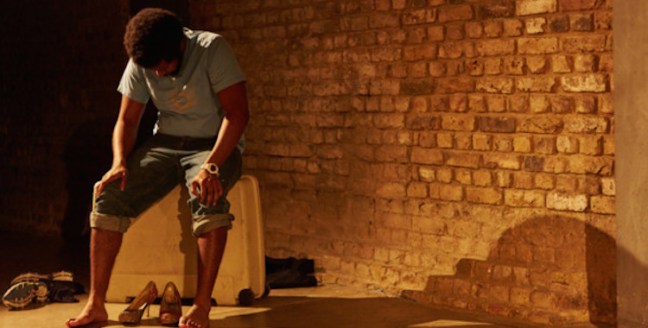
The man inside the box is Zach, a Welsh war veteran suffering from Post Traumatic Stress Disorder (PTSD). The box – huge and battered – is both a coping mechanism and a visual manifestation of the mental state he carries around with him. He seeks shelter from the outside world, retreating until he’s trapped within the four stifling walls of his own mind.
Trouble is, that simple image is so powerful that the show itself struggles to move beyond it. Visually, the dismal landscape of PTSD is established within moments of the show starting. As Zach, David Woods sits curled up in his box, the room around him grubby, colourless and bare. There’s a gloomy austerity – both material and emotional – to the set design that Jacob Williams has created. The resonances with Zach’s state of mind don’t need pointing out.
Everything that takes place around and within that image, though, runs the risk of obfuscating its potent clarity. What plot there is centres around MDMA-assisted therapy – a genuine treatment under trial for patients with PTSD, and one that Ridiculusmus seeks to dispel the stigma around. Zach hears about the trials via his mate Ieuan, who later comes by with some MDMA that he’s managed to get hold of and attempts to clumsily replicate the therapy process. Let’s say it doesn’t entirely go to plan.
Give Me Your Love is the second in a trilogy of Ridiculusmus shows exploring innovative approaches to mental health, following 2014’s striking The Eradication of Schizophrenia in Western Lapland. Both shows are theatre of images and impressions. The Eradication of Schizophrenia in Western Lapland used its form to suggest the experience of psychosis, layering two halves on top of one another and exposing each section of the separated audience to echoes from the other side of the performance. Give Me Your Love is similarly fragmented and similarly baffling – as fragmented and baffling, presumably, as the mental states it is attempting to evoke.
Here, though, that deliberate confusion is less productive. Give Me Your Love does not feel as fully formed or conceptually satisfying as its predecessor. Instead, it is often strangely disengaging. In a way, this is apt. Zach is a man cut off from the world; disconnection is a running thread through the piece. With the exception of one wordless, physical sequence, we never see anyone’s face. Zach is just a pair of legs in green trainers. Playing both Ieuan and Zach’s wife Carol, Jon Haynes is either an arm reaching through a door or a disembodied voice from offstage.
Laughter, meanwhile, is an intermittent and uncertain presence in the show. In keeping with Ridiculusmus’s brand of “seriously funny” theatre, comedy is frequently used in service of the company’s difficult themes, but the hints of farce throughout Zach and Ieuan’s meandering, drawn-out exchange undercut the stark visuals in a way that is as often clunky as it is poignant. And the loose connections suggested between the noise and confusion of ecstasy-fuelled club culture and the noise and confusion of war, forcefully introduced in an early interlude of thumping music and throbbing lights, are never really developed.
In the latter stages of Give Me Your Love, challenged to get out of his box, Zach retorts: “get out of whatever you’re in”. Ridiculusmus want us to get out of our own boxes and open our minds – both in our approaches to mental health and in our approaches to treatment. Whether their approach really opens up this issue or simply clouds it, though, is a question mark that troublingly lingers.
There are plenty of shape-shifters in Shakespeare, but few as sinister as Richard of Gloucester. In The Faction’s characteristically stripped-back production, the play’s world of secret plots and political machinations also shifts shape around its scheming protagonist, its performers moulding themselves around the text. As a company, The Faction have always been committed to physicality over props, bodies over stuff. Here, that minimalist aesthetic is pushed to its limit. In the black box space of the New Diorama, the storytelling relies on nothing but the bare stage, the ensemble cast of 21 and the sculpting effects of light and sound.
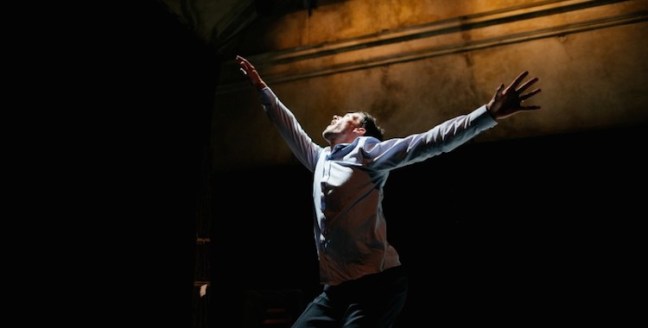
So limbs contort to form thrones, ghosts, even Richard’s horse as he rides into battle. The most fascinating physical work, though, is done by the aptly named Christopher York as the eponymous rogue. Often, much is made in performance of Richard’s deformity – he is “not shap’d for sportive tricks”, he tells us in his opening speech – but here his physical impairments are as chameleonic as his mood. Confronted by his mother, he retreats into himself, fingers shrivelling up and back hunching over. Elsewhere, his disability is a tool for manipulation, emphasised to plead his case. But then in moments of confidence he suddenly straightens up, tall and broad-shouldered as a soldier.
And soldier he is in this take on the play. When we first see York’s Richard, it is at the close of a dynamic opening sequence of fighting, his vanquished opponent at his feet. But as civil war melts into uncertain peace, he looks less and less comfortable. This Richard itches as much for action as he does for power and the throne. The path he pursues is one of chaos and destruction – eventually for him, too, alongside the mounting bodies of his enemies. While early on he has the air of a confident, calculated politician, summoning and dismissing his pawns with little sweeps of the hand, in the latter stages of the play York suggests the instability and senselessness of Richard’s actions. He has the look of a man driven on by objectless blood-lust, regretting his crimes – such as the killing of one-time ally Buckingham – at the same time as he seems powerless to change his own power-hungry course.
Elsewhere, the success of director Mark Leipacher’s ambitious stage choreography is more patchy. While he’s brought together an exhilaratingly large and hearteningly diverse cast, the quality and tenor of the acting is often inconsistent – in some cases even across the duration of one individual performance. It makes for an odd mixture of styles, as some lines are declaimed as if from the stage of the Royal Shakespeare Theatre, while others are intimately or hurriedly delivered. Even worse, the effect of such dissonant contrasts finds itself amplified: in a production so reliant on its ensemble, small weaknesses can cause large fractures.
And while a muscular approach suits a text with epic scope like this, the use of movement can be as distracting as it is illuminating. There are some absolutely stunning moments: the light touches of multiple couples highlighting Richard’s initial isolation; the chanting fervour of the final moments before the interval; the chilling crawl of corpses towards the king’s sleeping body in the tent where he lies haunted by his deeds. At other times, though, action on the periphery drags our eyes from the supposed focus of a scene, unhelpfully splintering the drama.
2016 marks the fifth year I’ve kicked off by watching The Faction perform in their adopted home at the New Diorama. The company now feel like an established feature of the new year – part of the theatrical furniture of January and February. At their best, they have the ability to crack open classic texts, finding whole hidden worlds to inhabit. But while this latest production may have all of The Faction’s familiar hallmarks – stripped-back aesthetic, inventive physicality, an emphasis on the ensemble – it offers only a limited window onto Shakespeare’s drama.
As so often, at the end of last year Philomena Cunk – the brilliantly terrible (or perhaps terribly brilliant) creation of Charlie Brooker and Diane Morgan – spoke the horrifying truth about the media’s portrayal of the refugee crisis. “Now it looked kind of different,” she reflected on the media’s sudden about-turn, “less swarm-y and threatening and more harrowing and urgent and sad. And the clever thing was, it was the same sort of pictures you’d seen earlier, but now you knew the twist about them being humans it seemed totally different.”
Zodwa Nyoni’s monologue attempts to recover the humanity so often denied in tabloid news reports and bile-filled columns. Nine Lives is the story of just one refugee: Ishmael, fleeing homophobic violence in Zimbabwe. Now in the UK, he waits in a mouldy flat in Leeds – emphatically “not home” – his life on pause while he’s suspended in bureaucratic limbo. Everything hinges on a brown envelope on the doormat, a black and white “yes” or “no” to his asylum request. Stuck on the conveyor belt of the UK immigration system, Ishmael is no longer a person but a number, a statistic on a computer screen or the page of a newspaper.
Under a single, stark lightbulb – the bareness of the stage suggesting the bareness of his new life – Lladel Bryant’s restless, lonely Ishmael tells his story. He talks of metamorphosis, of refugees in “concrete cocoons”, and of a hostile, overwhelming city. This jagged day-to-day experience is also punctuated with almost poetic interludes that refer to the wider plight of refugees and asylum seekers. Each beginning “some of us”, they break apart the undifferentiated mass so often shown in the media, reasserting shared yet particular human experiences:
“Some of us were running”.
“Some of us couldn’t recognise ourselves anymore.”
“Some of us were alone.”
“Some of us were begging for a taste of your liberty.”
In keeping with Nyoni’s reclaiming of these stories, the primary focus of Alex Chisholm’s production is the narrative. Aside from the lightbulb, all that joins Bryant on stage is a large, battered suitcase, which has to be both home and past for Ishmael in this temporary new existence. It’s a simple staging that could be even simpler still. Occasional, exaggerated sound effects – the nightmarish ticking of a clock, for instance – hardly seem necessary to communicate what straightforward storytelling does so clearly and compassionately. It’s through being stripped back where headlines are embellished that Nine Lives gains its power.
Implicit throughout, lingering like a bad aftertaste, is the vitriolic media narrative around immigration. Words like “swarm” and “droves” are never used, but they can’t help but haunt Ishmael’s experiences. When he’s targeted in the street, it’s with accusations right out of The Sun or the Daily Mail: he’s seen as a scrounger, an alien, a leech. To his landlady, he’s a source of cash and irritation; to the aggressive teenager who confronts him outside his flat, he’s a convenient figure of blame.
No one talks about the loneliness. Absent from all the news reports is the yawning emptiness of arriving on a foreign shore without family, friends or lovers. While lacking depth and background in some areas, what pierces through both Nyoni’s writing and Bryant’s performance is the terrible enforced solitude and isolation experienced by refugees like Ishmael. Pacing the empty stage and impressively inhabiting the voices of a range of other characters, Bryant can appear at times like a man frantically fighting to fill the void of his loneliness.
At a slender 55 minutes, there are limits to what Nine Lives can achieve. There are few resolutions, either for endlessly waiting Ishmael or for the wider issues that the piece touches on. But as a simple, unadorned plea for common humanity, it’s still depressingly necessary. In one of the play’s tenderest moments, teenage mother Bex – herself discarded and mistreated – reaches out a hand to Ishmael, recognising him for who he is and extending the offer of friendship. It’s an act that, on a much larger scale, Nine Lives implicitly appeals for.
It began with a bull fight. Mike Bartlett’s Bull at the Young Vic – a horrifying image of bloodthirsty corporate competition – was the first show of 2015 to really kick me in the gut. And it kicked hard. I might have had my problems with it, but the image of those three suit-clad figures circling one another, shiny and hard as Soutra Gilmour’s arena-shaped design, stayed with me. Right at the start of a new year, it was a brutal, damning perspective on the state of things.
But 2015’s theatre wasn’t all grim. Now, at the end of the year, the arrival of Megan Vaughan’s fantastic zine reminds me how many of the shows I loved in the last twelve months were tender and intimate and exposed (in every sense of the word). Or, to put it another way, how many of those shows involved nudity (no sniggering, now) not just as part of the plot, but as an aesthetic in its own right. Bodies – uncovered, meeting, parting – were central to three of my favourite shows of the year: Peter McMaster’s 27, The Mikvah Project at The Yard and, again at The Yard, the first public incarnation of Chris Goode’s new Ponyboy Curtis ensemble. Honourable mentions too, while we’re on bodies, for Igor and Moreno’s straining calves as they unrelentingly leapt up and down in Idiot-Syncrasy, and for all those sex dolls in the Young Vic’s brilliant Measure for Measure – a production of Shakespeare’s play that, crucially, embraced rather than attempted to solve its problematic strangeness.
The health of Political Theatre (capital P, capital T) is often, for better or worse, considered a barometer for the state of the art form. In the run-up to May’s general election, some complained that the stage was offering little in the way of topical critique. (The highest profile bit of election theatre, James Graham’s The Vote at the Donmar Warehouse and streamed live on TV, was really about the quirks of British democracy, more interested in the act of putting that cross in a box rather than what the boxes themselves might stand for). But I’d argue it all depends where you were looking.
On election day itself, I found myself reflecting on the theatre that refracted politics through the (all too often difficult) lives of ordinary people: the zero-hours workers of Beyond Caring, the everyday activists of Stand, the carers who told their stories in Turning a Little Further, a gorgeous piece created as part of the Young Vic’s ongoing Two Boroughs project. Meanwhile another community show, London Bubble’s Hopelessly De-Voted, offered a multi-faceted view of the way in which the workings of democracy are viewed by and impact upon residents in its local area around Bermondsey. This theatre all served as a reminder that politics is about people, not just parties and politics.
I found out the result of the election while in Berlin, at a distance that made it feel all the more unreal. I drowned my sorrows with fellow Brits, heaving an inward sigh of relief that I was at one remove from the messy post-vote dissection. The reason for being in Berlin was Theatertreffen, a festival I’ve gazed at enviously from afar in recent years. Thanks to the online scramble for tickets, I only saw two of the selected shows in the end, but one of them remains one of the best bits of theatre I saw all year. Common Ground, a partial and fragmented account of the break-up of Yugoslavia, confronted all the tangled complication of conflict, eschewing simple narratives of right and wrong, victim and perpetrator. And somewhere in there, emerging from the wreckage, was the slightest glimmer of hope.
There was a similar kind of complication and complexity at the heart of The Beanfield, the astonishing debut show from young company Breach. It also shared with Common Ground an interest in opening up its own process, with as much interest arising from the company’s flawed documentary techniques as the subject of their investigation: The Battle of the Beanfield, when police enforced a crackdown on the annual Stonehenge Free Festival. Breach continue the current outpouring of talent from Warwick University: fellow graduate companies Barrel Organ and Walrus Theatre also stood out this year, with the (lengthily titled) Some People Talk About Violence and Lemons, Lemons, Lemons, Lemons, Lemons respectively. (Disclaimer: I know members of all three companies, but I reckon I’d consider them all sickeningly talented regardless.)
The Warwick Triumvirate (replacing last summer’s Chris Trilogy) were among the highlights of this year’s Edinburgh Fringe. Another was Ross and Rachel, a witty and eventually devastating duologue-for-one written by James Fritz (whose Bruntwood Prize Judges Award-winning play Parliament Square is one to look out for in the future). Brilliantly performed by Molly Vevers, it cleverly used the iconic on-again-off-again couple from Friends as a springboard to interrogate relationships, cultural notions of romance and the problematic language of love. There was at the same time a similarly brutal look at love from Made in China, whose Tonight I’m Gonna Be the New Me put Jess Latowicki and Tim Cowbury’s relationship under the microscope in order to explore ideas of authorship and power.
Another couple putting their lives on stage this year were Bryony Kimmings and Tim Grayburn in Fake it ‘Til You Make It, a brave, careful and unapologetically personal look at male mental health. It was a show I first saw in scratch form a year ago at Forest Fringe, reducing me (as so much did that Fringe) to tears. A year on, it still pricked at the tear ducts, as well as arguing passionately for a society in which outdated understandings of masculinity are discarded in favour of openness and care. Masculinity was also implicitly critiqued in Lines, another powerful offering from The Yard that has haunted me despite an initially ambivalent reaction. The bleakest view of twenty-first-century masculinity, though, was to be found in Gary Owen’s Violence and Son, a piece as meticulously constructed as it was horrible. In the play’s all too believable world of casual sexism and irresistible violence, as I put it at the time, patriarchy shits on everyone.
This year Owen also offered us Iphigenia in Splott, a monologue that was defiant, devastating and spitting with rage. And the knotty father-son relationship in Violence and Son was just one of many complicated families encountered on stage in 2015. Alice Birch’s early play Little Light showed us a family caught in a cycle of pause and repeat, lives frozen in the icy grip of grief. Two sisters had a spiky, strained reunion in Sparks at the Old Red Lion. The sheer joy and silliness of Jamie Wood’sO No! was dotted with interruptions from his own growing family, while Paradise Lost (lies unopened beside me) brilliantly (and tear-jerkingly) transformed from an eccentric take on Milton’s epic poem into a startling portrait of the hopes and fears of parenthood. Even Robert Icke’s modern reworking of Oresteia – the best of what I saw of this year’s Greek takeover – was as much about a splintering family as it was about the political and divine forces surrounding them.
In March of this year, my theatregoing landscape suffered a casualty. I was sitting at home when images of a fire at Battersea Arts Centre first popped up on my Twitter timeline, making my stomach drop away. For long, long minutes I feared the whole place was lost. In the end, despite the complete destruction of the Grand Hall, the rest of the venue was saved and back up and running just the next day, and BAC was overwhelmed with support from those, like me, who love the place and the work it does. Plenty of theatres were on good form this year, but I want to treasure BAC in particular because it felt so close to disappearing. Alongside the already mentioned Stand, shows I saw and enjoyed at the old town hall this year included Song of the Goat’s Songs of Lear (honestly unlike anything else), David Rosenberg and Glen Neath’s new binaural head-fuck Fiction, Laura Jane Dean’s delicate This Room, the time-bending double bill of Deborah Pearson’s Like You Were Before and The Future Show and, most recently, the Christmas reboot of Will Adamsdale’s hilarious life-coach spoof, Jackson’s Way.
Some of the most joyful hours I’ve spent in the theatre this year, meanwhile, have come courtesy of a genre I don’t see all that much of these days: the musical. After a couple of years of refurbishments (and following an emotional farewell to Secret Theatre), the Lyric Hammersmith reopened with an ecstatic production of Bugsy Malone, leaving me grinning from ear to ear throughout. I was also grinning for much of Shock Treatment, the wacky Rocky Horror follow-up given a gloriously kitschy staging at the King’s Head, while National Theatre Scotland’s Our Ladies of Perpetual Succour combined great, gulping laughs with real emotional depth. And Imelda Staunton smashed it again in Gypsy, belting out a stunning turn as Mama Rose.
As ever, when I look back at the year more and more shows emerge from the murk of memory. 2015 was the year I finally saw Tim Crouch’s conceptually dizzying An Oak Tree; it was the year The Gate continued an impressive run of form, most powerfully with Danai Gurira’s blistering Eclipsed; it was the year Simon Stephens’s splintered yet beautiful Carmen Disruption came to London, receiving an equally splintered yet beautiful production from Michael Longhurst at the Almeida. The year’s theatregoing also offered me the flickering precariousness of Fireworks at the Royal Court; the rage-laced laughter of Desiree Burch’s Tar Baby; the non-stop hilarity of Sonia Jalaly’s live-art-skewering Happy Birthday Without You; the quiet yet oddly powerful naturalism of Eventide at the Arcola.
And it ended with just a little bit of magic. I didn’t see all that much theatre in the final weeks of the year, but most of what I did see was aimed squarely at kids and families. And it was brilliant. I giggled my way through the National Theatre’s adaptation of I Want My Hat Back, gurgled with joy for most of Little Bulb’s adorable The Night That Autumn Turned to Winter, and loved the bold, gender-switched retelling of Sally Cookson’s Sleeping Beauty at the Bristol Old Vic. All three proved, once again, that it’s all in the telling.
The Doors, “Break on Through to the Other Side” – 27
Will Smith, “The Fresh Prince of Bel Air” – Lemons, Lemons, Lemons, Lemons, Lemons Nick Cave and the Bad Seeds, “Into My Arms” – Paradise Lost (lies unopened beside me)
“Fat Sam’s Grand Slam” – Bugsy Malone
The Beach Boys, “God Only Knows” – Oresteia (just try listening to that song in the same way after watching the show)
—
Main image from Lost Dog’s stunning Paradise Lost (lies unopened beside me). May also be read as an expression of my feelings about the year in the form of contemporary dance.
Arriving at Jerwood Space to interview John Heffernan, I’m nervous about using the ‘M’ word. The actor is rehearsing to play Macbeth – He Who Must Not Be Named in theatrical circles. But Heffernan, chatty and affable from the moment he sits down, is quick to laugh away any superstitions around the role.
“When you’re working on it everything would take twice as long if you were constantly calling it the ‘Scottish Play’,” he reasons. “We made the decision quite early on: we’ve just got to say it, we’ve got to dive in.”
This production, directed by Carrie Cracknell and Lucy Guerin at the Young Vic, marks a welcome return to Shakespeare for Heffernan. It was the playwright who ignited the actor’s love for theatre: first via the television series The Animated Tales and then during Saturday matinees at the Royal Shakespeare Company’s London home, the Barbican. Later, as a teenager, Heffernan ushered during the summer in Stratford-upon-Avon, watching the likes of Samuel West and David Tennant tread the boards. “I’m going to sound like a complete anorak,” he warns, “but I think I’d seen all 37 [Shakespeare] plays by the time I was 19 or 20.”
It took a while, though, for Heffernan to pursue acting. Instead, his early aspiration was to be a theatre critic. “I just thought ‘what job will allow me to sit in the stalls all the time?’” he remembers. “I enjoyed writing and analysing, and I thought it would be a really blissful, happy job.” While at drama school, he even did a bit of reviewing under a pseudonym – “I thought ‘This is great, you get two free tickets, you get a free programme, you get a free drink in the interval’,” – before friends warned him off trying to combine acting and theatre criticism.



 Catherine Love