Samantha Spiro

ImageHandler

Originally written for IdeasTap.

Samantha Spiro has acted in everything from Shakespeare to musical theatre, as well as establishing herself as a familiar face on BBC Two sitcom Grandma’s House. As she prepares to play Lady Macbeth at the Globe, she shares advice on maintaining a healthy career balance and not losing faith…

How difficult was it to make the transition from drama school into the theatre industry?

As far as drama school is concerned, the brilliant thing is that you just get to do lots of plays. I was very lucky that my first job was at the Open Air Theatre at Regent’s Park, so I continued in a similar vein. In those days you got to do two Shakepeare plays and a musical, so I played Third Witch in Macbeth and Peaseblossom in A Midsummer Night’s Dream and everything from a canary to a courtesan in The Boys From Syracuse, which was the musical.

It felt very much like the old days of rep, which I never experienced because there were very few theatres still doing it. I was very lucky to have those opportunities to get into that kind of environment very early on.

You have described the role of Barbara Windsor in Cleo, Camping, Emmanuelle and Dick as one of your big breaks. What impact did that production have on your career?

Because it was at the National [Theatre] and we filmed it, it had the knock-on effect of opening doors. But it didn’t feel like it at the time, it didn’t feel immediate. I don’t feel there’s been any one moment in my life where suddenly everything’s burst into technicolour and everybody has been knocking at my door. It’s been more slowly-but-surely.

How do you maintain a balance between theatre and television work?

I felt for many years that theatre was my main source of employment. But in the back of my mind I knew that there probably was a better balance. Although the worlds do feel very separate, I think that the more you’re seen on television, the more people want to come and see you in the theatre, and the more chances of you getting better roles. It’s only really in much more recent years that I feel as though I’m doing a bit of both. I absolutely love it, but I’m always eager to get back to theatre. 

Is there added pressure with taking on an iconic role like Lady Macbeth?

It is an iconic role, but I think you just have to free yourself of those pressures. Most of my favourite actors have played this part brilliantly, but when you come to it you’ve got to think of it as a new play and pretend that nobody’s played this part before, because otherwise you do drive yourself mad and you’ll lose your nerve.

Do you have any advice for young actors?

Try and work as much as you possibly can and try and create as much as you possibly can. If the acting work isn’t coming in then keep active by writing or by trying to get in on the production side of things. Just keeping at it if you’re passionate about doing it is the best thing, because there’s no logic. As long as you’re part of the business, I think things can happen at any moment. To not lose faith.

In Focus: Creating a back story for Lady Macbeth

Joe Millson – who’s playing Macbeth – and I agreed very much on what our back story is. The back story for us is about having had a child who died within the first few weeks of its life. 

I’m approaching playing Lady Macbeth as a woman who had post-natal depression and had evil thoughts about her baby, and then the baby does die, so she’s left with this huge, gaping hole in her life. And her husband feels guilt towards her and wants to try and help her out of this.

Going through birth, going through post-natal depression, and then going through the loss of a child has left her with a chasm to fill. That then gives me the springboard or catalyst for what happens in the play.

Peter Reder

ContentsofaHouse-5-600x400

Originally written for Exeunt.

As I chat over the phone to artist Peter Reder about The Contents of a House, his latest project for this year’s Brighton Festival, I’m on a train, contesting with temperamental mobile signal and occasional off-putting jolts. For a conversation about place, my own location is particularly unstable, shifting and continually disrupted. In a sense, this mirrors the format of much of Reder’s work; guided investigations of sites peppered with detours and interruptions.

“I like that you’re telling this story but there are also all the digressions,” says Reder, musing on his continued fascination with the guided tour format. “Like in a travel book, you might enjoy that you find something out about the author as you go along; you perhaps learn about why they’re on this journey themselves. There’s a lot of potential to mix in quite disparate things.”

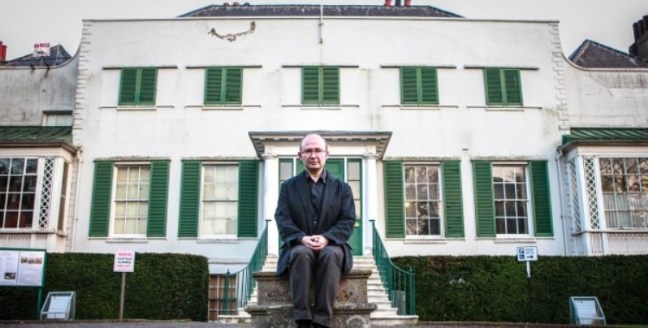
The latest location that Reder is leading audiences on a journey through is Preston Manor, a historic house and museum just outside Brighton. Reder explains that he was drawn to this particular building because it exists “very much on the fringes of everything” – on the outskirts of Brighton itself and at the peripheries of people’s awareness. With a history stretching back to the Domesday Book, the present house is a mixture of a 1738 rebuilding of the 13th century structure and a series of extensions made in 1905. Now functioning as a museum on Edwardian life, the manor is visited mostly by school groups, but is only vaguely known by many residents of the surrounding area. “I was intrigued by this building which is really interesting in its own right, but which is hovering there kind of half-known,” Reder adds. “There’s an air of mystery around the building.”

Reder also feels that, unlike many of the more famous historic homes across the country, Preston Manor has an accessible, tangible aspect. “What’s attractive is that everything’s quite small scale, it’s very intimate on every level,” he says. “Nothing is of huge significance; it wasn’t lived in by anyone that famous, nothing of national importance happened there. It’s interesting as an example of an Edwardian, relatively wealthy home, but it’s not got that grandeur, so in a way it’s very touchable – you feel it’s on a level that anyone could understand.”

Accessibility is also an element of the guided tour set-up, a format that is instantly familiar to audiences. Although this format is one that Reder has kept returning to in his work, it was one that he initially fell into almost by accident. During a period of research and development for a new show at Somerset House, Reder had a number of found objects to show to a small invited audience and naturally found himself presenting them, guiding spectators through his discoveries. “What I really stumbled on is that speaking about these things was a sort of performance,” he remembers. Intrigued by what could be achieved by adopting this presentational style, it quickly spilled over into the finished work and became a recurring technique.

“I’m aware that it’s a very familiar thing and in some ways I rather enjoy that,” Reder says. “It has a comfortable feel; people know how these things operate.” But he’s not content with simply appropriating this format without interrogating it; there’s a desire in the work to gently provoke and subvert, to acknowledge the way that guided tours traditionally “pander to what people want to hear” and dig away at what latent desires people bring to these tours. In this sense, Reder argues, it’s almost “anti-tourism”.

Recalling one production in Edinburgh, in a context surrounded by lots of real guided tours, Reder explains how they used fabrication to reveal what audiences wanted to hear. “In that particular show I always made up a story about a building that was a phantom, that had been in that place before the current building, which sometimes was true in some of the buildings we used, but at other times was entirely fictional. I realise that’s a very strong desire, that there should be something underneath the layers, that people like the idea of a ruin beneath the current building – a sort of archaeology.” It’s a desire that shares a kind of kinship with the experience of watching theatre; the impulse to peel back layers, to reveal something buried and authentic underneath the artifice.

As Reder has gone on, however, he’s had less recourse to fiction in his work. Whereas previously he would seek to change spaces or populate them with imaginary narratives, now he is more interested in “exploring how they already work and trying to see what I see in them as they currently exist”, noting in this a kind of acceptance. “I want to delve into their reality a bit,” Reder explains, adding, “I would go as far as to say that everything I say in the show is true.”

With this particular project, Preston Manor has revealed more than enough material for Reder to work with. After a lengthy and painstaking process of research, the task was to shape that nebulous mass of history and memory into a piece with a negotiable path through it, a process that Reder admits is “a bit mysterious even to me”. “Bit by bit there is some process of natural sifting where certain things feel more essential than others,” he tentatively continues. “But sometimes what seem like irrelevant things can be very vivid, so it’s a bit hard to explain. There’s some natural selection of the ideas that seem to stay with me and others that slightly fall to the wayside.”

Beyond his guided tours, the interest in space bleeds out into much of Reder’s other work; hisCity of Dreams project, for instance, created live performative maps of a number of cities across the world, fleetingly capturing the living memory of a place through the illusionary machinery of theatre. For Reder, however, place is never the primary concern. “I’d say my major preoccupation is probably to do with memory, but I think that’s played out often in experience of a place,” he says. “They’re very hard to divide, because I think so many memories inhabit landscapes of one kind or another, so what’s conjured up in your memory is full of spaces you’ve experienced and the atmospheres of particular spaces. I think that when you enter a space, even if it’s an entirely unfamiliar one, your memory of other places is always in play – otherwise how do you understand anything?”

Memory, of course, is inevitably delicate and personal, leading to the strong presence of Reder in his work, with The Contents of a House being no exception. “This current show is about the history of Preston Manor, and it’s also about me in some way. But it’s only me in relation to Preston Manor; it’s the bits of my own history that have been prompted by the things I’ve seen in Preston Manor. The two strands are completely enjoined and dependent on each other.”

“I have an anxiety with these performances that they don’t just become entirely self-indulgent, me rambling on about my own memory of things,” Reder is quick to add, expressing his desire to widen that circle of memory to include his audiences. “I’m very interested in the overlap with other people’s memories. As much as some of the things I talk about are genuinely quite personal, they’re there because I think other people will share quite similar associations. Maybe the personal can become a bit more publicly shared.”

This is not interactive theatre in the way it’s typically understood – “there’s no obligation for anyone to share anything” – but there is clearly a hope that those who join the tour might find their own memories being stirred by those that are revealed in the building. “It’s very rewarding to see that I’m not just communing with myself, that it does touch people,” Reder says. Returning to Preston Manor’s lack of historical or national significance – what Reder characterises as its “lightweight” quality – he wonders aloud whether ultimately it’s less about the place itself than the offer it extends to those who come to wander through it.

“I think it’s a place of some quiet reflection; maybe it doesn’t really matter what it’s about. It’s a contemplative space.”

Lucy Ellinson

A-Thousand-Shards-of-Glass_Jane-Packman-Company1-600x434

Originally written for Exeunt.

“I think I’ve always been a little bit cross about fourth wall theatre, if I’m really honest,” Lucy Ellinson suddenly admits in the middle of our conversation in the Albany cafe. She’s smiling as she speaks, any crossness buried beneath a warm grin, but a quick glance at her work is enough to confirm this aversion to distanced realism. Her last project was Unlimited Theatre’s Money the Gameshow, a show dissecting the current financial crisis through the interactive format of the TV gameshow, while she’s now appearing in a piece of lightly immersive solo storytelling. Even in the Gate’s thrillingly visceral production of The Trojan Women, in which Ellinson appeared at the end of last year, she had an itching temptation to “sneak under” that invisible barrier, to sit amongst the audience and “do a little agitating”.

“It’s never been part of my understanding of what performance is,” she goes on to explain. “I’ve always felt that it’s a strange condition to set in a room where we’re all clearly present and clearly needing each other to make this thing happen.” For the show she’s currently touring, Jane Packman Company’s A Thousand Shards of Glass, the necessity of this co-presence is not immediately obvious. It’s a show in which everything is told and evoked rather than shown, seeming to share more in common with the radio play than with the rough immediacy of live performance. Yet somehow, as Ellinson is keen to emphasise, the presence of the audience, arranged in a circle, is central to the piece’s effectiveness: “Even though it is a private journey, I feel like there’s a level of engagement that absolutely has to exist in order for the piece to be able to be told.”

The show, described as “a surround-sound adventure which happens mostly in your head”, uses Ellinson’s persuasive storytelling and a vivid soundscape by Lewis Gibson to create an action-fuelled thriller that sprints through the landscape of the imagination, narrating a story of resistance against a dulled corporate world. Despite the relative lack of visual stimulus, its rapid shifting from frame to frame acquires the quality of a graphic novel, just one that’s sketched in the minds of the audience. The graphic novel is also an apt reference point for its invitation to the reader’s imagination, offering just enough to work with. As Ellinson explains, “you look at it, you imagine yourself right into it, but you’re still aware of yourself as a reader, as an outsider – you’re able to do those two things simultaneously, which I really like”. In this sense it’s similar to the radio play, which is “around and inside your mind at the same time”.

I’m reminded of Robert Wilson, who has described his ideal theatre as “a cross between the radio play and the silent movie”; in each genre, both the medium and the imagination are that bit sharper due to the absence of either image or dialogue. Hoping for a similar sharpness, the landscapes that the company wanted to conjure in A Thousand Shards of Glass were always at the forefront of the creative process. “We had a process where we’d talk a lot about the worlds that we were trying to establish; this hyper-realised, capitalist, futuristic world, where all the sensual, visceral elements of life sort of disappeared into this corporate sheen.”

Beyond simply sparking the imagination, Ellinson notes how the show speaks to the current political situation, describing it as “very prescient, very relevant”. This was a piece that felt the impact of both Occupy and the riots, and without reaching for any explicit link, these influences show. For this reason, a level of audience autonomy – “allowing them to take that bit of work on their own shoulders and do something with it” – is essential. Ellinson adds, “it’s much more of an offering, which feels politically more in tune with the themes of the piece”.

There was a similar sense of an offering in Ellinson’s interpretation of her role as the Chorus in The Trojan Women. In Caroline Bird’s new version of the Euripides, the Chorus was pared down to just one individual, an ordinary and ignored pregnant woman. Speaking of the “sense of solidarity” that this device created between the Chorus and the audience, Ellinson describes a “funny little space” that existed between a fourth wall standing and being torn down: “There were moments where the Chorus was asked to laugh – it was scripted ‘the Chorus laughs’ – and the audience would do it, so after a while I sort of let them take that part of me on. It was an interesting blurry line.”

There is a blurry line, too, between the more traditional, text-driven process of The Trojan Women and the collaborative, devised work that is Ellinson’s preferred realm. She reflects that director Christopher Haydon “would have cast me because he knows I’m a deviser and like chirruping up with what I think here, there and everywhere”, before suggesting that collaborative ways of working are becoming more common, regardless of the pre-existence of a text.

“I think it’s just an idea, and then you gather artists around the idea. That certainly seems to be what I’ve encountered in different processes, whether it’s a play or whether it’s a devised piece which becomes a piece of written performance text; the idea is there in the middle, and then I’ve worked with directors who’ve pulled different artists around it. That idea could be an already finished script, or it could be something that we’re going to make. Long may that continue, because then it’s about serving that idea.”

As Ellinson also explains, the artists involved in that process need not all be theatre artists; they could be videographers, jewellery makers, musicians. Making that point, one of Ellinson’s most striking projects over recent months – and the winner of the Arches Brick Award in Edinburgh last year – is Torycore, a furious marriage of austerity politics and death metal music, performed by Ellinson alongside Chris Thorpe and Steve Lawson. Borrowing lyrics from government speeches, the piece is being continually reworked to reflect the latest cuts, with a new outing later this year drawing from the 2013 Budget and the most recent slashes to welfare. As Ellinson bitterly observes, “there’s no end of amazingly, startlingly brutal language coming out of the present government, so there’s lots of text”.

“It’s been really interesting tracking their language,” she continues, mouth stretched in a grim smile. “There’s Iain Duncan Smith saying this is fair, these welfare changes are actually fair, and then there’s this wonderful quote from David Cameron about a year and a half ago saying that ‘we need to redefine the word fair’. It’s been fascinating to me to track the journey of that word in particular and how they’ve used it. They have been absolutely audacious in trying to remould the meaning of the word in the public consciousness in order to open the door for these sorts of ideological cuts.”

In the midst of all this calculated rhetoric, Ellinson recognises that it can be challenging to express one’s own political opinion. This difficulty to speak out is part of the impetus behind another of her ongoing projects, One Minute Manifesto, which will be returning to Battersea Arts Centre in May. Offering participants their very own soapbox and a platform to address as many or as few people as they like, the simple premise is to speak on a chosen subject for 60 seconds. The aim is that it facilitates the airing of those passionate opinions that might otherwise remain unspoken, something Ellinson has grown increasingly galvanised by: “the more I do it, the more I feel it’s really quite an important exercise to do”.

Ellinson tells one story of a woman who was paralysed by nerves during her allotted one minute, unable to wrench out any words before the time was up. Afterwards they went for a walk that lasted over an hour, speaking about this woman’s life, her opinions, her view of the world. She was “hugely articulate”, yet she struggled to believe that her thoughts were worth hearing. For the very reasons illustrated by this example, the conversation that happens around that minute is just as important as the minute itself. “That timing, that 60 seconds, it’s deliberately there to provoke a response to want to continue to talk.”

Ultimately, this seems to be the driving force behind much of Ellinson’s work – getting people talking. As Ellinson drains the last of her tea and I gather my things, we continue chatting; about some recent work Ellinson was involved with at the Women of the World Festival, about getting primary school girls energised by the idea of feminism, about Ellinson’s connection with Forest Fringe and their current residency at the Gate. Even as we’re both glancing at our watches, conscious of the need to continue with our days, the pull of that conversation is hard to resist.
Hattie Morahan

Originally written for Exeunt.

Never was a door slam so deafeningly resonant. The escalating dramatic action of A Doll’s House hinges – quite literally – on the moment that Nora finally shuts the door on her husband and children, walking away from a life that has hemmed her in. It’s a climactic moment that has been variously read as a statement against stifling patriarchy, as the shocking action of an uncaring and irresponsible mother, as an inescapable tragedy. But for Hattie Morahan, who is just about to return to the role of Nora in Carrie Cracknell’s production at the Young Vic, the play’s famous culmination is just one of its many facets.

“One is aware of that whole phenomenon and I can totally understand it, but it’s a phenomenon that’s built up around a single act,” she says of the debate surrounding the play’s conclusion, going on to describe readings that focus on that act as “incredibly reductive” ways of looking at Ibsen’s masterpiece. “It’s quite an incredible arc to go on from the start of the action to the end, and I think if it’s all geared towards the door slam then that actually distorts what the play is,” Morahan continues. “The play is about a marriage and it’s about a particular family. I think the more you can honour the detail and the particularities of those individuals and the mess that they’ve made of their lives, the more that her leaving will resonate in whatever way it does with the people who see it.”

This approach lends a richly detailed texture to Morahan’s Nora, a woman perpetually caught between ringing laughter and crushing despair. As she juggles her husband, her young children and the creditor knocking insistently at the door, small moments are repeatedly on the cusp of betraying her carefully hidden turmoil – a flutter of the hands, the startled catching of a reflection. Like Ian MacNeil’s elegantly revolving set, this Nora glides swan-like through the play, all composure on the surface, while frantically churning the water beneath. She also emerges as frequently spoilt and manipulative, a slyly wheedling flirt with a fragile strain of naivety.

“I’ve never really found I have any trepidation about making characters unlikeable,” Morahan reflects on her interpretation of the role. “If anything I’m far more drawn to people’s flaws and when they behave badly than someone who’s heroic or pious – I’ve got a weird reflex against that. I think my gut instinct is to try and reduce heroism and make it human.” She also believes that to do justice to Nora as written by Ibsen, a character with “such a skewed view of the world and her place in it”, it’s necessary to draw out the less palatable aspects of her personality. “She behaves really appallingly,” says Morahan, “and it’s only through the action of the play that you discover why that is.”

It’s a role that demands overt performance, both in the central theatricality of Nora’s dancing of the tarantella – here a display of sensuality that collapses into distracted frenzy, an arresting physicalisation of Nora’s desperation played out under a twitching spotlight – and in the unrelenting performance of her marriage to Torvald and the display she feels compelled to put on for other men. “The performative element, as I understand it, seems to have come right from when she was a child,” says Morahan. “There’s a shame or an inappropriateness associated with just being herself; she’s always got to be what pleases other people – specifically men.” When this audience dissolves, as Morahan explains, Nora is left with a yawning gap in her identity.

“I think that’s one of the most terrifying things she realises at the end. Her marriage has been such a stressful time that she’s had not a moment to really breathe or consider who she is or what it means to be happy, or if she is happy. One of the shocking realisations at the end is that when all that is taken away, underneath the performance she doesn’t know who she is – there’s a sort of void. She’s never been given the self-worth or the self-esteem to value herself as an entity when it’s not in a pleasing shape for men.”

Morahan explains that the aim shared by Cracknell and designer MacNeil was to somehow replicate the play’s original sense of accusatory familiarity for its bourgeois audiences: “yes it’s nineteenth-century, and yet half-close your eyes and you could be in a shabby chic apartment in West London”. She also gives much credit to Simon Stephens’ new version of the script, which “seems to have one foot in the nineteenth century and one foot in now, without ever drawing attention to it”. It is not a self-conscious, pointed updating, yet like the design it applies a light contemporary gloss. “It’s sort of miraculous,” says Morahan. “The words, as you’re saying them, feel of their time and yet utterly now. It’s very deft.”

This evocation of the now within the context of the past immediately raises the much asked question of what A Doll’s House has to say to us today. What the freshness of this interpretation raises is how many of the difficulties that are grappled with in the play remain sadly relevant in the twenty-first century, particularly in relation to female experience. “The gender politics are weird,” Morahan muses on this topic, “because in so many respects things have utterly transformed in terms of the independence that women have nowadays, but equally, in terms of a kind of insidious sexism – when we’re not talking about wage differences or glass ceilings or third world gender problems – I think there are still these same tensions.”

These tensions and the delicate balancing act that many modern women find themselves negotiating today were also explored in the short film Nora, made through a collaboration between the Young Vic, The Guardian and The Space, and sitting alongside and in dialogue with the production. Taking inspiration from the premise of A Doll’s House on what Morahan calls “a very crude level”, it is instead more of a probing meditation on contemporary motherhood and what glossy women’s magazines have enshrined as “having it all”.

It’s a now ubiquitous phrase that Morahan uses wryly: “On appearances you’re having it all – your mothers have won all the battles and here you are. The questions the film asks are to do with happiness and to do with satisfaction and what this is all for – what have we actually gained? It was fascinating to do, because it did make me think about how roles have changed and how expectations have changed, but we’re still trying to work out what that balance is. Whatever it is, it’s going to be messy; there are no perfect answers.”

For now, Morahan is back in rehearsals with the rest of the company, rediscovering the play after several months away from it. “It feels a bit backwards,” she says of the experience of returning to a production, with a role that was fully formed but now needs to be re-excavated. There is also added pressure for this run, as Morahan goes back to the role that won her the Evening Standard and Critics’ Circle awards. She admits that this enhanced level of expectation has caused some anxiety, but for the most part she describes this second rehearsal period as “liberating”, an opportunity to truly inhabit the play and make new discoveries.

“It’s a bit like knowing you have to jump into a really freezing cold swimming pool,” Morahan laughs. “You know it will be fine when you’re in.”

Photos: Johan Persson

Jack Thorne

Jack Thorne 1 - high res

Originally written for The Stage.

One of the first things to emerge from conversation with Jack Thorne is his compulsion to multitask. “If I’m not working on at least two scripts at once then I stop sleeping,” the playwright and screenwriter tells me, his voice charged with a jittery energy that makes this easy to believe. The circumstances of our interview are testament to this need to always have more than one project on the go: Thorne is speaking to me over the phone from the set of his latest film in Majorca, while he prepares for the start of rehearsals for his new play.

“If I’m working on just one thing I’m not a good writer,” he says by way of explanation. “When I run into problems, the scene that won’t end or the element of the story that won’t make sense, I’ll just spend a week walking around my house. To be able to swap onto another project and go ‘I know how this works’ saves me every time.”

Multitasking has also informed Thorne’s diverse writing career, which spans from television dramas such as This is England and The Fades, both of which won him BAFTAs, to a recent adaptation of Friedrich Dürrenmatt’s The Physicists for the Donmar Warehouse. “There was no deliberate plan,” Thorne admits of his career path, “it all just sort of tumbled out.”

It is almost impossible to discuss Thorne’s career trajectory without mention of the small phenomenon of Skins, for which he was one of first writers to be recruited by creators Bryan Elsley and Jamie Brittain. While Thorne is immensely grateful for this experience, describing Elsley as “generous and brilliant”, the show’s popularity inevitably meant that it became attached to his professional identity. “There was a while when it was just Jack Thorne, open brackets, Skins, close brackets,” he laughs.

Thorne has since been able to break away from this exclusive association, partly through screenwriting departures, such as his segue into the supernatural genre with BBC Three series The Fades, and partly through his work for the stage. Although one of his earliest writing experiences was the Royal Court Young Writers’ Programme, Thorne continues to find theatre the toughest of the mediums he writes in: “I find that if I’ve been writing a lot for telly or film and then I try to write for the stage I really can’t do it, I can’t remember how it works.”

This difficulty was intensified during the writing of his latest play, Mydidae, a commission by new writing company DryWrite that issued Thorne with a peculiarly specific demand. “They just said we want to do a one act play in a bathroom, what have you got?” The result, premiering at the Soho Theatre in December, morphed into a full-length two hander that Thorne found “somehow liberating” to write. As he speaks about the challenge of adapting Dürrenmatt – “the extraordinary thing is that the more you unpick him the less you realise you can unpick him” – and admires Alan Ayckbourn’s tactic of setting himself rules before writing, Thorne creates the impression of a writer who thrives under creative constraints.

This makes his latest project with DryWrite a perfect fit. As a writer acquainted with film and television, which offer the constant possibility of cutting away to sustain narrative dynamism, the charge to confine a whole play to any one room is a challenge for Thorne, but the bathroom is a particularly tricky space due to its inherent echoes of loneliness. “It’s a place you go to on your own,” Thorne says, “you don’t really share it”. To negotiate this difficulty, he has filled the space with just two people, a couple in the throes of a nightmarish day whose relationship “builds to a pitch”.

Alongside the specificity of the setting, Mydidae has also offered Thorne the opportunity to write for a particular performer, DryWrite’s co-artistic director Phoebe Waller-Bridge. Describing that process, Thorne speaks of Waller-Bridge’s “rhythm”, a word that repeatedly peppers his understanding of writing for theatre. “She’s not quite Christopher Walken, with that level of distinctive rhythm, but there’s a sort of joy to how she talks and trying to capture that rhythm was a great thing.”

This habit of speaking about theatre like a musical score suggests a certain sensitivity to the idiosyncrasies of playwriting, a sensitivity perhaps informed by the contrast with his writing for the screen. This sensitivity is contradicted, however, by a confessed inability to think about an audience’s reaction while writing. Recalling an interview with screenwriter Melissa Mathison, Thorne mentions her working relationship with Steven Spielberg, who would constantly be asking her about the experience of the audience. “That’s why he’s such a genius,” says Thorne with almost boyish admiration. “I don’t have that ability, I don’t think about an audience reaction. Instead it’s what I’m thinking, what I can see, what that feels like.”

It’s a quiet undermining of his way of working that is typical of Thorne’s tone throughout our discussion. Despite his clutch of writing awards and his current foray into film with an adaptation of Nick Hornby’s novel A Long Way Down, the writer often comes across as tentative, grateful for but slightly baffled by his own success. Ultimately, Thorne suggests, his fierce work ethic is simply a way of restoring self-esteem.

“Some writers are blessed with real confidence in what they do and how they do it. I don’t really have that, so I need to be able to restore my confidence at regular intervals – almost daily,” he says. As well as fighting insomnia, “having two projects on the go at once is a way of doing that.”