This Room, Battersea Arts Centre

tumblr_inline_n8axax3tRw1r4vduw

Originally written for Exeunt.

Twice in the last twelve months, I’ve taken a mental health questionnaire – not in the office of a doctor or psychologist, but in the theatre. 

At one point in Are You Lonesome Tonight?, Ellie Stamp’s playful but urgent interrogation of mental health, creativity and the perils of diagnosis, she reads out a list of statements and asks us to lower our arms – which are raised at the start of this exercise – as soon as we hear one that describes our experience. Mine is down like a shot; before long, everyone’s hands are back in their laps. And the statements? They describe the symptoms of a recognised mental disorder.

There’s a similar device used in This Room, which takes an affecting look at the treatment of mental illness and what it really means to “get better”. At the start of the show, theatre-maker Laura Jane Dean reads from a list of unwanted, “intrusive” thoughts, later gently asking us which of these thoughts we’ve ever had. They range from worrying that the door has been left unlocked to the sudden, unwelcome, unnerving thought of slitting your wrists or throat when looking at a sharp knife (yep and yep).

Both question the idea of some kind of mental “norm” and divergences from that norm. Both trouble the dichotomy of “ill” and “well”. Both create a space where we can look at ourselves and each other and maybe, just maybe, collectively admit that we’re not OK. And that’s OK.

In This Room especially, well and not well are allowed to sit alongside one another. The room of the title is a doubled, overlapping space, referring both to Dean’s bedroom, where her crippling anxiety began, and to the room where she underwent cognitive behavioural therapy following her diagnosis of obsessive compulsive disorder. These are spaces at once comforting and terrifying, safe and perilous. No more powerfully is this the case than when Dean recalls the time her therapist accompanied her home, permeating the divide between the two rooms, and urged her to confront her fear of hurting herself in her sleep.

Meanwhile the room of the performance, haunted by the presence of those two other rooms, feels like an archive of anxiety. Dean’s medical notes, from which she reads at several points, are housed in boxes and blu-tacked to the walls. From another box, Dean produces a handful of tights, bundled away out of fear that she would use them to hang herself in the middle of the night. As she clutches them in tight fists, holding them out to us, these everyday objects take on an almost alien quality, the fear they represent becoming tangible and heavy in the room.

This Room is full of moments like this, when worry seems to vibrate through the air and tingle on the skin. Dean reads from her case notes into a microphone, her speech faster and faster and faster, skipping along at the pace of her anxieties. She stands on a chair and gazes out at us in a long, suspended moment. The lightbulbs suspended from the ceiling flare and flicker like neurons firing in the brain. All the while, Melanie Wilson’s lightly throbbing soundscape gives voice to the background buzz of unease, its constant hum occasionally bursting into crescendos of panic and fear.

As a viewer, it’s impossible not to be present in the room – this room – and be uncomfortably aware of that presence. At times, as in the vacuum cleaner’s raw and affecting show Mental, the intimacy almost feels too much. Should we really be here? Is it right for these delicate experiences and thoughts to be relived for us? As a result, the power dynamic between performer and audience is one that is always in flux, creating a sense of shared responsibility for this space we’re all in, a space where we might not all be OK.

The questions “am I OK?” and “are we OK?” are ones that are left open. This Room feels like a searching, reaching gesture rather than one that ever reaches a destination or closes a fist around its object. There can be no neat resolution, no satisfying arrival. Because when the thing that harms you is part of how your brain works, how do you get away from that? Where does the illness end and the person begin? And if being “ill” is who you are, then what does it mean to get better?


Harajuku Girls, Finborough Theatre

image7-600x337

Originally written for Exeunt.

On paper, Harajuku Girls is an intriguing prospect. Francis Turnly’s play promises to examine the social and economic pressures on young Japanese women through the journey of two friends from innocent cosplay to less-than-innocent image clubs in twenty-first century Tokyo. The marketing blurb’s emphasis on image and fantasy, when I first read it, strikes me as having lots of mileage: it poses implicit questions about who is looking, whose desires are really being indulged, who is in control. Plus, it’s directed by Jude Christian, whose assured and striking production of I’d Rather Goya Robbed Me of My Sleep Than Some Other Arsehole at the Gate last year immediately grabbed my attention.

Which makes it all the more disappointing when it struggles to land. Expectations can be dangerous things and unfair markers against which to judge a production, but Harajuku Girls is muddled by any measure. To its credit, it is trying to do a lot – too much, perhaps, causing it to wobble under the weight of its own ambitions. Through the story of best friends Mari and Keiko, Turnly casts his gaze on various of Tokyo’s less savoury aspects, from panty shops to love hotels, while at the same time attempting to tackle big questions around agency, tradition, family, freedom, sexual politics, consumerism … the list goes on and on.

At the centre of this web of ideas is Haruka Abe’s naive but determined Mari, a would-be actress who is quickly persuaded to put her talent for role-play to profitable use when her parents refuse to support her through drama school. Her rebellious trajectory might be familiar, but her particular brand of teenage defiance opens up underexplored avenues. Spurred on by Keiko, Mari joins her friend in working at an image club, where the two one-time cosplayers once again don outfits, this time to act out the sexual fantasies of a constant parade of men. They claim to be calling the shots, but bit by bit their grasp on events slips away from them. As a counterpoint to this murky underworld, meanwhile, we see odd glimpses of Mari’s strict, concerned parents and her childhood friend Yumi, whose dead-end job offers little argument for pursuing more legitimate employment.

For all the themes knocking around, though, it’s sometimes hard to locate the critique – by no means obligatory in a piece of theatre, but it feels strangely lacking in a play that’s so clearly aiming its fire on something. Is it the exploitative, unseen owners of the image clubs who are to blame? The pressures from family and culture that send Mari and Keiko to one of these establishments? The entire industry of illicit sex? The continuing vein of misogyny and discrimination that runs through the society of both play and audience? All of the above? By the end, I’m still not sure. Acknowledging complexity is one thing, butHarajuku Girls seems, like its protagonists, to progressively lose its way, not helped by a production that is just as unsure.

After so vividly capturing the bright, plastic, grubby allure and repulsion of modern capitalism in Goya, Christian’s depiction of Tokyo’s seedy underside is oddly diluted. What should be garish, flashing neon is instead muted watercolour. It all just feels a bit lacklustre, from the tentative performances to Cécile Trémolières’ ungainly, laborious set design. As the actors shift around bits of furniture between scenes, their attempts to keep up momentum with bursts of “aren’t we all having such fun?” laughter and dancing are increasingly strained – apt, maybe, but awkward to watch. If this absence of colour and animation is the point – as well it could be given the subject matter – then the production lacks the confidence to fully make it, instead leaving that promising premise mired in a tangle of question marks.

Photo: Alexander Newton.

Closer, Donmar Warehouse

DWcloser2015JP-03922-Edit-600x400

Originally written for Exeunt.

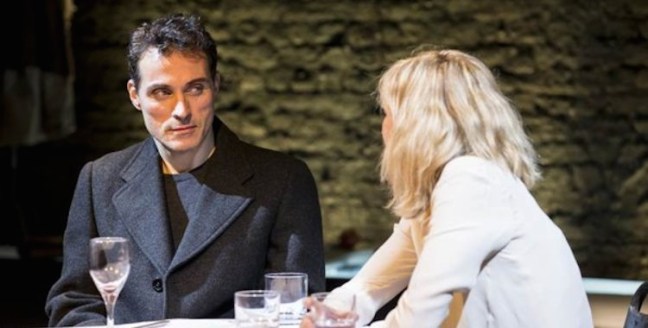
There’s one image that jumps out from the text of Closer, punching me right in the same organ it describes. Surprisingly, it comes from the mouth not of posturing writer Dan but of the dermatologist with whom he repeatedly crosses swords in pursuit of passion. “Have you ever seen a human heart?” Rufus Sewell’s Larry snarls, furiously eyeballing his rival across his desk. “It’s like a fist wrapped in blood.”  

This is love as Patrick Marber paints it: fierce, aggressive, violent. And selfish. Watching the four characters circle around and collide with one another, I’m oddly reminded of the ruthless corporate matadors in Mike Bartlett’s play Bull. Here, though, the prize is not a job but the equally fragile promise of love, of companionship, of The One.

But romcom happy endings are in short supply here. People are as likely to fall out of love as in it, twisting the knife on their way out of the door. First, Dan falls in love with Alice, a self-styled free spirit just returned from the States. After chewing Alice up and spitting her life out into a novel, Dan switches his affections to photographer Anna. Spurning him, Anna meets and dates Larry before finding her way to Dan’s bed all the same. Partners change and change again, cheating and lying along the way. Swap, hurt, repeat.

Again, like in Bull, appearances are important. Manipulation, Marber realises, is all about surface; it’s not what you do, but how you do it. Oliver Chris’s whining, wheedling Dan exemplifies this, clothing his selfishness and malice in a mixture of charm and feebleness. For all that he seems a bit wet, you get the impression that beneath his Hugh Grant-style dithering he possesses a steely, unforgiving determination to get what he wants. If Larry’s ugly side sits closer to the surface in Sewell’s grimly compelling performance, he’s no less schooled in getting his own way, while Nancy Carroll’s deceptively warm Anna has the talent of making manipulation look blameless. It’s just a shame that this version lets Rachel Redford’s Alice off the hook, going heavy on her vulnerability and light on the ways in which she uses her sexuality and air of mystery to her advantage.

Meanwhile, the world these characters move within – unfussily though not quite seamlessly shifted from the late nineties to the present day – is an all-encompassing advert for instant gratification. Love and sex might as well be consumer products, picked off the shelf or, as in the famous chatroom scene, ordered on the internet. It’s astonishing now how prescient Marber’s 1997, pre-Tinder play looks, anticipating the ways in which romance was to become packaged and monetised in the digital age.

This is a thread that David Leveaux’s production pulls on to the point of unravelling. Bunny Christie’s swish set, with its column of coloured lights and its large screen periodically adorned with Finn Ross’s busy video projections, all feels a bit much. The point may be that we live in an information saturated, image obsessed world, but by straining to apply this gloss the production paints over some of the raw brutality that makes the play lodge uncomfortably like a bur in the mind. What lingers is the very human capacity to hurt and be hurt.

The title, of course, is just another of the play’s cruel deceptions. No one really gets close to anyone else here; these characters are as allergic to intimacy as they are addicted to it, only able to reveal one part of themselves by concealing something else. Secrets are divulged not out of love but as a way of scoring points. Sex is as much a weapon as it is an act of passion. And even the most seemingly naive of the quartet turns out to be an elaborate fiction of her own making.

More than sex or lies or cruelty, though, Closer is obsessed with death, a fixation that is brought to the fore here. Marber’s is a play that fully subscribes to fellow playwright Simon Stephens’s description of dramatic action’s driving force: “Because we know we die, we want stuff”. The memorial stones that Christie keeps fixed to the back wall throughout are as stark a reminder of mortality as the obituaries that Dan writes for a living, a threat that sends each of the characters seeking that promised greener grass. In the spectre of death, though, perhaps lies the play’s one minuscule scrap of optimism. Because we know we die, we want stuff, but we also stubbornly keep searching and keep hoping. For all the characters’ brutality, maybe next time they’ll get it right.

Fireworks (Al’ab Nariya), Royal Court

590x494.fitandcrop

Fireworks is an exercise in dislocation. From its first, flashbulb bursts of light, we are shoved slightly off-kilter. With deft simplicity, Dalia Taha’s play and Richard Twyman’s production wrench us into the fear and uncertainty of war-ravaged Palestine, a suspended present moment in which nothing can be relied upon. Violence shades into playground games and make-believe shimmers with menace.

At the same time, we are always set at one remove. We can never forget that we are, after all, just watching, choosing to spend an interval of our privileged lives in this simulated state of precariousness. We can see the clearly demarcated outlines of Lizzie Clachan’s self-contained bunker of a set, a picture frame opening out onto another world. It might as well be the firework display that its title references; an explosive diversion, one that may leave us rattled but that we can walk away from nonetheless.

This closeness and distance, this sense that we walk in the characters’ shoes but can throw them off at any point, is crucial to how Fireworks functions. We need to be there, with the action, but at the same time always uncomfortably aware of the huge chasm that safely separates us from what is being depicted. We can be transported, but only temporarily, conscious all the while that our shaken responses cannot possibly be enough.

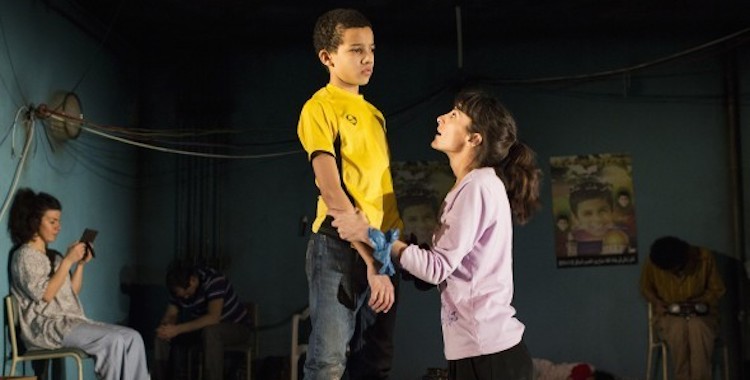
Almost everything happens in the deserted apartment building so vividly represented by Clachan’s design: all exposed pipes and wires, corners cluttered with the detritus of living. The side-by-side existence of two families, eschewing the questionable safety of public shelters for the claustrophobic refuge of home, is here compressed into one space, their lives overlapping and interweaving in the single, dingy room.

Taha’s play is anchored by the two children at its centre, both teetering on the brink of adulthood at the same time as staring down death on a daily basis. The familiar contours of childhood are mapped onto violent, shifting terrain. Like so many other youngsters, Khalil and Lubna play at being soldiers, but their games are unnervingly close to home, throwing back sharp reflections of the conflict they are surrounded by. Khalil’s favourite is the checkpoint game, one played out with chilling brutality.

Adults play too. Khalil’s mother attempts to coax him into childish fantasies, desperate to preserve their brittle shared innocence. The two women find fleeting respite in a game of skipping. Lubna’s father tells her that the rockets lighting up the horizon are just fireworks, a fiction that he seems to take more comfort from than his solemn, perceptive daughter does. Roles are reversed.

Through these playful coping mechanisms and loving deceptions, the lines between reality and fiction become increasingly blurred. Dreams, too, acquire unusual importance, representing a world beyond everyday reality – be that in the afterlife or up among the clouds. With the wall dividing the living from the dead so perilously thin, Taha vividly captures the importance of believing in an existence beyond the final bomb blast or hail of bullets; those lost in the conflict are always martyred, never killed.

If it all sounds a little amorphous, that’s because it is. There is little shape to Taha’s play, which instead lurches from one scene to the next. Given the circumstances, however, it feels utterly apt. The impression created – by everything from the restless performances to Natasha Chivers’ flickering lights – is of delicate moments carved out of an extended, indefinite zone of uncertainty. In the knowledge that everything could come crashing down at any moment, these small exchanges, these little sparks of connection, take on painful, nerve-shattering significance.

Boa, Trafalgar Studios

13boa1002a-600x399

Originally written for Exeunt.

Clara Brennan seems to have a direct line to an audience’s tear-ducts. The playwright’s last offering, the doubly devastating Spine, left barely a dry eye during its soggy, sniffly Edinburgh run. Boa, which is similarly small-scale but wide-ranging, also produces its fair share of tear-stained cheeks by the end. At one point during the performance I see, there’s an audible gulping back of tears; the evening’s customary applause is followed by the no less appreciative rustling of tissue packets.

But where Spine effortlessly intertwined the personal and the political, dragging up sobs with both its ideas and its characters, Boa shows the strain of trying to replicate that feat. Again, there’s a relationship at its heart, though this time it’s a romantic one. Harriet Walter, all black-clad sophistication and brittle emotion, is the Boa of the title. Or rather, that’s her nickname, a childish contraction that stuck. Sometimes like the feather variety, at others more of a constrictor, she clings passionately to Guy Paul’s wry, brooding Louis as their lives are catapulted through the last few decades of world history. Love and marriage play out against a backdrop of war and devastation.

The story of the couple’s life together is told in economical but contrived reminiscences, flashing backwards and forwards through years of infatuation, excitement, anger, regret, depression, reconciliation, contentment, grief … Both Boa and Louis pursue livings that push them to extremes: the former as a dancer, contorting her body into constant, punishing pain, and the latter as a war correspondent in the ravaged south-east Asia of the latter quarter of the 20th century. Boa loses her faith in her body; Louis loses his in humanity.

The couple’s dissection of their shared history, placed in a present day context that remains indeterminate until the final moments, verges on the masochistic. Both are determined to isolate where things went wrong – in their relationship, in their careers, in the world – at the same time as reluctantly acknowledging that “you can’t fix the past”. But still they rake it over and over, stirring up old soil until you want to shake them and tell them to stop. Leave it alone.

The point is that they can’t. Hannah Price’s simple, intimate production captures something of the frenetic movement of these memories, snapping the action back and forth through time with the absolute minimum of fuss. Eventually, the two seem to bleed into one another, the past leaving its indelible stain on the present. We see this too in Walter and Paul, whose gorgeously layered performances feel shadowed in each individual moment by the characters’ past and future selves.

In an attempt to stop this obsessive scab-picking from getting too painfully introspective, Boa also casts its gaze outwards. The world intrudes both through Louis’ work, forever offstage and unseen but leaving its bloody mark nonetheless, and in Boa’s guilty, complicated preoccupation with the lives of those less fortunate. “I’m drawn to people’s suffering,” she admits, “it makes me feel.”

The handling of this confrontation of privilege and deprivation could be whereBoa gets more interesting, in the way Spine did with its angry yet unforced engagement with contemporary politics, but instead it turns out to be something of a missed opportunity. Boa and Louis are a walking parade of first world problems and they know it. Boa laughs at herself – and we laugh knowingly along with her – when she compares her rage at poverty and injustice with her no less forceful anger upon cutting into an over-ripe avocado, but Brennan rarely digs deeper than this sort of familiar and ineffectual middle-class guilt.

More convincing than the play’s nods to the wider world are the multiple ways in which its two protagonists fall apart and clumsily put each other back together again. “We’re all lovely fucking fuck-ups,” says Boa at one point, a bitter laugh on her lips. Between them, the haunted, hard-drinking couple offer plentiful proof of this over the years, but still they keep returning inexorably to each other’s arms, finding both retreat and redemption in one another. And what better reimagining of the old “warts and all” than the line “I love the piss and shit of you”? This is love not in spite of but because of every flaw, every ugliness, every mistake. That sentiment, if nothing else, can begin to make the eyes prickle. Because aren’t we all just lovely fucking fuck-ups?