put your sweet hand in mine, Battersea Arts Centre

put-your-sweet-hand-in-mine-wings-600x475

Originally written for Exeunt.

There is something both seductive and unsettling about eye contact. That flicker of glances across a busy train carriage; embarrassed yet oddly conspiratorial sidelong looks while standing in a queue; the jolt of meeting a performer’s gaze from the darkened safety of the audience. It is these awkward glimpses of one another, and the awkward bodies that accompany them, that are at the fluttering heart of Andy Field and Ira Brand’s new show. In their fragmentary, dreamlike journey through the landscape of love, the desire to look is always tied up with the impossibility of really seeing one another.

At the end of Nicholas Ridout’s book Passionate Amateurs, there is a sentence that struck me with the quiet sadness of its truth: “The theatre protects us from full communication”. And I wonder if therein lies its appeal. The theatre is a space in which we are forever straining towards those moments of connection and intimacy, safe in the knowledge – loathe as we may be to admit it – that genuine intimacy, the kind of intimacy that leaves us raw and exposed and vulnerable, is always deferred. We can get tantalisingly close to it, but it is ultimately closed off to us. Unlike love, which involves a breathless moment of letting go, in the theatre we can remain teetering on the precipice.

But this isn’t the whole story. Ridout goes on to suggest that this shielding from communication is perhaps why the theatre “is one of those odd places outside the most intimate of personal relations where it is possible to attempt such communication”. put your sweet hand in mine, in its delicate collision of bodies and gazes, feels like one such attempt. Inscribing intimacy in its staging, the piece sits audience members in two rows facing one another, separated by a distance similar to that down the middle of a tube train. We are invited, from the very beginning, to contemplate the face of the individual opposite, in much the same way as commuters snatch occasional looks at one another. But it is as much about our awkward failure to meet eyes, our failure to connect. It is surely not for nothing that Field and Brand’s pair of lovers are seated at different ends of their respective rows, only ever coming face to face when separated by an insurmountable distance.

The strange, startling discomfort of direct eye contact, a possibility that is played with throughout, is enhanced for me by finding myself sat opposite Field, who determinedly locks eyes with me as he delivers his lines. I am reminded of the long, stretched-out moments in Uninvited Guests’ Love Letters Straight From Your Heart in which audience members are instructed to gaze into the eyes of the stranger opposite for the duration of the song “First Time Ever I Saw Your Face”. As then, the performative situation highlights for me the revealing nature of this simple act; despite myself, my eyes occasionally drop, a small, embarrassed smile stealing across my face.

Seated in this uncomfortably close, immediately charged formation, we are treated to fleeting snippets of a love story, or many love stories, depending on how you take it. Looks are exchanged in the anticipatory moments before a show; shy sentences are traded in a Metro carriage in Paris; bodies hold each other close in the dark and cold. I am tempted to say that there is more to put your sweet hand in mine than romantic love – because there is – but its gentle interrogation of everything love might be tangles these different possibilities together. The giddy, pulse-quickening head rush of infatuation, for instance, is evoked by a barrage of sensory information, part of which invites us to imagine a city torn apart by riots, bleeding together revolutionary passion and romantic desire.

For all the uneasiness and the determined stares at floor and ceiling, Field and Brand cradle their audience within the piece, making any discomfort productive rather than distressing. And the show they have crafted is playful as well as reflective, setting us at ease with gentle humour. Even as we laugh, however, it is underscored with a subtle hint of loss. The most affecting of the show’s metaphors – which are also invariably the simplest – are all to do with a sense of slipping away, a diminishing of possibilities. Melting ice is held tenderly in cupped hands, water dripping to the floor with the steady inexorability of tears.

In another of the show’s most dazzling moments, in which it is held unnervingly taut between playfulness and desolation, Foreigner’s “I Want to Know What Love Is” begins to play, greeted by a ripple of soft chuckles from the audience. On one level it’s a joke, one that trades on the groaning familiarity of the power ballad and its inflated packaging of emotion. But at the same time it feels overwhelmingly apt. Those well known lines, as overblown as they are packed with yearning, represent the unresolved, reaching note on which the show inevitably departs. I want to know what love is. I want you to show me.

Creative Constraints

Theatre-Ad-Infinitum-Ballad-of-the-Burning-Star--Alex-Brenner-please-credit-_DSC8291

Originally written for Exeunt.

Ballad of the Burning Star, the latest show from chameleonic theatre company Theatre Ad Infinitum, opens with a bomb warning. It’s an explosive statement of intent from a group of theatremakers who were last seen wordlessly exploring love and loss in gentle mime showTranslunar ParadiseBallad, a blistering satirical cabaret that provocatively examines the Israeli-Palestinian conflict, is about as far away as Theatre Ad Infinitum could get from the moving tale of a grieving widower which propelled them to worldwide success. As co-artistic director Nir Paldi says of the company, “it would be very hard to say ‘ah, they do this’”.

Ballad is very much Paldi’s project; as he explains, he and fellow artistic director George Mann take it in turns to lead the company’s shows. The group of Lecoq graduates “want to constantly be doing different things and different styles”, boasting a back catalogue that ranges from reinventions of classical myths to creative explorations of depression and love. Ballad, however, is by far and away their most ambitious production to date. It emerged as a result of Paldi’s need to find a way of talking about his experiences of growing up in Israel and took a number of years to find its current form. The difficulty, as Paldi quickly discovered, was in finding a theatrical metaphor that could contain the many sensitive complexities of the political situation in Israel.

“I really felt that I needed some mechanism to distance it from myself and to make it clear to the audience that as a theatremaker I’m conscious of the complexity in quite a declarative way,” Paldi explains carefully. The show began life as a straightforward autobiographical monologue, but both Paldi and Mann sensed that the material needed a different vehicle. This arrived in the form of drag, an instinctive artistic choice that Paldi says he simply thought “would be really fun”, but which developed into a multi-layered theatrical device. Paldi thus occupies the centre of the show as the larger-than-life Star, a fabulous but bullying cabaret host, supported by a troupe of dancing “Starlets”.

“The nuances were found later as the metaphor became clearer and clearer,” Paldi reflects. “The relationship between Star and her co-performers; how she occupies the stage; how she occupies her co-performers and bullies them and manipulates them against each other; how she treats the audience. The metaphor that started appearing – this is not necessarily what the audience perceives, but it’s what I was working with – is the audience as judges judging the two parties, Star and her Starlets, Israel and Palestine being played by these two bodies in the space. It was a discovery; it wasn’t a decision that was made.”

Discoveries of this kind often emerge from the stylistic decisions imposed on Theatre Ad Infinitum’s creative process. The first thing the company looks for when starting to research a show is a form that will work for the subject matter in question – mime for Translunar Paradise, cabaret for Ballad. This then establishes the limits of the piece, allowing the work of making the performance to take place within those limits. “It’s a constraint, but actually it’s a creative constraint, so that’s the thing that allows you to start working,” says Paldi, echoing the words of co-artistic director Mann.

In the case of Ballad, however, the company was also working with other creative challenges. Chief among these was the dilemma of how to begin exploring such fraught political terrain. “The story that I wanted to talk about and the theme that I wanted to raise in this piece were fairly clear,” Paldi tells me, “it was just how the hell do you do that, how do you speak about it without sounding banal and obvious or very one-sided?”

In resolving this question, the role of work in progress showings and audience feedback in Theatre Ad Infinitum’s process became more vital than ever. Paldi is enthusiastic about the virtues of testing work on audiences during its development, explaining that “it just gives you such a strong image of where you are”. It was these early audiences who pushed Paldi and his creative team to go further with the piece, encouraging them to make the show increasingly provocative. With this in mind, Paldi meticulously researched the viewpoints and arguments from both extremes, daring to make Ballad potentially inflammatory but determined to avoid becoming one-sided.

Of course, no show as provocative as Ballad of the Burning Star could expect to emerge unscathed. The production’s Edinburgh Fringe premiere, while attracting critical acclaim and winning the ensemble an award from The Stage, also faced its fair share of censure. What Paldi was encouraged by in these attacks, however, was the even balance of the anger directed towards the show. “After one show I would be encountered by two different people, sometimes at the same time, and they would tell me ‘that felt really one-sided towards Israel’, or ‘that felt really one-sided towards the Palestinians’, and these conversations would happen almost every day.”

The intensity of these responses vindicates Paldi’s feeling that this is a subject that needs to be talked about – “the whole point was to talk,” he says emphatically. When it comes to his own role in these discussions, however, he is more ambivalent. “I still sometimes find it very hard to …” Paldi trails off, pausing for a moment. “It’s so complicated, so it’s very hard for me to hold a very firm opinion.” He insists that he does not want to be speaking directly to audiences about politics, adding, “I’m not a politician, I’m not very good at it.”

While he is pleased that Battersea Arts Centre and Dialogue will be running discussions alongside the event when it comes to London, Paldi does not necessarily feel that it is his responsibility to offer a space for these conversations to take place. “I don’t know if I see it as my responsibility to provide the place for discussion; it’s more to provoke the discussion,” he explains. It is more important to Paldi that his art speaks for itself: “I’m making a piece and this is what I think.”

As Theatre Ad Infinitum also begin work on their new show – the company are nothing if not multi-taskers – they are still keen to “reinvent ourselves every time”. Light, which will premiere at this year’s Edinburgh Fringe, is different again from Translunar Paradise andBallad of the Burning Star. This new piece, which Paldi describes as “George’s baby”, is inspired by Edward Snowden’s recent revelations about the NSA and by a dream of Mann’s about a “totalitarian, futuristic society”. Drawing on sci-fi influenced aesthetics, it will examine “what happens when technology is being misused by human beings and it falls into the wrong hands” – all without words.

As a commission from the London International Mime Festival, the creative decision to turn once again to mime is appropriate, although the challenge of tackling these complex ideas wordlessly is a formidable one. Paldi explains that the company have been encouraged by the early responses of audiences, who have told them to trust the power of their storytelling, allowing the bulk of the show to develop within the self-imposed “creative constraint”. The question that Theatre Ad Infinitum are now grappling with is the one that continues to guide their work: “how can we say the most interesting and provocative and complex things with this form?”

Photo: Alex Brenner.

Gym Party

gym party-163-square

As an audience member, I have a slightly strange relationship with Gym Party. I went to two very early scratch versions, spent over an hour in a rehearsal room chatting about it with Made in China’s Jess Latowicki and Tim Cowbury, and saw a final work-in-progress at the Almeida Festival – before entirely missing the Edinburgh run. Now, catching it at BAC, it’s the fourth time I’ve experienced the show in some form (fifth if you count the extended conversation about it) and each time it’s been significantly different.

What has remained the same in each of these various incarnations, however, is the underlying impulse. Made in China want to talk about competition. It is, as Jess admitted when I spoke to them, a massive, nebulous topic. There are the more obvious types of competition – sporting events and talent contests – but it’s also a drive that motors almost every area of our existence and is deeply embedded within free market capitalism. As Jess says, “There’s always a winner in the free market, whether it’s Hollywood, or whether it’s banking, or whether it’s you got a new car but I got a better new car.” In whatever context it might be, individuals are constantly pitted against one another.

The desire of Made in China (at least, this is the impression I got from our conversation and from the various incarnations of the show that I’ve seen) is to address not the specifics of competition, but its troubling grip on us as a society. The various manifestations of competition, be it X Factor, a political debate or a game of one-upmanship between school kids, are all just symptomatic. What the company is attempting to do, by alluding to all these different varieties of real world competition within the frame of a staged contest that they compete in each night, is to playfully but powerfully draw our attention to how competition determines our interactions and what that might be doing to our society.

With such ambition and scope comes the very real possibility of failure. There is, after all, a hell of a lot to fit in there. What’s been fascinating about seeing the show at various stages of its development is witnessing just how much material has been hacked off, discarded and occasionally recovered along the way. Victims of the process included a scene in which performer Chris Brett-Bailey was tied to the floor, a sub-plot involving the gym party of the title, and a shrine to Hollywood actor Taylor Kitsch, an ardent espouser of hard work and American Dream ideals.

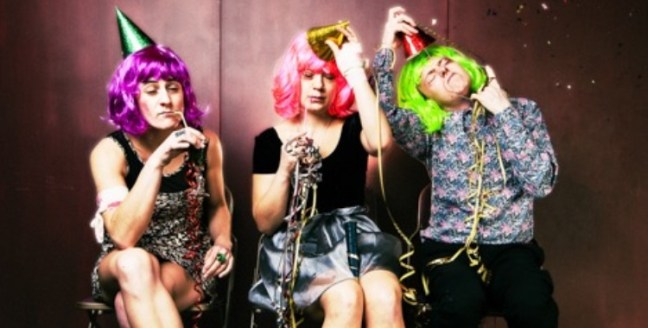
The show at the end of this process follows a smart and surprisingly tight structure, within which there is room for a certain amount of conflict, messiness and digression. Even the material itself sometimes seems engaged in an internal competition, but the rules of the containing contest are clear. The piece is divided – ironically, one might argue – into three parts. Rather than acts, however, these take the form of rounds. Competing in these rounds are Jess (Latowicki), Chris (Brett-Bailey) and Ira (Brand), all dressed in primary school PE-style shorts, T-shirts and plimsolls, with the added gaudiness of brightly coloured wigs. They all want their name up in lights; they all want to win. There are lots of things they’re willing to share, but not the glory of victory.

There is a light balance throughout between anger and playfulness, which is expressed in perhaps its purest form through the rounds of competition themselves. These start out innocuously enough, with a light-hearted blend of sports day activities and party games. Jess, Chris and Ira are up against each other in contests to see who can stuff the most marshmallows in their mouth or who can jump the furthest. It’s silly, entertaining, riotous stuff, even on the fourth viewing.

In the second round, we are taken into more personal territory with a series of votes based, essentially, on nothing but appearances. In this section there are obvious similarities with Ontroerend Goed’s latest show Fight Night (which, incidentally, I paired with Gym Party in an Edinburgh preview feature), but where Fight Night felt slick and smug, here there is an uncomfortable proximity between laughing pretence and very real approval or rejection. It’s often funny, but there are also odd, jolting lurches when the hollow meanness of the task suddenly hits you with horrible force. This feeling is to an extent replicated in the final round, in which the personal is brought right to the fore and the role of the audience is even more integral.

Following each of the rounds – and this is where the anger really bites – are the penalties for the losers. It might all seem like fun and games, but the punishments that ensue leave us in no doubt of the bitter consequences for those who find themselves unable to win. Here too the show carefully tiptoes the line between the fake and the real, the funny and the distressing. The most unsettling of these moments occurs when Jess, one of the losers, strips down to her underwear and stands on a platform while Ira brutally criticises her physical appearance. The genius of it is that Ira’s dry delivery still generates laughs – great guffaws that quickly sour in the mouth. Like so much competition, it’s hilarious and horrifying in the same moment.

The other key strand of the show, alongside the three rounds of competition, is made up of interweaved monologues from the performers. Each of them asks us to imagine them at a key point in their lives, all aged twelve. For Jess, it’s the mortifying aftermath of falling out with a group of friends; for Chris, a moment of betrayal at the school dance; and for Ira, it’s the first time she discovered the victory involved in acts of noble self-sacrifice. Juxtaposed with the frenzied tempo of the contests, these are delivered with captivating stillness, adding interesting shade to the bright and sometimes blinding light of the rest of the piece. This segment also produces one of my favourite moments of the show when the stillness is eventually broken by Chris, who takes up his guitar to perform a haunting rendition of ‘Everlong’.

Although it can sometimes feel as though the show has moved away from the reference point of its title, it is in these monologues that it regains its vital significance. The gym party – a distinctly American term, but one with a clear British equivalent – is one of the first serious competitions in life. The prize might only be to dance with the partner of your choice at arm’s length, but it’s a competition nonetheless – and a cutthroat one at that. The significance of the memories being pinned to the age of twelve, meanwhile, is perhaps that this is the age when we are on the cusp of competition turning nasty, when we are at the tipping point between that playfulness and anger. There is also something striking about the potent anxiety of adolescence, an anxiety that seems to be mirrored in our nagging impulse to compete. What if we don’t fit in? What if we’re lagging behind? What if we’re a failure?

These insistent, troubling questions bubble away beneath the whole piece, uniting what might otherwise seem like disconnected fragments. As well as the competitions and the monologues, we get the desire for fame and beauty; the desperate need for attention; the poison of David Cameron’s “aspiration nation” rhetoric, barely concealed within a blistering speech from Jess. There is also, crucially, a key element of competition being addressed through the relationship with the audience. They are here for us, the performers frequently remind us – to give us “bang for our buck”, as Ira puts it. If it weren’t for us, none of this would be happening.

It strikes me that there are a number of layers to this relationship with the audience. In one sense, we are like the television audience watching contestants being humiliated on talent shows, silently offering our complicit approval simply by choosing to watch. As the performers are keen to point out, our quiet acquiescence can be read as a “consensus”. Linked to this, we are also a necessary presence, both in a theatrical sense (though, interestingly, the knowing references to the theatrical contract have been diluted since earlier showings, wisely abandoning a pointed meta-theatricality in favour of a more all-encompassing construction of the audience’s role) and in a “democratic” sense. We vote and thus we are essential to the outcome. One individual succeeds, but they only succeed via the approval, aid or inaction of the collective, offering another fascinating perspective on how competition functions in our society. After all, what would the success of the individual mean without the presence of the group they outstrip?

They may involve their audience, but equally integral to Made in China’s approach is the desire not to offer us with ready-made answers. As Tim explained to me back in the summer, “the show won’t try and give answers and we never really have”. He went on to say that the company are much more interested in asking questions, in creating a provocation and leaving it up to audience members to go away and form their own opinions. As an audience member and as a critic, this is a tactic that I tend to find far more effective than work that simply tells me what I should think. If you make a straightforward argument, it can be disagreed with and therefore easily dismissed; if you ask a question, it has a habit of lingering for longer.

It’s interesting that this is an explicit aim of Made in China’s work, as there are ways in which some of the earlier versions of the show arguably did come close to offering answers, or at least to implicitly instructing audiences in their response. Without giving too much away, the ending that I saw in the Almeida Festival work-in-progress was far more shocking and confrontational, seeming to actively encourage an intervention from audience members. It was deeply uncomfortable and provoked a number of walk-outs. The final scene that the company eventually opted for in Edinburgh and at BAC, however, tones down the discomfort, still asking for the audience’s involvement but in a way that enables the conclusion rather than interfering with it.

I was intrigued by the dramatic shift in tone between the two different endings and in the different responses they provoked from an audience. At the Almeida, the atmosphere in the audience after the show was one of light shock; it was as if we had been collectively shaken, and were still reeling slightly from the force. At BAC, however, the aftermath was calmer, more thoughtful. On leaving the performance at BAC, my own position on these contrasting conclusions was ambivalent. There was something thrilling and violently galvanising about the original ending, which without doubt had more of an immediate impact than the modified one. On the other hand, the way that Made in China had eventually chosen to conclude the show made more dramaturgical sense, completing a structural circle rather than rupturing it.

Because I found myself torn but fascinated, and because I know Jess and Tim a little from our conversation a few months back, I emailed them the day after seeing the show at BAC to ask about the decision to change the ending. Given how much I talk about dialogue between critics and artists, it seemed like an interesting opportunity to initiate that kind of conversation. I made it clear in my email that I was simply curious, that I appreciated it was a slightly unconventional request from a critic, and that I would completely understand if they didn’t want to share the details.

Happily, though, Tim replied with a brilliantly thoughtful and articulate explanation of the company’s decision. Their interpretation of the reaction to the Almeida showings was that audiences were “getting and digesting our message before the show was finished”, resulting in an intervention within the theatre space rather than outside of it. This touches on a question I frequently find myself grappling with, namely whether action in the theatre can be a spur to action outside the theatre. I still don’t think I have an answer to that one. Made in China, however, “don’t want people to have the catharsis of righting wrongs within the theatre: they should save that for the real world”. Instead of intervening, audiences should leave “cursing their own passiveness and maybe (ideally) the fact that the show, like most of the power structures in our society, sneakily manipulated this passiveness of out them”.

It’s this idea of passivity and manipulation that I’m most intrigued by. Some of the most powerful experiences I’ve had in theatres have involved being uncomfortably torn between action and stasis, feeling the need to do something but not quite able to do it. It’s a feeling that is sickeningly familiar in a world where the structures around us so often reduce us to a state of perceived powerlessness. And it is this feeling, I think, that was missing from Fight Night – a helpful comparison to bring back in at this point.

When I saw the show in Edinburgh, I found myself slightly perplexed by how I could have so much admiration for the show’s intelligence yet be almost completely unmoved by it. Despite the machinations by which it cleverly revealed the failings of modern democracy, I was not left feeling angry or frustrated. There were a couple of moments during the show when the sharpness of its critique sent a slight shiver down my spine, but afterwards I found it all too easy to shrug off. It was so slick, so glib, so seemingly pleased with its own cleverness. Despite the obvious necessity of my presence as an audience member, I never really felt that I had any influence on the outcome – which is of course the realisation that Ontroerend Goed and The Border Project wanted to provoke, but that internal conflict that I described above can only be produced when there seems to be some possibility of making a meaningful intervention, however slim that possibility might be. I felt utterly distanced from Fight Night, in such a way that its impact barely touched me.

By contrast, Gym Party is injected with a certain sense of risk. Yes, we know that it’s theatre, that it isn’t “real”, but there’s somehow something more raw, more rough about it, which allows an audience – perhaps – to feel that their intervention is an actual possibility, that it might change something. The opportunity is there, and the weight of responsibility falls on our shoulders if we fail to take it. This is an extraordinarily delicate balance to strike. The piece must make us feel that we can act, yet at the same time disable that possibility. It has to build in its own failure.

Personally, though it gets far closer than Fight Night, I’m not quite sure the balance has entirely been struck. The first time I saw the ending, I felt horrified by how little action I took, but the event did offer the opportunity for others to intercede. The second time around, intervention was possible and yet not attempted, but the force with which the piece closed was weakened; perhaps the feeling of manipulation was greater, but the guilt was less. The comparison, however, begs an interesting question. Are we more affected by the opportunity to act within the space of the theatre, or by a piece that implicates us through our failure to act? In the spirit of Made in China, I’ll just leave that question mark hanging …
The Various Lives of Infinite Nullity

Web-Infinite-Nullity-Summerhall_view

Revisiting a production for a second viewing is always a slightly odd experience. The performance is strangely haunted, inevitably occupied by the lingering ghosts of that previous encounter. Each movement appears like an echo of its last enactment and each moment is stained with a dreamlike residue of familiarity. The performance is at once the same and different.

This metaphor of haunting is particularly apt for Clout Theatre’s new show, in which the dead do not pester the living so much as the living revisit the dead. The three figures who populate the piece are stranded in a sort of purgatorial state, stuck in a relentless cycle of living and dying; kicking the bucket in ever more ingenious and gruesome ways, in between which they are desperate to achieve the semblance of life. Elements of the lives they have left doggedly return to them – unfinished business that refuses to release its hold.

I first saw The Various Lives of Infinite Nullity on the Edinburgh Fringe this August, in the suitably atmospheric surroundings of Summerhall’s Demonstration Room. Watching the piece then, although able to admire the stunning images crafted by Clout Theatre, I struggled to fully engage with it. That might, admittedly, have had as much to do with the context of Edinburgh as with the show itself. Let’s not pretend that seeing four or five shows a day leaves a critic in the freshest state of mind when approaching new work.

Whatever the reasons, I took a lot more from The Various Lives of Infinite Nullity on this second viewing. Particularly with heavily visual work of this kind, it strikes me that you often almost need two chances to take it all in and process it effectively. There were elements that I missed, had half-forgotten or didn’t fully consider the first time around: the grey wash that repeatedly floods the stage, suggesting the surreal tedium of this existence; the shadowy, ghost-like movements visible behind the set’s plastic shroud; the importance of the childhood motifs that keep popping up.

This final strand was one that particularly struck me when watching the show at BAC. In this second encounter with the piece, the childlike behaviour that often characterises the performances suddenly seemed hugely, glaringly important to the whole thing. There are hints – in the items of school uniform, in the water guns spewing fake blood, in the gurning, exaggerated throes of death – of familiar playground games; playing dead, only here they aren’t playing at all. This recurring element also adds to the heightened and often hilarious tone of the show as a whole, which insistently draws out the ridiculousness of both life and death. It’s at once funny, tragic and grotesque.

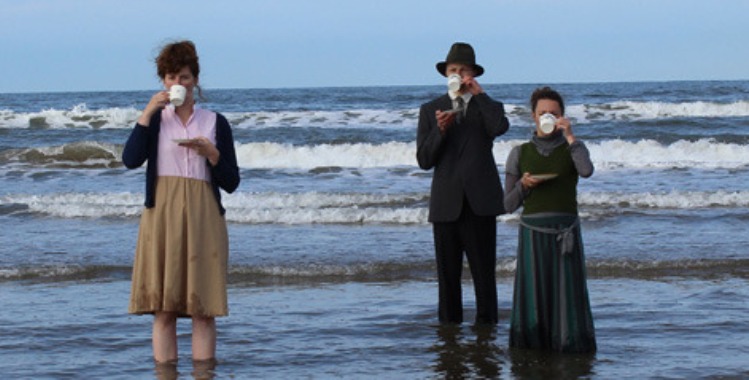
Previously I had complained that the various striking scenes that make up The Various Lives of Infinite Nullity “feel like a string of stage images and little more”. Revisiting this opinion, I still feel that the piece is a little slight, but its images speak powerfully for themselves. Tea cups – ever-present symbols of banality – suddenly slice open throats; fake blood splatters against plastic; an innocuous skipping rope becomes a deadly weapon; a performer’s face is horrifyingly drenched in red liquid.

And then, perhaps, the most effective image of all: a woman lying on the floor, draped in plastic, her incessant, trivial chatter slowly muffled by a downfall of earth. Buried alive and still worrying about what to cook for dinner. Moments like this are when Clout Theatre are at their best, tapping into the essential absurdity of everyday existence and presenting it with a flourish of the surreal.

London Stories: A 1-on-1-on-1 Festival

London-Stories

Originally written for Exeunt.

“We all want to connect, I think,” Richard Dufty muses as we chat in one of Battersea Arts Centre’s many cosy, secluded corners. The last time I was face to face with Dufty was in his company Uninvited Guests’ show Love Letters Straight From Your Heart, as he shook my hand and offered me a glass of sparkling wine on the way into the performance. Now, in a new festival of intimate storytelling, the senior producer at BAC is interested in interrogating just those kinds of theatrical encounters – the moments where the mask slips and a more genuine connection between performer and audience member might just be possible.

“A lot of the performance that we’re interested in here is performance that is reaching for the real,” he says, quickly adding, “whatever that means.” Dufty and his artistic colleagues at BAC are fascinated by “the power of directness and honesty and immediacy”, a power that they have explored through a number of building-wide projects. The One-on-One Festivals in 2010 and 2011 questioned the nature of theatre and the relationship between performer and spectator, offering a series of encounters that shifted participants’ perspectives on the theatrical event. In BAC’s latest foray into intimate performance, however, Dufty and his co-producer Rosalie White are also interested in the intimacy that might be possible between audience members.

“There’s so much talk about the kind of community that you can get in an audience and what happens when you experience things together, and often it feels like a load of guff,” Dufty says frankly. By shrinking this down to an audience of two, the 1-on-1-on-1 Festival will go beyond this empty rhetoric and look at “the intimacy in what happens in a very small audience”. Each audience member will experience the event in the company of a series of strangers, entering each encounter alongside another person. The hope is that this will foster a closeness that is usually absent from larger performances; as Dufty points out, it’s hard to ignore your fellow audience member when they are the only other person in the room.

Another shift from previous One-on-One Festivals is in the nature of the encounters themselves. Rather than commissioning professional artists to create work for the 1-on-1-on-1 Festival, the theatre issued an open call for Londoners willing to share their stories, receiving over 100 responses. Dufty explains that the reasoning behind this approach was driven by the same desire to strip away layers of artifice from the theatrical event.

“There is something exciting about people who are not necessarily trained performers telling their stories,” he suggests. “If you’re interested in the frisson of something feeling like it’s actually happening there and then rather than being perfectly rehearsed, then there’s something to be said for not always working with professional performers.” There was also an attempt on the part of the theatre to tell the stories that we might not usually hear. Dufty recognises that the life experiences of those who make and regularly attend theatre at a venue like BAC are likely to be fairly similar; he and White wanted to open the building up to other stories, issuing an invitation to “come look at the rich variety of lived experience just in this one city”.

And the city itself is key. While the original focus was on stories rather than on place, Dufty and White soon discovered that the narratives they had collected from Londoners were all “saying something quite beautiful about this city”. In a sprawling metropolis where we usually avoid meeting each others’ eyes at all costs, London Stories forces us to take a closer look. Dufty is not expecting audience members to leave and immediately strike up conversations with strangers on the Tube, but he does hope that “you can at least wonder what their back story is, where they come from, how they came to be here, and what happiness and sadness and hope and tragedy is in their lives.”

The festival’s relationship with its city extends to its layout within BAC. The “building-wide adventure” will take audiences on a labyrinthine journey through candlelit rooms and corridors, dimming the light inside to allow some of the world outside to seep in through the windows. “There’s some idea that London is bleeding both ways,” explains Dufty, “from the storytellers out to the city and in again.” In many ways, the old Victorian town hall is the perfect location for this evening of urban storytelling; as Dufty suggests, London Storiescontinues in the building’s tradition of democracy, activism and community.

The stories themselves range from the heart-lifting to the heartbreaking. Dufty tells me that many of the narratives are deeply emotional for the storytellers – “it’s partly therapeutic” – but that in even the bleakest tales there is an element of hope and redemption. In selecting and curating the stories that make up the event, Dufty and White have dedicated thought to the texture and mood of the evening, contrasting the melancholy with the joyous. Dufty admits that “the curating job has been, on a very crude level, about mixing the heavy ones up with the lighter ones, the sad ones up with the funny ones”. There has also been a responsibility towards the storytellers, who are committing themselves to a necessarily exposing series of encounters by sharing their own experiences.

For all his talk of honesty, however, Dufty acknowledges that through the repeated telling of these stories, they will inevitably be transformed into a kind of performance. No matter how intently we tear away at artifice, a thin layer will always remain. Despite his instinct to reach for the real, Dufty cautions that “we shouldn’t be naive about ever being able to reach it”, adding “there are always masks”. But this should not stop us from reaching nonetheless. “Whilst you recognise that getting to absolute honesty is impossible, the pursuit of it is beautiful – the honest, genuine pursuit of it is a beautiful and very human thing.”

While unadorned honesty might be impossible, what London Stories – and intimate performance more widely – does have the potential to do is delicately reconfigure the theatrical contract. In these surroundings, there is a sense that the audience is indispensible and that the event itself “doesn’t feel too pre-determined”. And as Dufty emphasises, there is something fascinating about this not just theatrically, but also politically. “Things don’t have to be like this. It could be different.”